
Channel partner commission calculation: slabs, milestones, TDS and GST in one worked example
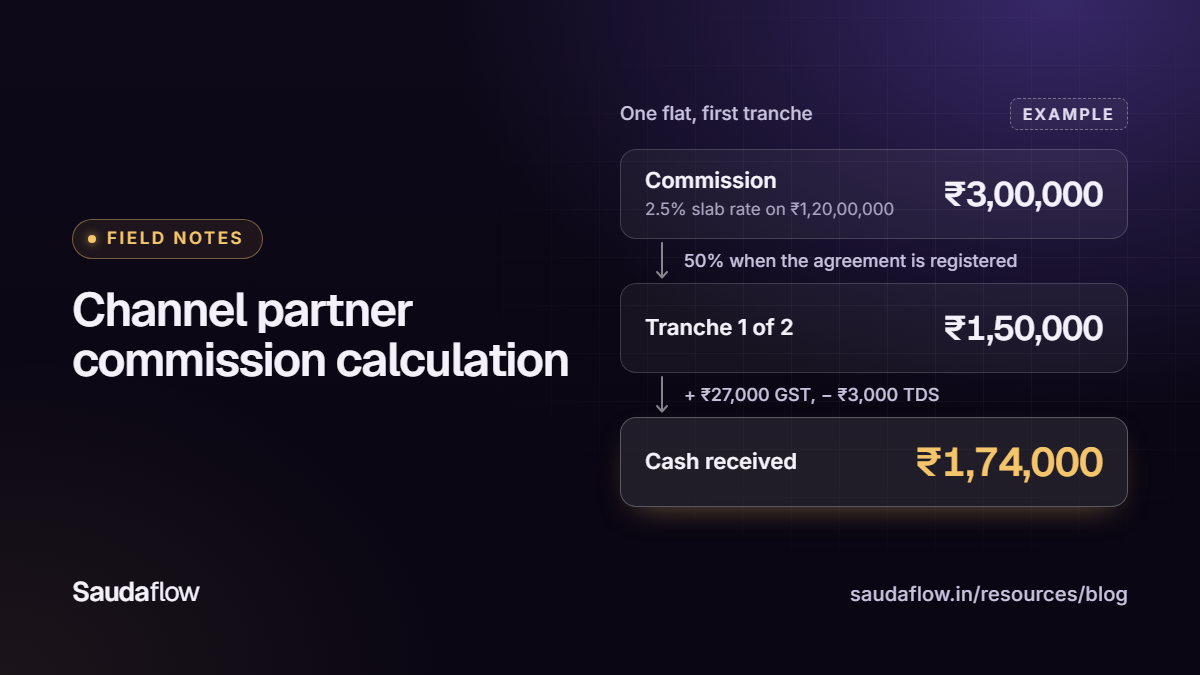
Take one ₹1,50,000 tranche. The CP's invoice for it is ₹1,77,000 and its bank gets ₹1,74,000, and neither one is the commission, so here's how each figure is worked out.
Builders often call it brokerage and CPs call it their payout, but the maths is the same.
How channel partner commission is calculated
Six things go into the number, and the CP agreement should settle each one in writing.
- The base the percentage applies to.
- The rate, which could be a flat percentage or a fixed amount per unit, or a slab that goes up as the CP sells more.
- Any extras, like launch incentives and other bonuses.
- The split, meaning each CP's share when two work one deal.
- The tranches, or how much is paid on which trigger.
- And tax, which is 18% GST added to a registered CP's invoice and 2% TDS deducted by the builder, both on the commission alone.
Cancellation terms sit on top of all this, covering tranches not yet paid and those already paid.
The base: agreement value or basic sale price
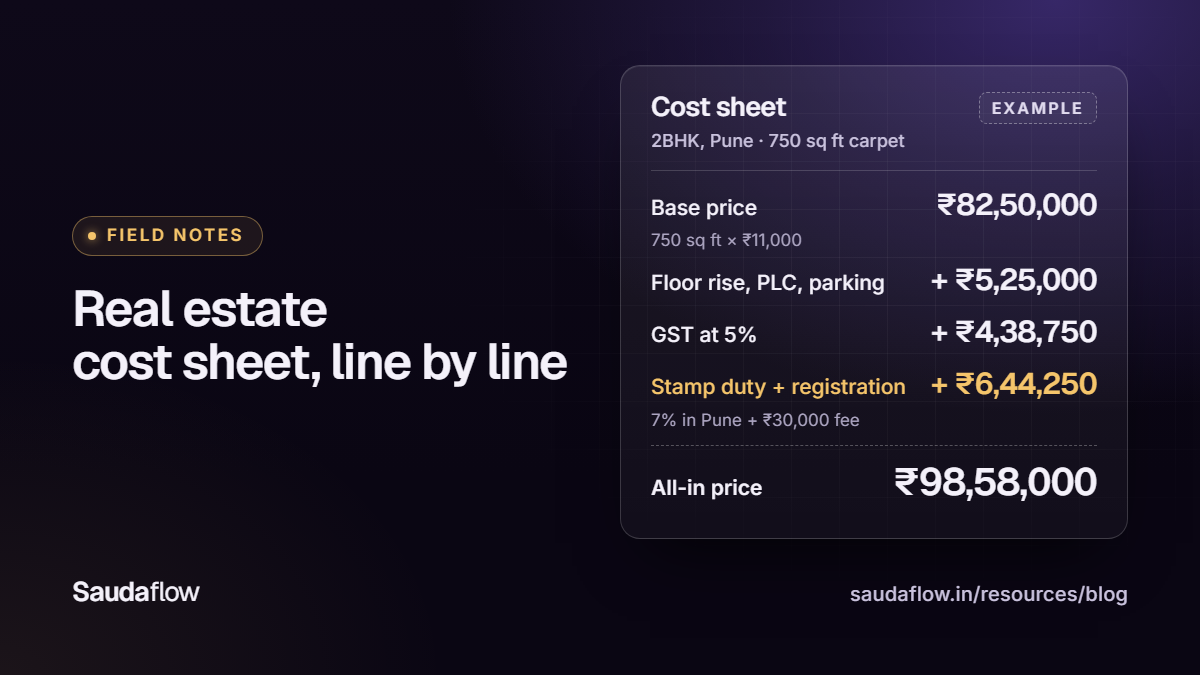
Two bases are common: the agreement value stated in the agreement for sale, which may include preferential location charges (PLC), floor rise and parking, and the basic sale price (BSP), the rate per square foot times the area. Our guide to PLC, floor rise and the flat cost sheet explains each of those lines.
GST and stamp duty are taxes, registration charges are a government fee, and maintenance deposits are held for the building's upkeep, so agreements usually leave them out. Where builders really differ is parking, club membership and PLC, and that's why the agreement has to name each item.
Example (illustrative numbers): the BSP on a flat is ₹68,00,000, it faces the garden so there's ₹2,00,000 of PLC, and the buyer takes a covered parking for ₹5,00,000, which puts the agreement value at ₹75,00,000.
| Base named in the CP agreement | Base amount | Commission at 2% |
|---|---|---|
| BSP only | ₹68,00,000 | ₹1,36,000 |
| BSP plus PLC | ₹70,00,000 | ₹1,40,000 |
| Agreement value (BSP, PLC and parking) | ₹75,00,000 | ₹1,50,000 |
On the same flat at the same rate, that's a ₹14,000 difference from the choice of base alone. And while you're on the base, agree whether a discount given after the CP registered the buyer brings it down, and whether it's re-read if the agreement value changes later.
Real estate broker commission rates in India: who sets them
The RERA Act, 2016, the central law that regulates real estate agents, sets no commission rate. It defines an agent as someone paid for the service "whether as commission or otherwise" (section 2(zm)), bars an unregistered agent from facilitating a sale in a registered project (section 9(1)) and lists the agent's duties (section 10), all in the Act's text. So the rate is what the written agreement says, unless a state law caps it.
Haryana is one state where a law does. Rule 10 of the Haryana Regulation of Property Dealers and Consultants Rules, 2009 provides 1% of the agreed consideration, half paid by the seller and half by the buyer, and the Haryana Real Estate Regulatory Authority decided in October 2020 to issue restraint orders to promoters and brokers in registered projects against charging more, according to a note by the law firm Ethical Legal Consultants. If you sell Haryana projects, ask your advocate how that applies to a commission the builder pays.
- New flats from a builder: usually the builder pays the CP, at the rate and on the base in the CP agreement. In Maharashtra, MahaRERA added clause 15A to its model agreement for sale by an order of 22/10/2024, so the agreement can record a registered agent's agreed fee and whether the promoter, the buyer or both pay it, as LiveLaw reported.
- Resale: there is no builder, so the buyer, the seller or both pay the broker, as each one's brokerage agreement says.
If someone quotes a "standard" percentage, ask which agreement or rule it comes from, and get the rate, the base and who pays in writing.
Flat rate vs slabs, and the two ways a slab can apply
A flat rate is one percentage on every booking. It is easy to calculate and hard to argue about.
A slab raises the rate once the CP crosses a threshold in a period, counted in units or in value. "2% per booking, 2.5% from the third booking in a quarter" can be read two ways:
- Reading A, only above the threshold. Bookings one and two stay at 2%; booking three gets 2.5%.
- Reading B, retrospective. Cross the threshold and every booking in the period gets 2.5%, even the ones made before it, so the builder owes a top-up on the first two.
In the worked example below the two readings are ₹85,000 of commission apart in a single quarter, and nobody wants to find that out at payout time with the CP sitting across the table. So write the reading into the agreement in plain words, and while you're at it, what counts as a booking (the token, the booking form or the registered agreement), the period, whether a cancelled booking still counts and when the top-up gets paid.
Launch incentives
A launch incentive is an extra payout for bookings made in a set window, say the first 30 days after a project opens, and it can be an extra percentage or a fixed amount per booking. Before the launch, while things are still calm, agree whether it sits on top of the slab rate or replaces it, whether launch bookings count towards the slab, which tranche pays it and whether it's recovered on cancellation.
A cash incentive is commission like the rest. The Income-tax Act, 2025 defines commission or brokerage to include any payment received by a person acting on behalf of another "in relation to any transaction relating to any asset" (section 402(7)(c)), so the builder deducts TDS on it and the CP bills it on its GST invoice, just as with the rest of the commission. A non-cash reward, such as a trip or a gold coin, sits on a different TDS line, section 393(1), Table serial 8(iv), at 10% of its value (old section 194R), covered in our post on TDS on commission under section 393.
Co-broking: splitting commission between two CPs
Co-broking is when two CPs work one deal: one is empanelled with the builder, the other found or advised the buyer. If the builder pays only the empanelled CP, the split is between the two CPs. Put it in writing before the first site visit: the share, whether it applies to the whole commission or to each tranche as paid, and what happens to it on cancellation.
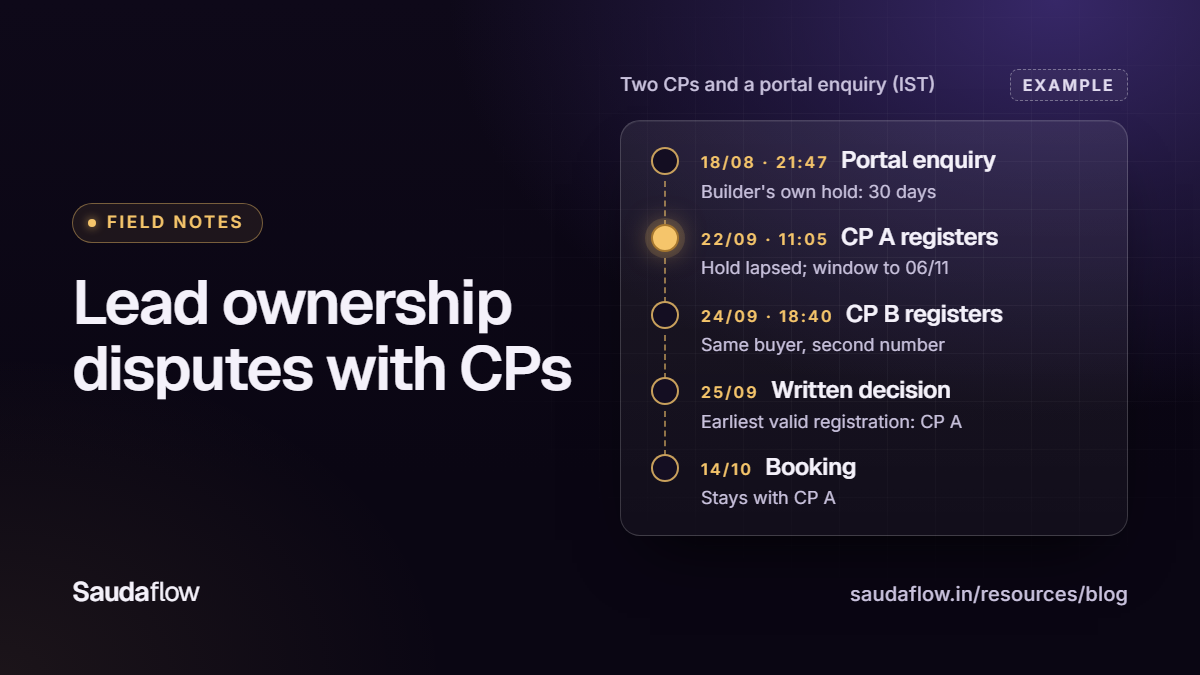
Two checks come first. The co-broker needs its own RERA agent registration, because section 9(1) of the RERA Act bars an unregistered agent from facilitating a sale in a registered project. And the builder's records should show which CP registered the buyer: our post on the channel partner agreement covers how a CP protects that claim.
Example (illustrative): two CPs share a ₹1,50,000 commission 60:40. The empanelled one bills the builder for the whole ₹1,50,000 with ₹27,000 GST on top and gets paid that less ₹3,000 of TDS, and then the co-broker bills the empanelled CP for its ₹60,000, adding ₹10,800 GST if it's registered. If the empanelled CP is a "specified person" (any person other than an individual or HUF, or an individual or HUF whose business turnover crossed ₹1 crore, or professional receipts ₹50 lakh, in the previous tax year), it deducts 2% TDS, ₹1,200, from that share, since the year's total to that co-broker is above ₹20,000. The empanelled CP keeps ₹90,000 of commission.
Milestone tranches: when each part is earned
Commission is often paid in parts, and what releases each part is a trigger in the agreement, like the booking amount coming in, the agreement for sale being registered, the buyer having paid a stated share of the price, possession, or a lock-in period ending.
Tying a document to a payment, as in "agreement registered and 20% of the price received", keeps the builder from paying out on a booking that may not hold. The CP's risk is vagueness, so ask the agreement to define "price paid": the agreement value alone, or including GST and other charges, and which record proves it.
TDS and GST on each tranche
TDS gets cut on the builder's side, and since 01/04/2026 it's been deducted on commission or brokerage under section 393(1) of the Income-tax Act, 2025, Table serial 1(ii), the provision that took over from section 194H of the 1961 Act. The rate is 2%, though nothing is deducted until the amount, or the total credited or paid to that CP in the tax year, crosses ₹20,000, and once it does, the 2% runs on the entire amount. If the agreement or contract shows GST separately, TDS is taken on the commission without the GST, going by CBDT Circular No. 23/2017, which section 536(2)(j) of the 2025 Act keeps in force where consistent. Our TDS on commission guide has the dates, forms and the no-PAN rate.
GST sits on the CP's side. A registered CP adds 18% GST to each commission invoice: 9% CGST plus 9% SGST when its registration and the property are in the same state, or 18% IGST when they are not (the CGST and IGST rate notifications, heading 9972). The property's state decides because, for an estate agent's service, the place of supply is where the property is (section 12(3)(a) of the IGST Act). Codes and invoice fields are in our post on GST on brokerage and the commission SAC code.
The other thing to get right is when to invoice. The CP is the one supplying the service here, so it has 30 days from the date of supply to issue its tax invoice (section 31(2) of the CGST Act with rule 47). Get it out in time and the time of supply is the invoice date or the date payment is received, whichever is earlier (section 13), and that date decides which tax period's return carries the GST.
If the CP agreement is a "continuous supply of services", a supply made continuously or on a recurrent basis under a contract for more than three months, with periodic payment obligations (section 2(33)), section 31(5)(c) says that where payment is linked to the completion of an event, the invoice is issued on or before the date that event is completed. The Act does not say whether a CP agreement is a continuous supply. If yours makes each tranche payable only when its trigger is met, invoicing it that day fits section 31(5)(c). Settle with your CA which date is the date of supply under your agreement: if an invoice is late, the time of supply becomes the date the service was provided, or the payment date if earlier (section 13(2)(b)).
Worked example: three flats, one slab, two tranches each
Cancellations and clawbacks
A cancelled booking raises three questions, and the agreement should answer them in advance: whether unpaid tranches lapse (no trigger, no invoice); whether paid tranches are kept, refunded or set off against the next payout, and at the invoice amount or the cash received; and whether the cancelled booking still counts towards the slab.
Cancel flat 2 from the worked example on 20/11/2026, after its first tranche was paid. Its second tranche of ₹95,000 is never invoiced. If paid tranches are recoverable, the builder wants back the first tranche's ₹95,000 of commission. Whether it asks for ₹1,12,100 (the invoice) or ₹1,10,200 (the cash paid) depends on the wording, because the ₹1,900 TDS is already deposited against the CP's PAN. If cancelled bookings leave the slab count, 2.5% is never reached: flat 3's commission falls from ₹3,00,000 to ₹2,40,000 under either reading, and the ₹85,000 top-up under reading B is no longer due; if it was already paid, the agreement decides whether it comes back. The agreement should say whether that ₹60,000 comes out of flat 3's unpaid tranche.
GST on a clawback. When a paid commission is refunded, the CP can reverse its GST with a credit note under section 34 of the CGST Act, which allows one where an invoice's taxable value turns out to exceed the value of the supply. The credit note must be declared by 30 November following the end of the financial year in which the supply was made, or by the annual return date if that is earlier (section 34(2)).
Since 01/10/2025, the CP's GST also comes down only once the builder has reversed any input tax credit it took that relates to the credit note. Section 126 of the Finance Act, 2025 (clause 121 of the Finance Bill) replaced the old proviso to section 34(2), and Notification No. 16/2025-Central Tax brought it into force from that date, as TaxGuru's summary sets out.
TDS on a clawback. The TDS on the original tranche is already deposited and reported against the CP's PAN. How the recovery is shown in both sets of books is a question for both CAs.
Keeping the calculation in one record
The examples above show where commission arguments start, and this is where Saudaflow fits, for builders and the CPs they work with.
For CP firms, Saudaflow shows commission only where the builder runs it, gives them a partner login and chooses to show commission there. Saudaflow's brokerage and commission tracking keeps the builder's ledger: brokerage accrues when a partner's booking is made, at the rate agreed with that partner for that project, as a percentage of the booking value or a slab, plus any flat or percentage launch bonus, split into tranches that each have their own trigger.
Every tranche in the ledger shows its base, and once it moves to Scheduled the ledger also shows the 18% GST if the partner is GST-registered, TDS under section 393(1) (old 194H) at 2% on the GST-exclusive base, and the net. The invoice itself still comes from the partner. Anything unpaid gets aged by partner, from 0–7 days at one end through 8–30, 31–60 and 61–90 to 90-plus at the other.
For builders, the channel partner module shows each commission as Accrued, Scheduled or Paid, and says to "keep reversals or clawback flags visible rather than erasing the history". It adds that commission profiles, tranches and TDS/GST tracking "need the correct partner, project and tax settings", to be reviewed with your finance team. The module is on the Professional Team and Custom plans. For how CP deals work end to end, see our guide to the channel partner in real estate.
We checked this against the Acts, rules, circulars, notifications and other sources linked above on 16/10/2026 and 22/10/2026, and the product details on 17/10/2026 and 22/10/2026. Still, this is general information, not tax/legal advice, and your CA/advocate is the person to ask about your own case.
Frequently asked questions
How is channel partner commission calculated?
Take the base the CP agreement names, typically the agreement value without GST, stamp duty, registration charges or deposits, multiply it by the agreed rate or slab and break the result into the agreed tranches. Each tranche then gets its own invoice, where a GST-registered CP adds 18% GST and the builder deducts 2% TDS under section 393(1) of the Income-tax Act, 2025 (old 194H) once the year's total crosses ₹20,000, on the commission alone where the agreement shows GST separately.
Does a commission slab apply to all bookings or only those above the threshold?
Whatever the CP agreement says, so make sure it's written there in plain words. If the higher rate applies only above the threshold, earlier bookings keep the lower rate, and if it applies retrospectively, every booking in the period gets the higher rate. In this post's three-flat example, the difference is ₹85,000 of commission.
Is CP commission calculated on the agreement value or the basic sale price?
On whichever base the CP agreement names. At 2%, the same flat pays ₹1,36,000 on a BSP of ₹68 lakh and ₹1,50,000 on an agreement value of ₹75 lakh that adds PLC and parking. Name each item in the agreement.
What is the real estate broker commission rate in India?
The RERA Act, the central law for real estate agents, sets none, so it is the rate in your written agreement: the builder's CP agreement for a new flat, or the brokerage agreement with the buyer, the seller or both for a resale. A state law can cap it: in Haryana, rule 10 of the Property Dealers and Consultants Rules, 2009 provides 1% of the agreed value, half each from seller and buyer, according to a 2020 note by the law firm Ethical Legal Consultants.
What happens to CP commission if a booking is cancelled?
Whatever the CP agreement says: whether unpaid tranches lapse, whether paid ones are kept, refunded or set off against the next payout, and whether the booking still counts towards a slab. If commission is refunded, the CP can reverse its GST with a credit note under section 34 of the CGST Act, within that section's time limit and, since 01/10/2025, only once the builder has reversed any input tax credit it took on it.
How is commission split between two channel partners?
By a written co-broking agreement. Where the builder pays only the empanelled CP, that CP invoices the builder for the full commission and the co-broker invoices the empanelled CP for its share, with GST if registered. If the empanelled CP is a "specified person" (anyone other than an individual or HUF, or one above the turnover limits), it deducts 2% TDS from that share once the year's total crosses ₹20,000.
Sources
- Section 393, Income-tax Act, 2025: Tax to be deducted at source (Table, Sl. No. 1(ii), commission or brokerage; Sl. No. 8(iv), business benefit or perquisite)
- Section 402, Income-tax Act, 2025: Interpretation (clause 7, commission or brokerage; clause 37, specified person)
- Section 536, Income-tax Act, 2025: Repeal and savings
- CBDT Circular No. 23/2017 dated 19/07/2017: TDS on GST component
- Notification No. 11/2017-Central Tax (Rate), as amended up to 01/04/2019 (serial 16, heading 9972)
- Notification No. 8/2017-Integrated Tax (Rate), as amended up to 01/04/2019 (serial 16, heading 9972)
- Integrated Goods and Services Tax Act, 2017 (section 12: place of supply)
- Section 2, CGST Act, 2017: Definitions (clause 33, continuous supply of services)
- Section 13, CGST Act, 2017: Time of supply of services
- Section 31, CGST Act, 2017: Tax invoice
- Rule 47, CGST Rules, 2017: Time limit for issuing tax invoice
- Section 34, CGST Act, 2017: Credit and debit notes (sub-section (2): time limit for declaring a credit note)
- The Real Estate (Regulation and Development) Act, 2016: sections 2(zm), 9 and 10 (real estate agents)
- HRERA Approves Brokerage Of 1% For Real Estate (rule 10 of the Haryana Regulation of Property Dealers and Consultants Rules, 2009; originally published 27/10/2020)
- MahaRERA Issues Order on Project Registration Eligibility and Real Estate Agent Fee Clause in Agreements for Sale (clause 15A; 02/11/2024)
- Notification No. 16/2025-Central Tax dated 17/09/2025: provisions of the Finance Act, 2025 (including sections 126 to 134) in force from 01/10/2025
- GST amendments of the Finance Act, 2025 effective 01/10/2025: section 126 substitutes the proviso to section 34(2) of the CGST Act
Comments
No sign-up and no email address. Comments appear as soon as you post them; obvious spam is held back.