Android field app

Property is not sold at a desk. So this is not a companion app.

Six tabs, built for someone standing at a site gate with one hand free. A call outcome to review when you return from the dialler. A check-in that records where you were and when. And when the signal goes — basement, lift, a site with no bars — the day carries on and syncs later with the time and the position it really had.

  • Android · no iPhone build
  • Six tabs
  • Call outcomes with a clear next step
  • Works with no signal
  • Manual logging · optional Android call-log help
  • Same sign-in as the web app

Three screens that carry the day

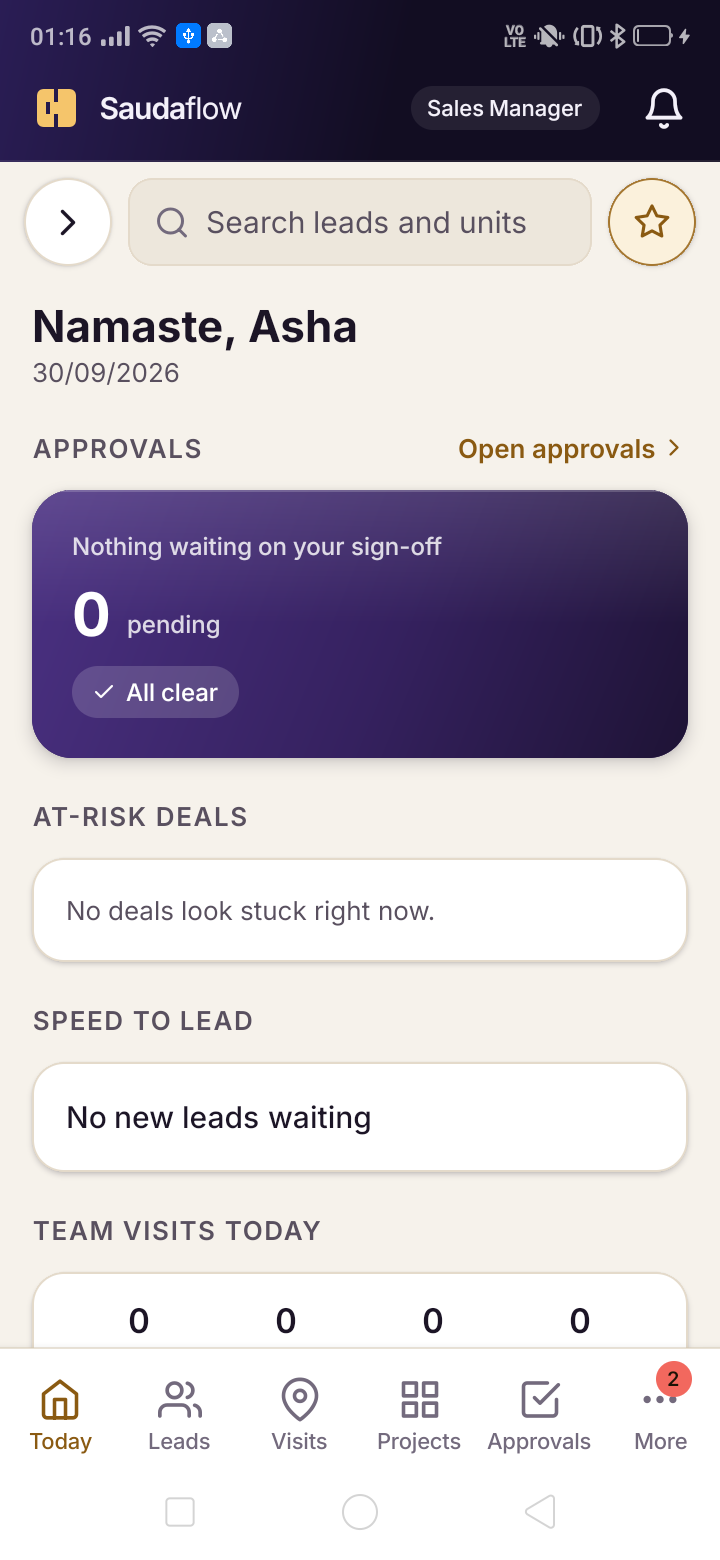
Sales Manager Today screen with zero pending approvals, no stuck deals, no new leads waiting and the team visits section.
A manager’s Today view. Approvals, at-risk deals and team visits in one view. This demo account has no pending approvals or stuck deals.Current Android preview · demo dataThese screens show a private Android preview with demo data. The public download is build 30, so its screens may differ.See these workflows in a demo ↗
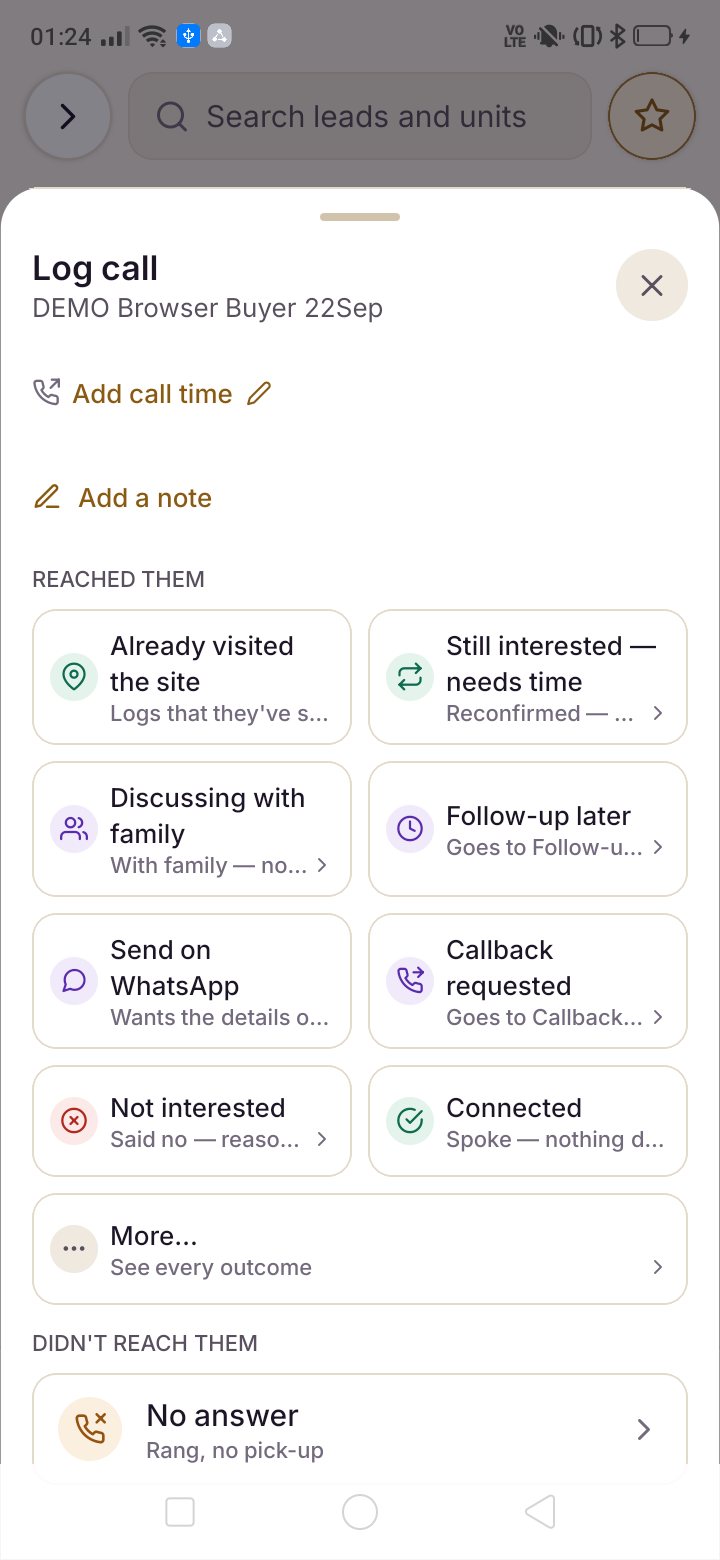
Manual call-log sheet for DEMO Browser Buyer 22Sep with reached-them options, More and No answer.
Review a call outcome. The manual log shows reached-them choices, More and No answer for a demo buyer. No outcome has been selected or saved.Current Android preview · demo data
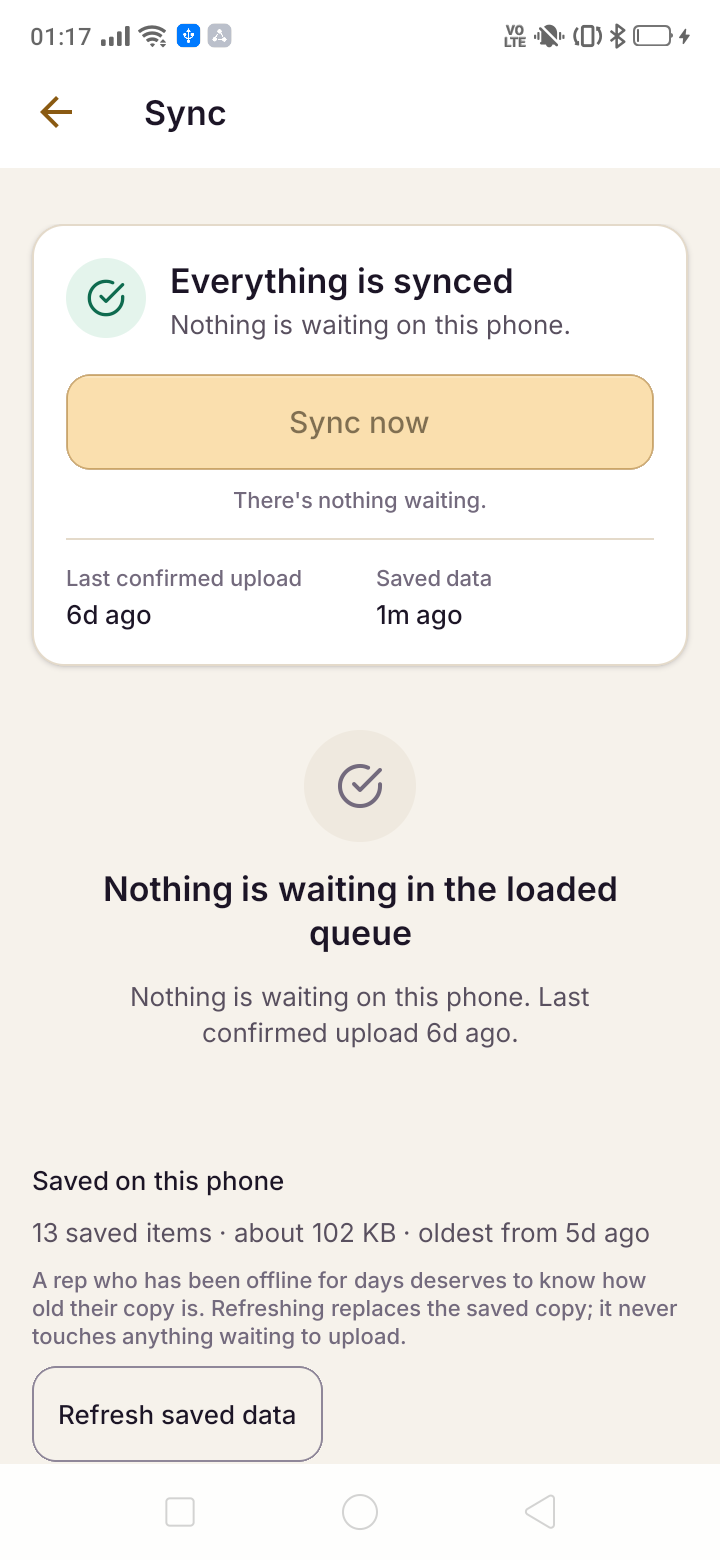
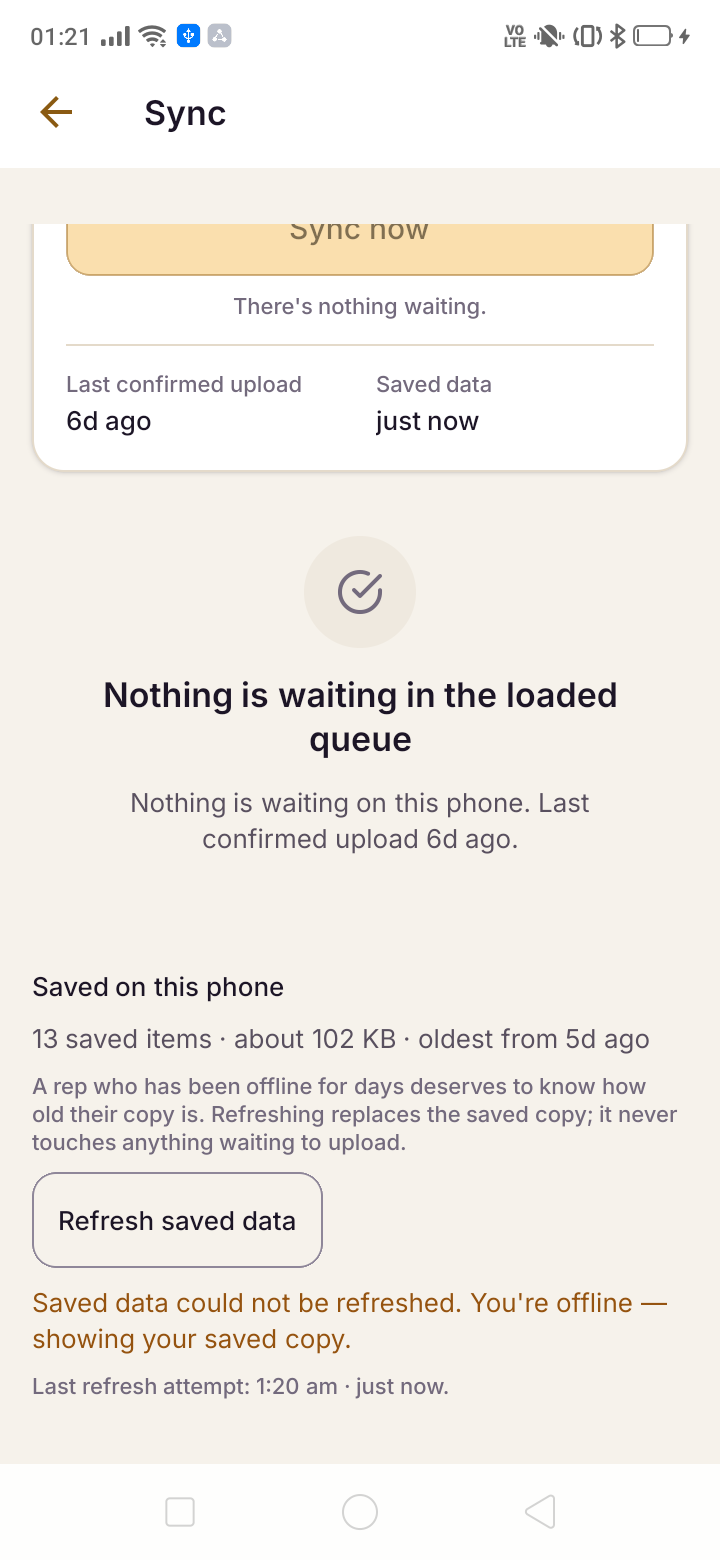
Sync screen with an empty upload queue, last confirmed upload six days ago, saved data one minute ago and 13 saved items.
Know what is saved. See the upload queue and saved-data age separately. This phone has no queued uploads and 13 saved items.Current Android preview · demo data

Every screen on this page came out of the app itself, rendering its own code. Nothing here is a mockup, a redraw or a designer's impression. The names, projects and rupee figures in them are sample data — they prove the screen exists, and they are not anybody's results.

The shape of it

Six tabs. That is the whole app.

Not a menu tree shrunk down from the desktop. Six places, in the order a field day uses them — and a tab you have no permission for is not there at all, rather than there and refusing you.

  1. 01TodayVisits due, follow-ups due, callbacks, and the attribution windows about to close. Every card says why it is on the list.
  2. 02LeadsThe pipeline as a list you can burn through — stage, source, language, budget band, and Call · WhatsApp · Share · Log on every row.
  3. 03VisitsToday, upcoming, overdue and no-show. Check in at the gate, and finish the visit with structured feedback.
  4. 04Projects & inventoryProjects, towers, floors and units with holds and prices. Read-only by design — a unit is not held from a car park.
  5. 05ApprovalsDiscounts, refunds, hold extensions and ten other request types, each with its chain rule, its step and its clock.
  6. 06MoreNotifications, sync, conflicts, what the app can see of a call, what it shares about your location, and your access summary.
Today

The day, in the order it actually needs.

Today is where everyone lands, whatever their role. It is not a feed. It is the six things that can go wrong today, sorted: what is urgent, the visits, the follow-ups, the callbacks, the attribution windows about to expire, and what is close to closing.

  • Every card says why it is there. "New lead · 03:36 on the clock". "Asked for a callback at 7:11 pm". "Attribution expires in 2 days". Nobody has to guess the ordering, so nobody argues with it.
  • Expiring attribution is on the home screen. It is money walking out of the door, and it belongs on a home screen rather than in a report nobody opens.
  • Every number is a tap target. A stat lands on the records behind it — and when that section is empty today, the tap still lands somewhere real instead of doing nothing.
  • A telecaller and a field agent get different homes. Four role dashboards plus a plain fallback for the seats that do not need one. Presets, not separate products — and they do not lock.
Calling

A clear outcome. A useful next step.

Call from a lead, then record the outcome and next step. Manual logging works without call-history access. On supported corporate Android builds, optional call-log help can suggest a matching call's duration for you to review before saving.

Manual call-log sheet for DEMO Browser Buyer 22Sep with reached-them options, More and No answer.
Review a call outcome. The manual log shows reached-them choices, More and No answer for a demo buyer. No outcome has been selected or saved.Current Android preview · demo data

Optional help, deliberate review

Call-log help is off until you enable it and Android grants access. Android's permission covers call history; Saudaflow limits this helper to finding an outgoing call to a known lead that you started from the app, within a two-hour window. You review the suggestion before saving. If access is unavailable or the match is unclear, use manual logging.

Time away measures how long you were outside Saudaflow; it does not measure talk time. Keep it labelled as an estimate. Enter the talk time you can confirm, or review an available Android duration suggestion before saving. Neither an estimate nor a phone suggestion proves a provider connection.
  • Keep the distinction clear. This helper does not import incoming calls, calls started outside Saudaflow or your personal call history. It does not read your contacts, record call audio or identify an incoming caller. Calls to a configured company number are handled separately through the calling provider.
  • Keep working when offline. Supported manual outcomes queue with their original time. The optional helper needs current access checks and may be unavailable.
Site visits

Check in at the gate. Close the visit properly.

One tap records the coordinates, how accurate the fix was, and the time. A photo, a note and who came along are offered and optional — a rep with a buyer in front of them is not filling in a form.

  • Feedback is a gate, not a nag. Under the default workspace policy a visit cannot reach Completed until the structured feedback is in: interest, outcome, who actually came, what was shown, what was handed over, and the objection — from fifteen named ones, price and loan eligibility and possession timeline and carpet versus super built-up among them.
  • Structured feedback in three steps. Record the visit outcome, useful context and next action. Complete the required fields before moving on.
  • "Anything you don't tick is recorded as not shared." The app's own words. A handover list that quietly defaults to yes is how a possession dispute starts.
  • A no-show is a routed outcome, not a blank. It goes back into follow-up instead of leaving a visit hanging.
About the distance readout. A check-in always records the coordinates and the time. The distance and the verified-or-flagged verdict need something to measure from — a site pin set once per project, on the project's page in the web app. Until that pin exists, check-ins at that site are recorded and honestly marked unverified: the product will not invent a distance from a project it has no location for. And when a position does look wrong, Saudaflow flags it for a manager to review. It never blocks the rep at the gate.
Offline

No bars in the basement. The day carries on.

This is most of the reason the app exists as something you install rather than a website on a phone. Offline is not a spinner and a prayer here — it is a queue you can open, read and retry, and a set of rules about what is allowed to happen while nobody can check.

Sync screen showing a failed saved-data refresh, the retained saved copy and the last refresh attempt.
A clear refresh failure. When the app could not reach its server in a controlled test, it kept the saved copy and showed the last refresh attempt.Current Android preview · demo data
Sync screen with an empty upload queue, last confirmed upload six days ago, saved data one minute ago and 13 saved items.
Know what is saved. See the upload queue and saved-data age separately. This phone has no queued uploads and 13 saved items.Current Android preview · demo data

What queues

Call outcomes and notes · voice notes · follow-ups · snoozes · check-ins · check-outs · no-shows · structured visit feedback · lead status changes · shares. Ten kinds, and the list is exhaustive by construction — the app will not build if someone adds an eleventh without classifying how risky it is to replay.

It syncs with the time it really happened

A check-in made at 11:02 that uploads at 15:40 reads 11:02, with its own GPS fix attached — and the server keeps its own receipt time next to it, so neither can be quietly rewritten. The queue replays dependencies first, then in the order things actually happened, one request at a time.

One action, one id

Every queued write gets an id the moment you make it, and carries the same id on every delivery — including the first. A request that times out but actually landed is recognised on the retry instead of writing a second row. Retries back off 30 seconds, two minutes, ten, thirty, then hourly.

Nothing is overwritten quietly

If the record moved on the server while a write sat in the queue, that write is not retried into an overwrite. It becomes a conflict for a human. Ownership, money, inventory, approvals, attribution and compliance can never resolve themselves by last-write-wins, whatever the workspace has switched on.

And one thing the app refuses to do offline: create a new lead. A new lead decides ownership — whose it is, which attribution window starts, who gets paid at the end of it — and that has to be settled against the live pipeline, where the duplicate check can run. So the app says "You're offline. A new lead decides ownership, so it isn't queued — try again on signal", and means it. Everything else on the list above waits patiently. This is the one place we would rather fail in front of you than guess behind your back.
Approvals

The sign-off that used to need a laptop.

Review the approval requests available to your role — including discounts, refunds, hold extensions and marketing requests. Open a request to review its details, approval chain and any deadline before deciding. Available requests and actions depend on your workspace rules and permissions.

  • The figures are the server's. Discount percentage, net value, margin impact — computed where the data lives, never on the handset. The screen says "Approving asks you to confirm the figures first" because it means it.
  • Money is never bulk-decided. You can clear a batch of low-risk requests together; a request carrying a rupee figure has to be opened and decided on its own.
  • The chain is frozen on the request. Editing the approval rules tomorrow does not change what is in flight today — the request carries the chain it was raised under.
  • A rejection is structured. Breaks policy, margin impact, documents missing, or your own words — so a rejected request tells the next person why, not just no.
The rest of the day

The pipeline, the gate register, the stock and the nudges.

Current Android previews show more of the field workflow using demo data.

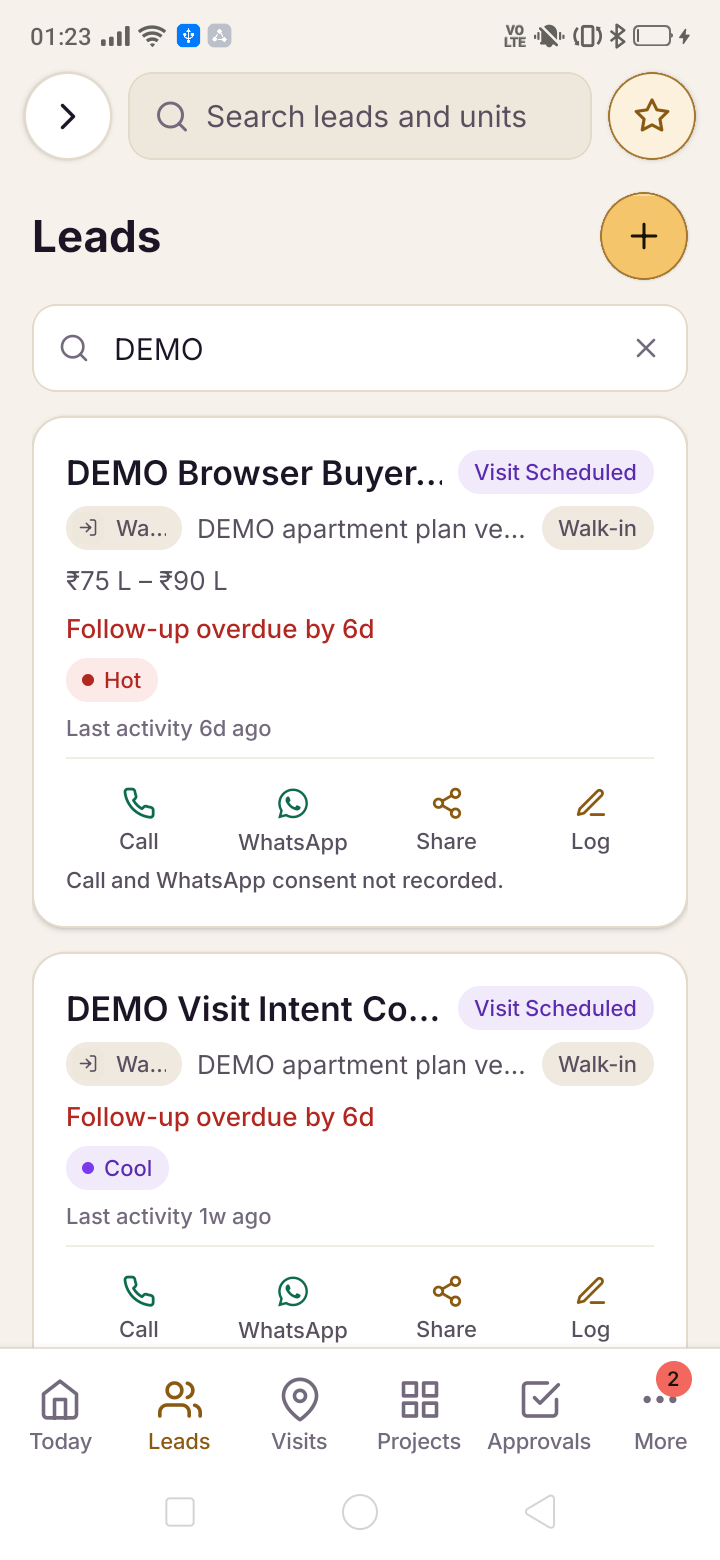
Leads list filtered to DEMO, showing two sample buyers, visit-scheduled stages, overdue follow-ups and manual action buttons.
Find the right lead. A DEMO search brings up two sample buyers with their stages, follow-up indicators and manual contact actions.Current Android preview · demo data
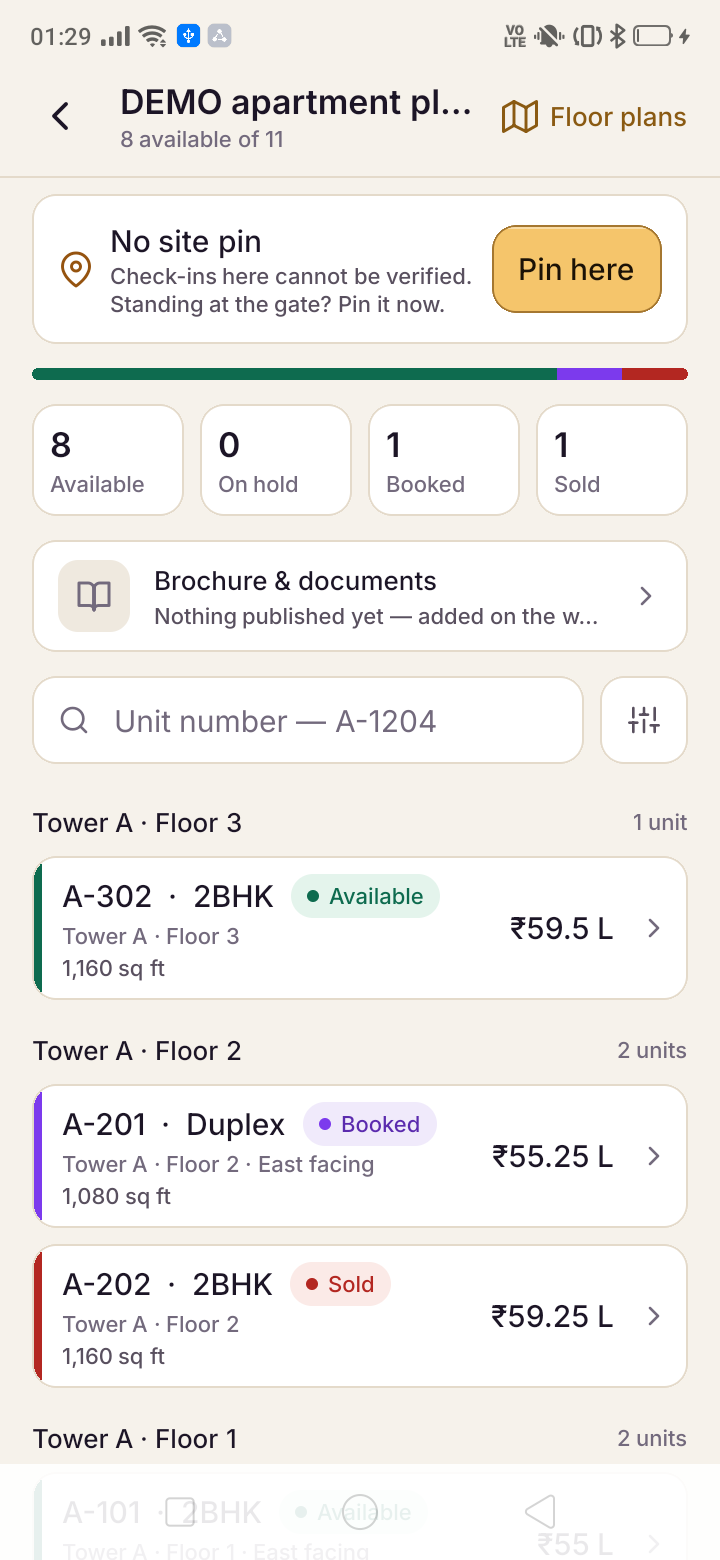
Demo apartment inventory grouped by tower and floor, with unit availability, configuration, area and recorded prices.
Inventory by tower and floor. See recorded availability, configuration, area and price beside each unit. Sample inventory includes available, booked and sold homes.Current Android preview · demo data
The honest half

What the phone does not do.

You will find this out in week one anyway. Better here, where you can still price it into the decision — and where you can weigh it against the rest of the page knowing we did not hide the ugly part.

  • iPhone access. An iPhone release has not been verified. You can use the web app for its available workflows. That does not establish native iPhone features or offline parity.
  • Check the map before the site day. Check map availability on the installed build. Keep the project address and visit details available before heading to the site.
  • Location evidence has limits. A location verdict needs an available GPS reading and a configured project pin. Missing location or a missing pin must remain unverified. Review accuracy and any flagged check-in; a recorded visit is not automatically location-verified.
  • Selected workspace actions are on Android. The Android app includes contacts, deals, booking details, payment milestones, receipt and document information, selected record edits, company-call history and callback tasks. Eligible roles can view reports and the organisation's commission ledger; commission requires Professional or Custom. Booking creation, collection entry and reconciliation, commission payouts, partner administration and company-number setup still need the web app. Mobile action coverage is not yet complete.
  • WhatsApp actions have different delivery paths. Manual actions open WhatsApp on the phone. Provider messaging requires the workspace’s approved setup and templates; opening WhatsApp is not proof of delivery.
  • Alert settings are not delivery proof. Optional foreground chimes and generic voice alerts start off. Push delivery still depends on device permission and configured services; check the available state on your phone.
  • Recording is separate from the call-log helper. Call-log help does not record audio. Company-call recording requires the workspace's provider setup, recording configuration and applicable notice and permission checks. The product shows the available state for that workspace. A configured account alone is not proof that a call was recorded.
  • Check the current download. Check the download page for the available Android version, device requirements and installation notes. The direct download is a test build, not a Google Play release. An iPhone release has not been verified. Compatible screen and asset updates can arrive through the app's update service. Native code, permissions and a new app version require a new APK. Call-log help requires a build that includes the native helper; a screen update cannot add it. Check the download page and release notes before updating.
  • Location sharing is narrow on purpose. Approximate position, only while the rep is on duty with the app open on screen, never in the background and never when it is closed, visible only to managers of that rep's team, kept seven days by default and less if you choose. The rep reads those exact words before it is switched on, and switching it off takes effect immediately.
  • Property collections and subscription payments are separate. Property collections are tracked through booking milestones and receipt records. Buyer Connect can request a payment link from the team; it does not provide an inline property-payment gateway.
FAQ

The questions field teams ask

The install prompts, step by step, are on the download page.

Is there an iPhone app?

An iPhone release has not been verified. You can use the web app for its available workflows. That does not establish native iPhone features or offline parity.

Does it show me who is calling before I answer?

The current Android app does not identify incoming callers. Call-log help is off until you enable it and Android grants access. Android's permission covers call history; Saudaflow limits this helper to finding an outgoing call to a known lead that you started from the app, within a two-hour window. You review the suggestion before saving. If access is unavailable or the match is unclear, use manual logging. This helper does not import incoming calls, calls started outside Saudaflow or your personal call history. It does not read your contacts, record call audio or identify an incoming caller. Calls to a configured company number are handled separately through the calling provider.

Does it really work without internet?

Yes, and it is most of the reason it exists as an installed app rather than a mobile website. Call outcomes, notes, voice notes, follow-ups, snoozes, check-ins, check-outs, no-shows, structured visit feedback, lead status changes and shares are all captured with no signal.

The banner tells you how many are waiting and how old the saved copy is, and the sync screen names each item rather than showing a spinner. When signal returns each write is replayed with the time it really happened, in dependency order, carrying the same id it was given when you made it — so a request that timed out but actually landed does not write a second row.

One thing is deliberately refused offline: a brand-new lead, because creating one decides ownership and ownership has to be settled against the live pipeline.

What happens if two people change the same record?

The clash is shown to a person. A queued write that reaches the server and finds the record has moved underneath it is never retried into an overwrite: it becomes a conflict record naming the field and both timestamps, and it waits on the conflicts screen for someone to decide.

Ownership, money, inventory, approvals, attribution and compliance writes can never resolve themselves by last-write-wins, whatever the workspace's settings say.

Is every check-in location-verified?

A location verdict needs an available GPS reading and a configured project pin. Missing location or a missing pin must remain unverified. Review accuracy and any flagged check-in; a recorded visit is not automatically location-verified.

Can a manager run the whole week from the handset?

The Android app includes contacts, deals, booking details, payment milestones, receipt and document information, selected record edits, company-call history and callback tasks. Eligible roles can view reports and the organisation's commission ledger; commission requires Professional or Custom. Booking creation, collection entry and reconciliation, commission payouts, partner administration and company-number setup still need the web app. Mobile action coverage is not yet complete.

Can my team send WhatsApp messages from the app?

Manual WhatsApp actions open WhatsApp on your phone. Provider messages depend on the workspace’s account configuration, approved templates and messaging rules. Opening WhatsApp does not prove the message was sent or delivered.

How do we install it, and is it on the Play Store?

Check the download page for the available Android version, device requirements and installation notes. The direct download is a test build, not a Google Play release. An iPhone release has not been verified. Compatible screen and asset updates can arrive through the app's update service. Native code, permissions and a new app version require a new APK. Call-log help requires a build that includes the native helper; a screen update cannot add it. Check the download page and release notes before updating.

Put it on one phone and give it a Tuesday.

Install it on a single handset, hand it to the rep who does the most site visits, and look at what came back on Wednesday morning — the check-ins, the outcomes, the feedback, and the ones that queued in a basement and arrived later with the right time on them.

Android 7.0 or newer, 64-bit ARM. It signs in to a Saudaflow workspace — the demo is where that gets set up, with your projects and your team in it.

Screens shown here were captured on an Android phone in a private preview workspace with demo data. The public download can look different; check its download page and release notes for version details.