
Channel partner agreement: the registration, attribution and dispute clauses
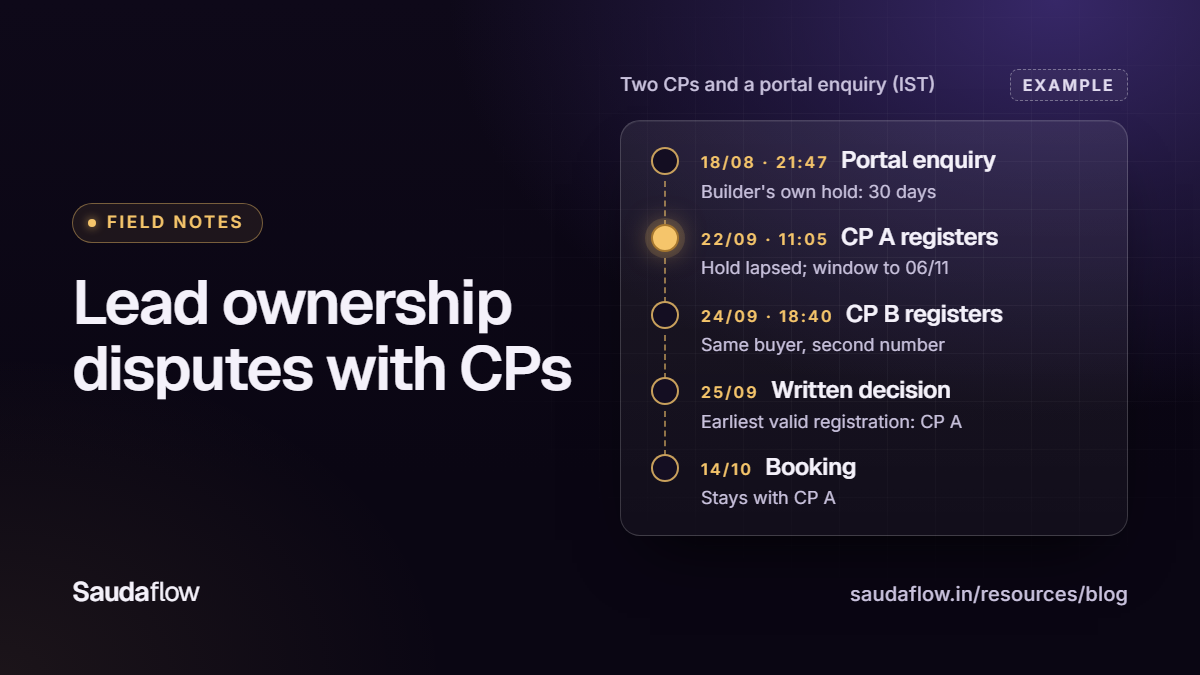
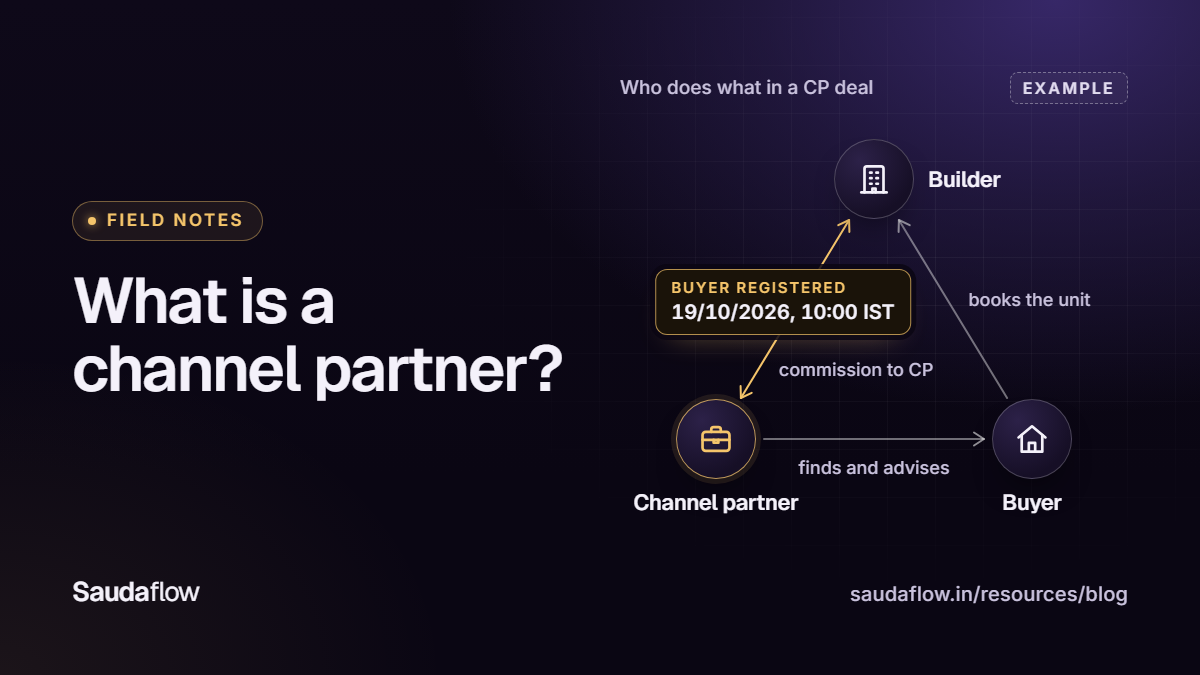
A channel partner agreement is where a builder and a CP settle, in writing, who owns a buyer. A lead ownership dispute is what you get when the same buyer reaches the builder by two routes, say a CP's registration on one side and a portal enquiry on the other, and nobody had agreed beforehand which record wins. The clauses that prevent it are plain enough, and the six below take them one at a time, starting with a single registration channel and ending with how possible duplicates get reviewed.
This is for builder sales heads and CP owners who are tired of fighting over who brought a buyer.
Why lead ownership disputes happen
Fights over a buyer usually start in one of six ways, and nobody has to be cheating, since a gap in a record or a rule is enough.
- Duplicate records and number typos turn one buyer into two records, and it takes very little, a swapped digit, +91 on one and a leading 0 on the other, an NRI number without its country code, or a second mobile number. Each side works "its" lead in good faith.
- Lapsed windows trip people up when the CP registered in time but the buyer sat on it, the window ran out and nobody had noted the expiry date. Or nobody wrote the length down, and now the builder remembers one number and the CP another.
- Site-direct walk-ins and calls are the buyer ringing the number off a hoarding, or turning up at the sales office on a Sunday, and the desk logging a fresh "direct" lead without searching for an existing registration.
- The buyer who wants the CP's commission as a discount sees the project with a CP and then contacts the builder directly, asking for a lower price "without the broker". If the policy is silent, the sales team may be tempted to agree.
- Two CPs register the same buyer, because a buyer may speak to more than one broker. Both register, one gets in first, and the other is the one who brings the buyer to the site.
- A portal or ad enquiry later meets a CP when a form the buyer filled in weeks back never got a call through, and now a CP brings in the same person, so the builder sees an existing lead and the CP a buyer it found.
Attribution is contract, not RERA law
For agents, what the Real Estate (Regulation and Development) Act, 2016 regulates is who may act as one and how. Section 9 is why a CP must register with the state authority before facilitating sales in a registered project, and section 10 lists its duties, facilitating sales only in registered projects, keeping books and records and so on.
What the Act does not have is any rule on which CP owns a buyer, how long a client registration lasts, or who wins a tie. Those terms come from your CP agreement and the written policy it refers to, which is to say from contract. Even Maharashtra's model agreement for sale, which has a clause on the agent's fee, says the fee is paid "in accordance with the agreed terms of payment" (paragraph 15A, added by the 2019 amendment rules and carried word for word into MahaRERA's 2024 model agreement by Order No. 63/2024).
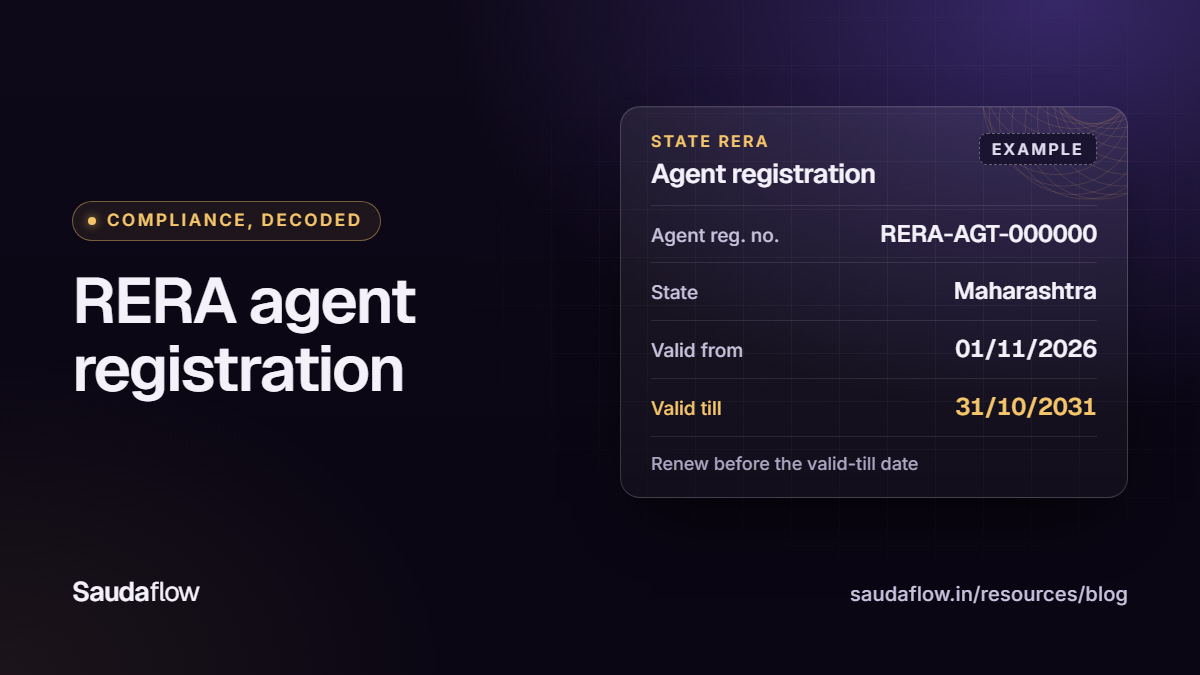
Where RERA does still matter is the CP's own registration, because a CP has to be registered to facilitate the sale at all (in Maharashtra, also named in the project's RERA application, as MahaRERA's Order No. 43/2023 records), and a builder's policy can make a current registration a condition of every claim. Fees, documents and renewal, state by state, are covered in our guide to RERA agent registration. And if a rule isn't written down and shared before launch, expect an argument at booking.
Six channel partner agreement clauses that keep ownership clear
1. One registration channel, with an instant acknowledgement
Pick the one channel that counts, for example a CP portal, a web form or a single registration inbox, and say in writing that a WhatsApp message to a sales manager or a phone call does not count. For every registration you want the buyer's name, mobile number with country code, email, the project, and the CP's RERA registration number.
Send an acknowledgement for every registration straight away, with a reference number and the time in IST, and that time becomes the registration time. Then tell the CP how it went, accepted with the date the window ends, or not accepted with the reason and the date of the record it clashes with.
2. A written attribution window for each project
The attribution window is how long a registration protects the CP. Write it per project, in days from the acknowledgement, since the RERA Act sets no standard length, and then write down what extends it, for example a recorded site visit that names the CP's firm, or an extension requested before expiry and approved in writing. Say too whether an extension can happen more than once, and that calls and messages extend nothing.
Say in writing what happens once a window expires, that the buyer is fresh and the next valid registration, from a CP or from your own marketing, starts a new window. Change the length halfway through a launch and it should apply only to registrations made after the change, with every CP told, so nobody's old registration shrinks overnight.
3. Who wins a tie
- Between two CPs, let the earliest valid, acknowledged registration for that project win, inside its window, valid meaning it came through the official channel with every required detail from a CP whose RERA registration in that state is current.
- Your own enquiries need the most thought, how long a logged portal, ad, website or site-office enquiry holds a buyer for your team, and whether one nobody even managed to reach should block a CP at all. If the hold is too long, CPs have little reason to bring you anyone who once filled in a portal form, and too short means you pay commission on buyers your marketing found, so write down where you draw the line.
- Other projects need a line too, on whether a registration covers them as well.
- If a buyer asks to go direct inside the window, that request does not change ownership, and the CP's commission is not offered as a discount.
4. What evidence counts
Agree on proof early, while everyone is still friendly. Good proof is the acknowledged registration and its time, a site-visit record with the CP's name on it, messages sent through the registration channel and, for your own team, the enquiry record with its source and time. What does not count on its own is a phone call, a WhatsApp message to one salesperson, a visit slip without the CP's name, or the buyer's word at booking, and that last one can change when a discount is on the table.
5. A dispute process with a deadline
- One named person decides, the CP manager for instance, with one appeal allowed, to the sales head.
- Disputes have a cut-off, 7 days from the booking for example, and they come in writing with the proof attached.
- The ruling has a cut-off too, say 10 working days, and both sides get it in writing, with the evidence and the rule behind it spelled out.
- Commission waits until the decision is out, and neither side is paid in between.
What happens after that is for the dispute clause in the CP agreement to decide, and that's one clause to have your advocate draft.
6. How duplicates are reviewed
Check every new registration and enquiry against existing records by mobile number, saved one way only (country code included, no spaces or leading 0), since one number typed two ways looks like two buyers. If a record nearly matches on email, or on name and project, it goes to one named reviewer, who makes the call within a set time, notes why and tells both sides. Don't merge or throw out a possible duplicate quietly, and linked records keep their original timestamps.
For builders: your one-page CP policy
Fill it in project by project, attach it to the channel partner agreement and send the same copy to every empanelled CP before launch. The Example column just shows the idea, and those aren't market rates.
| Clause | What to write | Example |
|---|---|---|
| Registration channel | The only channel that counts | The CP portal; messages to staff do not count |
| Required details | What makes a registration complete | Buyer's name, mobile with country code, email, project, CP's RERA number |
| Acknowledgement | When and how the CP gets proof | Instant, with a reference number and the time in IST |
| Attribution window | How long, and from when | 45 days from the acknowledgement |
| Extension | What extends it, and how often | A visit naming the CP: 60 days from the visit, once |
| Your own enquiries | How long they hold a buyer | 30 days from the logged enquiry |
| Tie-break | Who wins between two valid claims | The earliest valid acknowledgement for the project |
| Evidence | What counts and what does not | Registration, visit record, registration-channel messages; never a call alone |
| Going direct | A buyer's request to drop the CP | No change inside the window; no commission as a discount |
| Duplicates | Who reviews, and how fast | The CP manager, within two working days; both sides told |
| Disputes | Deadlines and the decision | Raise within 7 days of booking; written decision within 10 working days; commission held |
| RERA | Registration needed for a claim | Current in the state; checked at registration and before payout |
Two habits make it work. Train the sales desk to search by mobile number before logging any walk-in or call as new. And if your team earns more on "direct" bookings, check each direct tag against recent CP registrations before confirming the booking.
For CPs: how to protect a claim
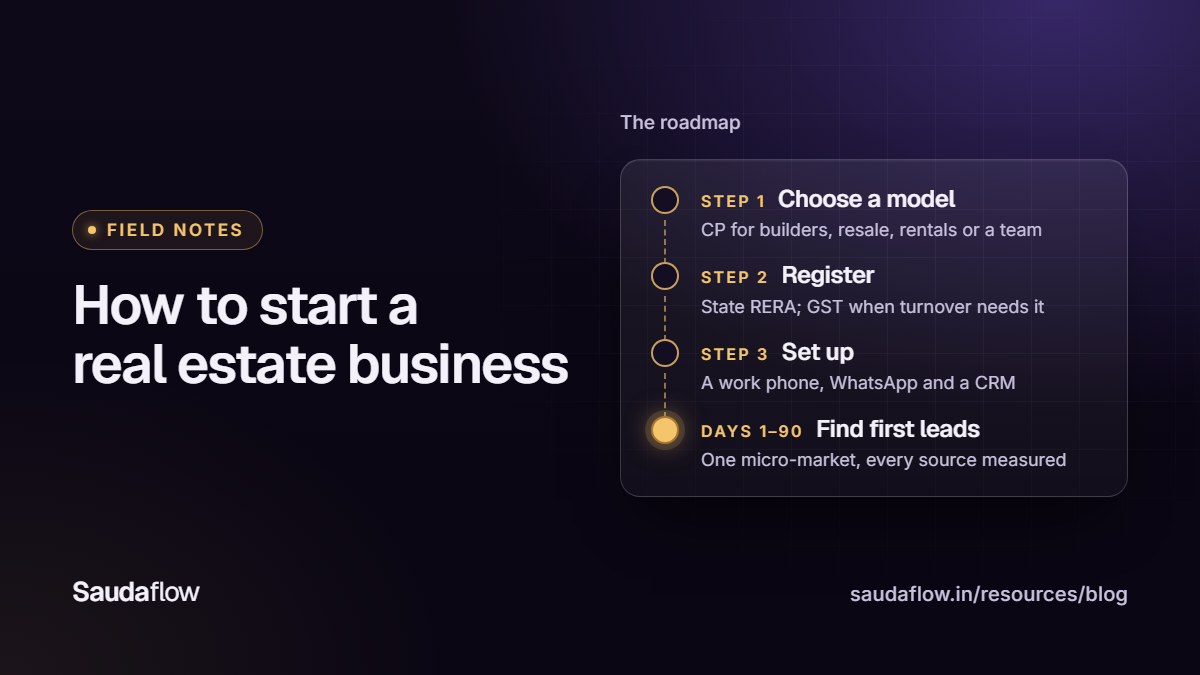
Client registration in real estate (CPs also call it CP tagging) is the record your claim stands on. Do these every time:
- Register before the site visit is planned, through the builder's official channel. The timestamp protects you, not the conversation.
- Save the acknowledgement with its reference and time. If none arrives, follow up in writing the same day.
- Get the numbers right. Ask for every mobile number the buyer uses, the office one too and the one on property portals, and add the country code for NRI buyers.
- Diary the expiry date as soon as you have it, and ask in writing for any extension before it lapses.
- Go along on the first visit, and before leaving the sales lounge, check the visit record has your firm's name. If the buyer will go alone, tell the builder beforehand through the registration channel.
- If the builder says the buyer is "existing", ask in writing for that record's source and date, and when it stops holding the buyer. If the policy allows, register again the day it ends.
- Keep your RERA registration current. Under a policy like the template above, a lapsed registration voids the claim.
- Dispute in writing and on time, with your evidence in date order: registration, acknowledgement, visit record, messages.
If the builder still refuses to pay
Who owns a buyer is settled under your CP agreement, not the RERA Act, so a refused claim is argued under that agreement too. That means sending one written claim before the deadline the agreement gives, with your evidence in date order, the registration first and then the acknowledgement, the visit record and the messages. If the written decision still goes against you, the next step is whatever the agreement's dispute clause sets, and your advocate can tell you which route fits. A claim that rests on a phone call or a verbal promise is the hardest kind to prove.
The rest of the agreement: commission, payout, clawback, termination
Ownership is only half of a channel partner agreement. Read the other half just as closely:
- Commission: the rate, the base it's worked out on and any slabs (our channel partner guide explains how CP commission is structured).
- Payout and tax: the trigger for each tranche and what your invoice must carry. See when CPs get paid and TDS on commission under section 393(1).
- Clawback: whether, and how, a paid tranche is recovered if the booking is cancelled.
- Termination: what happens to buyers you registered, and to commission not yet paid, if either side ends the agreement.
Worked example: two CPs and a portal enquiry
How Saudaflow records registration and ownership
We build Saudaflow, so read this as our own description, taken from our product pages on 16/10/2026:
- Registration. The channel partner workflow says to "capture the introduction inside the workspace with its source and timestamp" and to "review possible duplicates and the active attribution window before assuming a new ownership claim."
- Competing claims. The same page says: "Use the registration history and configured rules when introductions compete. A phone call by itself does not establish ownership."
- The window. The lead routing page keeps assignment and ownership apart: "Assignment decides who should act next. Lead ownership relies on timestamped registration and your configured attribution window, normally 45 days."
- Duplicates. On the lead management page, "intake checks the phone number for an existing contact and relevant lead", with a warning further down: "Do not assume that two similar-looking phone numbers identify the same person without checking the record."
- Visits. The site visits page tells teams: "For partner visits, retain the registration and attribution evidence. A visit or phone call alone does not replace the lead-ownership rule."
- The CP's own view. CP Connect, the partner portal, "is for the broker's own introductions, visits, commission information and notices." The channel-partner module and CP Connect need the Professional Team or Custom plan.
Software only keeps the record, though, and it's still your job to write the rules, share them with every CP and apply them the same way to all. If you are choosing software, our CRM guide lists what to ask a vendor about CP attribution.
On 16/10/2026 we checked this against the RERA Act, 2016 (sections 2(zm), 9 and 10), MahaRERA Order No. 43/2023, paragraph 15A of Maharashtra's model agreement for sale and MahaRERA Order No. 63/2024, and on 22/10/2026 against LiveLaw's report of Order No. 63/2024. None of this is legal advice, just general information, so for your own case, let your advocate see the papers.
Frequently asked questions
What should a channel partner agreement include?
Ownership first, written project by project, meaning the registration route and its acknowledgement, how long that protects the CP, tie-breaks, what proof counts and how a disagreement gets settled. Then put the money in writing too, the commission rate and base, payout triggers, clawback if a booking is cancelled, and termination. The RERA Act sets none of these, which is why they belong in the agreement.
What is an attribution window?
The period for which a builder honours a CP's registration of a buyer for a project, counted from the builder's acknowledgement. Inside it, a booking by that buyer goes to the CP; after it lapses, the builder's policy decides. The RERA Act sets no standard length, so each builder writes its own, project by project.
Does the RERA Act say which channel partner owns a buyer?
No. Section 9 of the RERA Act, 2016 makes agents register and section 10 gives them duties, but you could read the whole Act and not find a word on client registration, attribution windows or ties between agents. Those come from the CP agreement and the builder's written policy.
Who gets the buyer when two CPs register the same person?
Whoever the builder's written tie-break rule names. The simplest rule is the earliest valid, acknowledged registration for that project, inside its window. A site visit with the second CP does not move ownership unless the policy says it does.
Can a buyer get the CP's commission as a discount by going direct?
Not inside the attribution window, under a clear policy: the registration decides ownership, not the buyer's request. After the window lapses, the buyer is fresh and the builder's rules for new registrations apply.
What can a CP do if the builder does not pay brokerage?
You argue it under the CP agreement, because the RERA Act does not decide who owns a buyer. Put your claim on paper once, before the agreement's cut-off, and line up the proof in the order it happened, registration, acknowledgement, visit record, messages. If the builder's written answer still goes against you, the agreement's dispute clause says what happens next, and an advocate can tell you which way to go.
Sources
- The Real Estate (Regulation and Development) Act, 2016 (Act No. 16 of 2016), sections 2(zm), 9 and 10
- Maharashtra Real Estate (Regulation and Development) (Registration of real estate projects, Registration of real estate agents, rates of interests and disclosures on website) (Amendment) Rules, 2019 (notification dated 06/06/2019), paragraph 15A of the model agreement for sale
- Order No. 63/2024 dated 22/10/2024: clause 15A added to the model agreement for sale annexed to MahaRERA Order No. 60/2024
- MahaRERA issues order on project registration eligibility and real estate agent fee clause in agreements for sale (Order Nos. 62/2024 and 63/2024, 22/10/2024), 02/11/2024
- Channel partner CRM and commission
- Real estate lead management
- Lead assignment and routing rules
- Site visit scheduling and check-in evidence
- Order No. 43/2023: Submission of half-yearly reports by MahaRERA registered real estate agents
Comments
No sign-up and no email address. Comments appear as soon as you post them; obvious spam is held back.