
Real estate lead management, step by step: from portal enquiry to a booked site visit
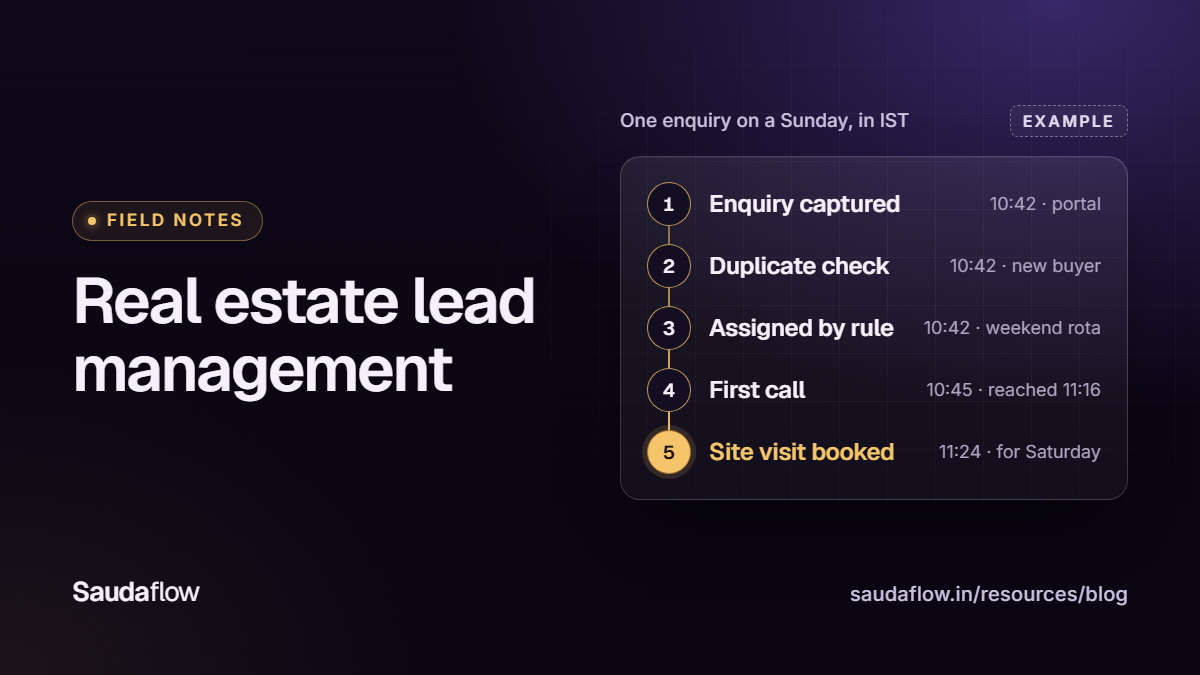
Real estate lead management is the routine that gets every property enquiry to one owner, a quick first call and a dated next step.
This one's for the builder's sales head, or the channel partner (CP) firm owner, who keeps losing enquiries between the portals, WhatsApp and some Excel sheet. We'll walk one enquiry to the site visit, then get into not-now leads, the numbers worth watching and where a spreadsheet stops coping.
What real estate lead management covers
One enquiry passes through six hand-offs, and any of them can drop it: capture, the duplicate check, assignment, the first call, follow-up and the site visit. What happens after the visit (unit holds, cost sheets, booking, payments and CP commission) is in our guide to what a real estate CRM in India must do.
Get every enquiry into one list
Enquiries come in from all over, the property portals (99acres, MagicBricks, Housing.com), Meta and Google lead forms, your website, WhatsApp, people ringing the hoarding number, walk-ins, CP registrations or uploads, and referrals. Anything that can sit only in someone's inbox, on a portal dashboard or on one person's phone will go missing one fine day.
Whichever way it comes, put down the name, the mobile with its country code, the source and campaign as they came in, the project, the IST arrival time, and what the buyer has said yes to so far, calls, WhatsApp or neither. Leave that first source alone afterwards, because it's what you'll judge your marketing on.
Ad lead forms do not keep leads for long. Google's own help page on lead form assets says Google Ads keeps leads for 60 days, and if you download them by hand you only get the last 30. A form nobody connects or exports is a lead list that quietly expires.
Walk-ins go in while they're still at the desk. For a buyer a CP brings, keep the CP's registration and its timestamp on the lead (see how CP client registration works).
Check for duplicates before anyone calls
The same buyer can return through another door: a second portal, an ad form, WhatsApp, a CP. Let each become a fresh lead and two of your people ring the same buyer, who wonders what sort of outfit this is, while your team argues over whose buyer it is.
- Normalise the number, because with +91, a leading 0 or spaces it's still one mobile, so store one form and match on it.
- Keep NRI numbers whole. A +971 number isn't an Indian number with extra digits, so don't trim it.
- If the number matches, it's a repeat enquiry on the existing lead, so tell the owner, add the new source and let nobody else call.
- Settle old leads by a written rule, so it's never a race to call first.
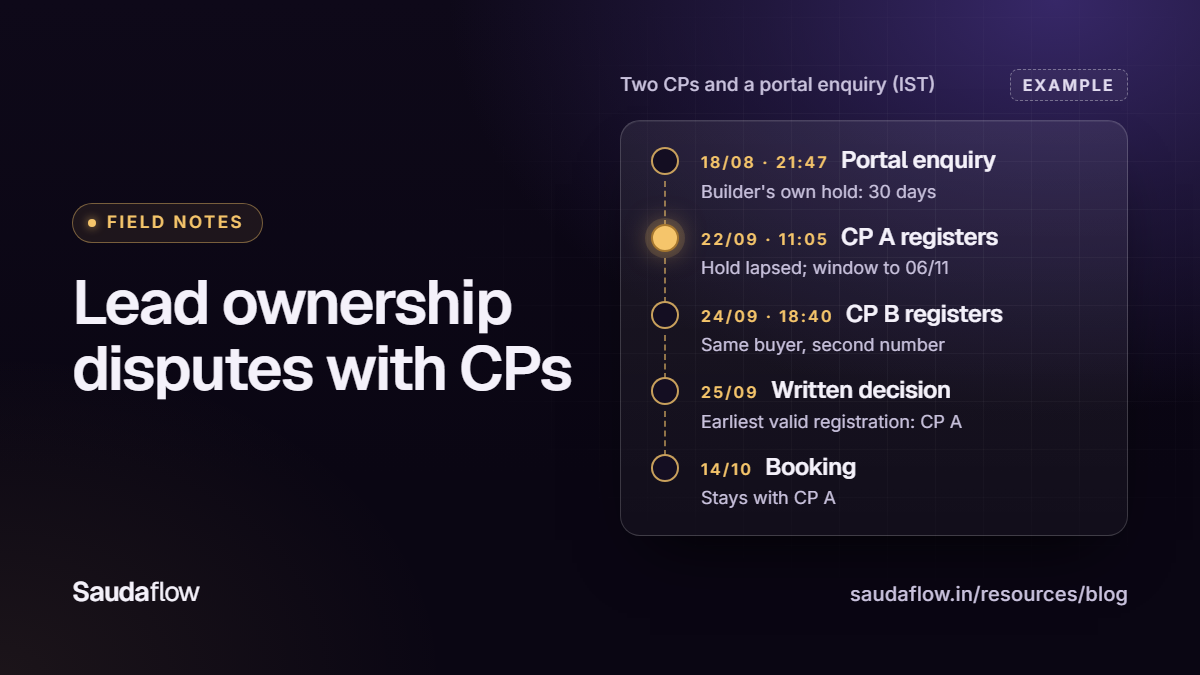
Who calls next is an assignment question. Who owns a buyer for commission is an ownership question: for CP introductions, it should rest on a timestamped registration and the attribution window agreed with your partners, never on whoever called last. Our guide to lead ownership disputes with channel partners shows how to write that rule down.
Assign by rule, not by whoever is free
Go by "Whoever sees it first" and the quickest person grabs the promising leads, while the 9:40 pm ones go to nobody. Make a rule instead. It can use any mix of round-robin through an eligible pool, project or territory, the buyer's language, load (open leads against each person's capacity) and an NRI desk that can call in the buyer's evening.
Write down which rule wins when two match, and name a fallback pool. It's worth pulling up when your enquiries actually come in, by hour and weekday, and planning leave, weekly offs and Sundays around that. When nobody's eligible, the lead doesn't vanish but sits in a queue the team can see till one named person clears it.
The first call: why speed matters
A buyer comparing flats can enquire about several projects in one sitting, on more than one portal, so their number may land with every seller behind those listings, and any of them can ring it. The first useful call asks the questions, sends the floor plan and suggests a day to visit, and later callers get compared with it. An hour later the buyer may be in a meeting or driving, and an NRI buyer may be asleep.
We won't throw a response-time study at you, because a number from another country or industry says little about your project. What counts is a target your team can hit day in, day out, for example a first attempt within 5 minutes between 9 am and 9 pm, and first thing next morning for night enquiries. Keep watching your first-response time by source, hour and person, and fix whichever gap is slowest first. And no, an automatic WhatsApp reply or SMS isn't a response, and nor is a missed call from the buyer.
The first call needn't be long. You confirm what they asked about, even if the whole enquiry was just "rate kya hai?", run through the qualifying questions below and offer two specific visit slots. Ask if WhatsApp is okay for details, note the answer, and don't put the phone down without fixing the next step, date and time included. If it just rings out, try again later the same day at some other hour.
Missed calls are enquiries too
Somebody rings the number on your hoarding or listing, nobody picks up, and that's an enquiry all the same. Every missed call from a new number goes in as a lead with its source and time, someone rings back within your target, and it counts as unanswered till a real person has spoken to the buyer. It's a callback you owe, so never count it as a response you made.
What to ask when qualifying Indian buyers
Save the answers as proper fields, because routing, follow-ups and reports can't do much with a long paragraph of notes.
- Their budget as a lakh or crore range, and ask if it's all-in (parking, GST, stamp duty, registration) or basic, because someone at "₹90 lakh to ₹1 crore all-in" and someone at "₹1 crore basic" are different buyers.
- Which configuration they're after, 2BHK or 3BHK, plot or villa, and the area they expect, plus whether that's carpet or super built-up.
- Location-wise, which micro-market and what it has to be near.
- When they need possession, ready-to-move or keys by a certain year.
- Their loan, self-funded or home loan, whether a bank has looked at eligibility, and how much of their own contribution is ready.
- Why they're buying, own use or investment, plus who else decides and whether they'll come for the visit.
- For an NRI, which country and time zone, the hours you can call, and who'll visit or act for them in India.
- Which language they're comfortable in, and whether they've said yes to calls and WhatsApp.
Follow-up cadence, with a disposition after every call
Each call ends with a disposition (just what happened) and a next action with a date on it, because a lead with no next action is one nobody really owns.
- Once the visit's booked, a reminder goes the day before and a confirmation that morning.
- Interested, no date gets a callback on the day the buyer named.
- Call me later means a callback at that hour, not "sometime tomorrow".
- No answer or switched off means another go later, say evening if you tried in the morning.
- With not interested, note why, whether budget or location, possession or the loan, bought elsewhere or just browsing, then close it or nurture it.
- A wrong number or junk lead gets closed and counted against its source.
Here's a starting cadence for a lead nobody's reached, to tweak for your own buyers. Ring at once on day 0 and again at another hour, try morning and evening on day 1, and give days 3 and 7 one go each. If there's still nothing, the lead moves to nurture with a reason.
WhatsApp has rules of its own. Under its Business Messaging Policy, you can contact people only if they've shared their mobile number and given opt-in permission to get your messages or calls, and if anyone asks you to stop, you stop. There's also a 24-hour customer service window on the WhatsApp Business Platform, which opens when the buyer messages or calls your business number on WhatsApp, and after it closes you can only send pre-approved template messages. So ask on the first call and write down what they say.
Book the site visit and make sure it happens
For a qualified buyer, the first good conversation should end with a fixed visit. Nothing is booked when they say "We will come this weekend", only when it's "Saturday, 11:00, both of us". Note the slot, who's coming (ideally every decision-maker), who will meet them and what they want to see, a sample flat, a tower or a floor.
Send the location pin and the name of whoever's meeting them, and ring the day before and again that morning to check they're coming. The visit only gets closed once the feedback's in, how keen they were, what's bothering them and what happens next. If they don't turn up, it's back into follow-up with a new date, straight away.
How to nurture the not-now leads
Some enquiries are real but early. The buyer's waiting for a bonus, to sell another flat, for a loan sanction or a family decision, or wants possession later than you offer.
- Put a reason and a dated next action on each one, like the month the bonus is due or the quarter your next tower launches.
- When you do get in touch, bring only what could change their mind, a unit in their budget, a price revision or a construction milestone, and only on channels they agreed to.
- Budgets and timelines change, so qualify the buyer again every time you talk.
- When they've bought elsewhere or told you to stop, close it with the reason, and the opt-out stays.
The numbers to watch
Four numbers show whether your lead management works. Decide once how each is defined, then count it that way every month.
| Number | What it tells you | How to count it |
|---|---|---|
| First-response time | How long a new enquiry waits for a person | The minutes from the enquiry reaching your system to the first call attempt by a person, taking the median by source, hour and person. Auto-replies don't count, and nor do missed calls from the buyer. |
| Contact rate | Whether you're actually reaching buyers | After merging duplicates, the unique new enquiries you had a real conversation with inside a set period, divided by all unique new enquiries. |
| Visit rate | Whether the conversations turn into visits | Completed site visits divided by contacted enquiries from that same period, and the gap between booked and completed visits is your no-show problem. |
| Cost per booking | What a booking from each source really costs you | What you spent on a source divided by the bookings its enquiries produced, counting only enquiries old enough to have booked. |
Judge a source by cost per booking and forget cost per lead, since a source can look cheap per lead and still bring no bookings. Bookings come weeks or months after the enquiry, so compare enquiries by the month they came in. And every number should open the leads behind it; a figure you cannot open, you cannot fix.
Spreadsheet and WhatsApp vs a lead management system
A spreadsheet and a WhatsApp group can run a small book while one person handles every lead. They break at particular moments:
| Moment | Spreadsheet and WhatsApp | Lead management system |
|---|---|---|
| Sunday, 9:40 pm, a new enquiry comes in | Nobody sees it till someone opens the portal and copies it across | It lands in the same list as everything else, with source and time, and a rule assigns it or marks it unassigned |
| The same buyer enquires on a second portal | A second row, and perhaps a second caller | The number matches the existing lead; the owner is told and the source is added |
| After the call | The outcome lives in memory or a personal chat | A disposition and a dated next action sit on the lead |
| A telecaller leaves | Their chats and call history leave with their phone | The history stays on each lead, and open leads can be reassigned |
| The manager asks how fast you call | Nobody really knows | First-response time by source and person, counted up to the first call a person actually made, and never to an auto-reply or a missed call from the buyer |
If several of these happen every week, that free spreadsheet is costing you, in enquiries nobody called back. If you do move over, merge the sheet's duplicates first, then bring each lead across with its original source and date.
One enquiry, minute by minute
How Saudaflow handles lead management
We build Saudaflow, so read this as our own description, taken from our product pages on 16/10/2026, not a verdict:
- Capture and duplicates. Our lead management page says intake checks each new enquiry's phone number for an existing contact and relevant lead, so a repeat gets reviewed instead of being counted as a new buyer, and enquiries go in by hand or by CSV import. To be straight with you, the portal and ad-source connections are built, but none is connected live today. Each one needs configuring, and a delivery you've checked, before you rely on it.
- Routing. Lead routing hands out leads round-robin, by load or by weight. Rules can go by territory, language, source, named assignee and NRI requirement. You can try an example enquiry in the preview before you trust a rule. If nobody's eligible for a lead, it can sit unassigned, with an explanation. The page makes no routing-speed promise. Ownership is separate: it rests on timestamped registration and your configured attribution window, normally 45 days.
- Calls in the field. The Android field app opens on Today, where everyone lands whatever their role, with visits due, follow-ups due and callbacks in the order the day needs. You call from a lead and then record the outcome and the next step. And when a lead calls, the app shows the lead on its own call screen with Answer/Decline, even with the app closed. With no signal, supported actions queue up with their original time, but a new lead is never created offline, because creating one decides ownership. The app is a direct-download test build that hasn't been released on Google Play.
- Site visits. Each site visit record holds the buyer, project, appointment and assigned person in one place. Every check-in is marked verified, flagged or unverified, and if there's no location data, it just stays unverified.
- First-response figure. You should know that, for now, Saudaflow's first-response figure counts a missed inbound call as a response, though a fix is built and waiting to ship.
Whatever software you look at, ours or anyone else's, take one real enquiry into the demo and watch every hand-off happen.
Frequently asked questions
What is real estate lead management?
It's how a sales team gets each property enquiry to one owner and a quick first call, with a dated next step after every call. It runs from capture and the duplicate check to a booked site visit, while not-now buyers wait on a dated nurture list.
What is the difference between a lead management system and a real estate CRM?
A lead management system handles the front of the sale, from capture and duplicates through assignment, calls and follow-ups to the site visit. A real estate CRM usually keeps going into unit holds, cost sheets, bookings, payments and channel partner commission. Some products do both in one record, so check which stages a product actually covers before you buy.
How quickly should a property enquiry be called?
Within minutes, before the buyer forgets they enquired and the other sellers get to them. Set a target the team can hit every time, for example a first attempt within 5 minutes between 9 am and 9 pm and first thing next morning for night enquiries, then watch the median by source, hour and person. An auto-reply doesn't count as a response, and nor does a missed call from the buyer.
What should I ask a property buyer on the first call?
Start with the money, their budget range in lakh or crore and whether it's all-in, then configuration, area, location, possession date and whether there's a home loan. Ask why they're buying and who else has to say yes, get NRI details if any and their language, offer two visit slots and check WhatsApp is fine.
Do I need lead management software for a small team?
Not always. While one person handles every enquiry, a shared sheet can do the job. Software earns its place once several people call off one list, enquiries come from several sources, or you must show who registered a buyer first.
Sources
- Real estate lead management
- Lead assignment and routing rules
- The Android field app
- Site visit scheduling and check-in evidence
- About lead form assets (Google Ads Help): CSV download covers the last 30 days; Google Ads stores leads for 60 days
- WhatsApp Business Messaging Policy (opt-in and opt-out)
- Service messages: the customer service window (WhatsApp Business Platform)
Comments
No sign-up and no email address. Comments appear as soon as you post them; obvious spam is held back.