
What is a channel partner in real estate? How to become one, and how CP deals and payouts work

A channel partner in real estate is an independent broker or brokerage firm that a builder signs up, or empanels, to bring buyers to its projects. The builder pays the partner a commission on each booking that partner brings. Under the RERA Act, a channel partner (CP) is a "real estate agent", so registration with the state RERA comes before the first deal.
To become one, you register with your state RERA, then get empanelled by each builder and sign its CP agreement. The steps are below, followed by how deals, disputes and payouts work, with a worked example in ₹.
What a channel partner in real estate is, and why RERA calls it an agent
In Indian primary sales (new launches and under-construction projects), CPs work alongside the builder's own sales team. A CP can work with several builders at once, takes their projects to its own buyers, and earns only when a booking goes through.
The Real Estate (Regulation and Development) Act, 2016 does not use the words "channel partner". Its definition of a real estate agent in section 2(zm) covers one anyway: it "includes a person who introduces, through any medium, prospective buyers and sellers to each other" and "includes property dealers, brokers, middlemen by whatever name called".
Being an agent under the Act brings three duties a CP cannot skip:
- Register first. Section 9(1) says no real estate agent shall facilitate the sale or purchase of a plot, apartment or building in a RERA-registered project being sold by the promoter without registration.
- Sell only registered projects. Section 10(a) bars a registered agent from facilitating sales in a project that is not registered with the authority.
- Quote your number. Section 9(5) requires the agent's registration number in every sale it facilitates.
Breaking section 9 or 10 can cost a penalty under section 62 of ₹10,000 for every day the default continues, up to 5% of the cost of the plot, apartment or building whose sale was facilitated, as the authority determines. Some states add conditions. Maharashtra requires a MahaRERA certificate of competency for registration and renewal, and Uttar Pradesh now requires its agent training and certification before you can apply. We cover fees, documents and renewal state by state in a separate post on RERA agent registration.
How to become a channel partner in real estate, step by step
You need two approvals: your state RERA's, then each builder's. In order:
- Register as a real estate agent with the RERA of each state you will sell in. In Maharashtra you first need MahaRERA's certificate of competency (a firm needs one for its authorised signatory and for its sales staff). In Uttar Pradesh you first need UP RERA's training certificate, a four-day course that ends in an exam; under UP RERA's order of 05/01/2026, agents registered before that rule have until 31/12/2026 to get it.
- Keep your papers ready: the RERA agent registration certificate, PAN, GST registration if you have one, bank details, and KYC for the partners or directors.
- Work only on RERA-registered projects. Check the project's registration number on the state RERA portal before you pitch it; section 10(a) bars you from selling an unregistered project.
- Apply for empanelment with each builder. Empanelment is the builder's sign-up process: an online CP registration form or portal, or forms from its channel sales team, with the papers above.
- Read the CP agreement before you sign, especially the five clauses listed below.
- Get your CP code or portal login, and register every client only through that channel. In Maharashtra, also ask the builder to add your firm to the project's list of agents (see below).
The builder has a RERA step here too. Section 4(2)(j) of the Act requires a promoter's project registration application to include "the names and addresses of his real estate agents, if any, for the proposed project". MahaRERA reads this strictly: its Order No. 43/2023 records that only registered agents whose names and addresses the promoter has furnished in the project application are entitled to facilitate that project's sales. In Maharashtra, empanelment is also a disclosure step.
Before you sign, find the five clauses that later arguments turn on:
- How a client must be registered (portal, email, form) and what counts as acknowledgement.
- How long a registration protects you: the attribution window.
- What counts as a site visit, and who must sign or record it.
- The commission rate, the base it is calculated on, and the payout triggers.
- What happens to commission if the booking is cancelled.
Client registration: why the timestamp decides
Client registration (CPs also call it tagging) is how a CP tells the builder, "this buyer is mine for this project." It normally records the buyer's name, mobile number, the project, the CP firm, and the date and time. The builder's acknowledgement is your receipt.
The timestamp matters because the same buyer can reach a builder by more than one route: a portal enquiry, a call from a hoarding, a second CP. When claims compete, the builder's written policy decides, and that policy usually turns on which valid registration came first. Get these details right:
- Register through the builder's official channel, not a WhatsApp message to one sales manager.
- Enter the mobile number exactly, with the country code for NRI buyers. A one-digit typo can make one buyer look like two.
- Save the acknowledgement with its date and time. If none comes, follow up the same day.
A shared system helps, because the builder and the CP see the same timestamp. Saudaflow's channel partner workflow captures each introduction "with its source and timestamp", lets you review possible duplicates and the active attribution window, and states that "a phone call by itself does not establish ownership." Its lead management intake checks the phone number for an existing contact and lead, so a repeat enquiry is reviewed rather than treated as a new buyer.
Attribution windows: how long a registration protects you
An attribution window (some builders call it the validity or ownership period) is how long a builder honours a CP's registration of a client. Inside the window, a booking by that buyer in that project goes to the CP. After it lapses, the builder's policy may treat the buyer as fresh.
There is no standard length; each builder sets its own, sometimes per project. As examples only: one builder might honour a registration for 30 days, another for 90, and another might extend it after a completed site visit. Read the clause, not the rumour.
Site-visit tagging
The site visit is where attribution gets tested. The sales desk records who came, when, and with whom. If that record names your firm, your claim is much easier to defend.
- Accompany the first visit where you can, and make sure the visit form or slip names your firm.
- Keep a copy or photo of the signed slip, or the builder's visit confirmation.
- If the buyer will visit alone, tell the builder in advance through the registered channel, not on a call.
On the builder's side, Saudaflow's site visit records distinguish verified, flagged and unverified check-ins, and the page is careful about what a visit proves: "For partner visits, retain the registration and attribution evidence. A visit or phone call alone does not replace the lead-ownership rule."
The "site-direct" dispute pattern
A site-direct dispute starts when a buyer a CP introduced is later recorded by the builder as a direct walk-in or call. At booking, the CP claims commission and the builder's team says the buyer came on their own. Sometimes the buyer asks for the CP's commission as a discount.
Nobody has to cheat for this to happen. A second record under a slightly different number, a lapsed window, a visit slip without the CP's name, or a buyer chasing a lower price is enough. Settle it by laying the evidence out in order against the written policy:
- The registration and its timestamp, with the builder's acknowledgement.
- The attribution window that applied on that date.
- The site-visit record and any confirmation messages.
- The written policy on ties and lapses.
Whoever can show the first three, dated and in line with the written policy, has the stronger claim.
How CP commission is structured
Commission terms live in the CP agreement, built from a few common blocks:
- A percentage of the agreement value. Check what the base includes: agreements treat GST, stamp duty, registration charges, parking and deposits differently.
- Slabs. The rate rises after a set number of units or value in a period. Get in writing whether the higher rate applies to every unit or only those above the threshold.
- Launch incentives. Extra payouts for bookings in a defined window.
- Milestone-linked tranches. Commission paid in parts, each tied to an event such as registration of the agreement for sale or the buyer paying a stated share of the price.
- Cancellation terms. Whether, and how, paid tranches are recovered if a booking is cancelled.
Maharashtra's model agreement for sale also has a clause on the agent's fee. Since the 2019 amendment to the Maharashtra Rules, the model agreement for sale says that where a registered real estate agent facilitated the transaction, the agreed fees or brokerage "shall be paid by the Promoter/ allottee/ both, as the case may be, in accordance with the agreed terms of payment."
Where the builder runs Saudaflow, a partner can follow this tranche by tranche through a partner login, depending on what the builder chooses to show. Saudaflow's brokerage and commission page describes brokerage that accrues when a partner's booking is made, at the rate agreed with that partner for that project, split across tranches that each have their own trigger.
When CPs get paid
A CP is paid when three things line up: the trigger in the agreement has happened, the CP has raised a correct invoice, and the builder's finance team has processed it. The CP controls the invoice, so make that step fast and complete:
- Raise the invoice the day a trigger is met, with the booking reference, agreement registration date and payment status attached.
- Track what is due by builder and by age.
- Escalate with a reference and a date, not a request for a favour.
On the builder side, Saudaflow's channel partner page describes commission moving through Accrued, Scheduled and Paid, with reversals and clawback flags kept visible rather than erased.
TDS and GST on CP commission
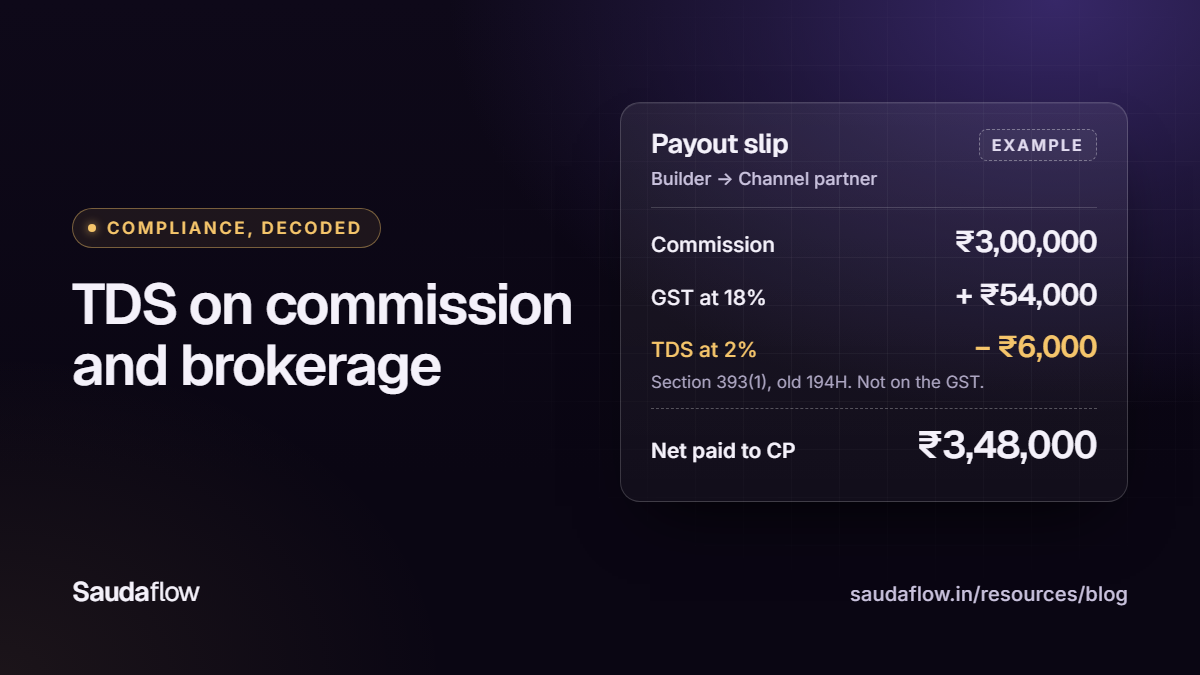
From 01/04/2026, TDS on commission or brokerage falls under section 393(1) of the Income-tax Act, 2025, serial 1(ii) of its table, the provision people still search for as section 194H. The rate is 2%, deducted by the payer (the table's "specified person") once the amount, or the total of amounts, credited or paid in a tax year exceeds ₹20,000.
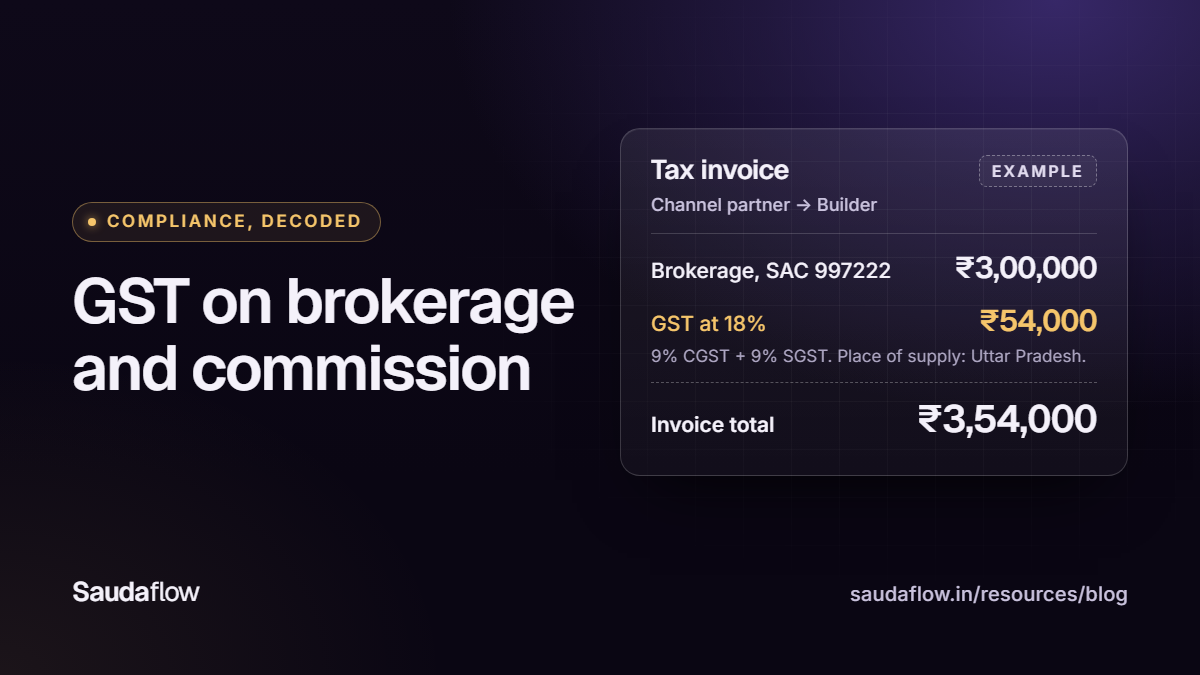
If the CP is registered under GST, its commission invoice also carries 18% GST: brokerage is a real estate service under heading 9972, and item (iii) of that entry in the CGST rate notification sets 9% CGST, matched by 9% SGST (or 18% IGST when the property is in a different state from the CP's GST registration). Our posts on TDS on commission under section 393 and GST on brokerage and its SAC code cover the rate, threshold, SAC code and invoice format in detail.
A CP deal in ₹: one worked example
Channel partner vs in-house sales vs resale broker
A real estate channel partner sits between two other ways a home gets sold. Here is how a CP differs from the builder's own sales team and from a resale broker.
| Channel partner (CP) | Builder's in-house sales team | Resale broker | |
|---|---|---|---|
| Works for | Its own firm, empanelled with one or more builders | The builder, as employees | Its own firm, for buyers and sellers of existing homes |
| Paid by | The builder, as commission under the CP agreement | The builder, as salary and incentives | Whoever engages it, as agreed |
| What it sells | Units in the builder's empanelled projects | The builder's own projects | Ready and resale homes |
| RERA angle | Registers as a real estate agent (section 9) to sell in registered projects | The builder registers the project (section 3) | Section 9 is written for sales by the promoter in registered projects; check your state's rules for resale-only work |
| Where disputes tend to start | Attribution and payout timing | Lead allocation and incentive rules | Commission sharing between brokers |
Channel partner management: how builders can work well with CPs
For a builder, channel partner management is mostly about removing doubt before it becomes a dispute:
- Publish the rules before the launch: the registration channel, the window for each project, what counts as a visit, and how ties are decided.
- Check RERA registration at empanelment and before every payout. Record the number and expiry date. In Maharashtra, also check the certificate of competency; in Uttar Pradesh, the training certificate.
- Acknowledge every registration at once, with a reference number and a timestamp the CP can see.
- Decide duplicates by the written rule, on the evidence, and tell both sides why.
- Keep your project's agent list current. Section 4(2)(j) asks for your agents' names in the project registration, and MahaRERA ties a CP's right to sell your project to that list.
- Pay on the agreed trigger and show the status. A CP who can see where a payout stands does not need to phone your accounts team.
- Agree cancellation terms up front, including what happens to tranches already paid.
If you run this in Saudaflow (the channel-partner module is on its Professional Team and Custom plans), its pricing page describes a partner record that holds onboarding, KYC, RERA registration, tier and territory, and says a lapsed RERA registration blocks that partner's payout. The channel partner page describes CP Connect, the partner portal, as being "for the broker's own introductions, visits, commission information and notices."
RERA and tax references checked on 16/10/2026 against the RERA Act, 2016, MahaRERA's orders and rules, UP RERA's agent registration manual, section 393 of the Income-tax Act, 2025 and the GST rate notifications for heading 9972. This is general information, not tax or legal advice; ask your CA or advocate for your case.
Frequently asked questions
What is a channel partner in real estate?
An independent broker or brokerage firm that a builder empanels to bring buyers to its projects, paid a commission on each booking it brings. Under the RERA Act, 2016 a channel partner is a real estate agent.
Does a channel partner need RERA registration?
Yes. Section 9 of the RERA Act, 2016 bars any real estate agent from facilitating sales in a RERA-registered project without registering with that state's authority. Some states add conditions, such as MahaRERA's certificate of competency in Maharashtra and UP RERA's training certificate in Uttar Pradesh.
How long does a CP's client registration stay valid with a builder?
For as long as the builder's CP agreement says: this is the attribution window, and it varies by builder and sometimes by project. Read the clause before you register a client and note the expiry date.
What is a site-direct dispute?
It is when a buyer a CP introduced is later recorded by the builder as a direct walk-in or call, and the CP's commission is contested. It is settled on the registration timestamp, the attribution window, the site-visit record and the builder's written policy.
How do I become a channel partner in real estate?
Register as a real estate agent with the RERA of each state where you will sell. Maharashtra first needs MahaRERA's certificate of competency and Uttar Pradesh a UP RERA training certificate. Then apply for empanelment with each builder with your RERA certificate, PAN, GST registration if any, bank details and KYC, and sign its CP agreement after checking the registration, attribution, site-visit, commission and cancellation clauses.
Is TDS deducted on CP commission?
Yes. Under section 393(1) of the Income-tax Act, 2025, the provision people still search for as section 194H, TDS on commission or brokerage is 2% once the amount or total of amounts credited or paid in a tax year exceeds ₹20,000.
Sources
- The Real Estate (Regulation and Development) Act, 2016 (No. 16 of 2016), sections 2(zm), 4(2)(j), 9, 10 and 62
- Guidelines for real estate agent training and certification (MahaRERA Order No. 41 of 2023 roadmap)
- UP RERA mandates training for real estate agents, requires certificate for registration and renewal (order dated 05/01/2026)
- Order No. 43/2023: Submission of half-yearly reports by MahaRERA registered real estate agents
- Maharashtra Real Estate (Regulation and Development) (Registration of real estate projects, Registration of real estate agents, rates of interests and disclosures on website) (Amendment) Rules, 2019
- Section 393, Income-tax Act, 2025: Tax to be deducted at source (Table, Sl. No. 1(ii), commission or brokerage)
- Notification No. 11/2017-Central Tax (Rate), updated version as amended up to 01/04/2019 (heading 9972, real estate services)
- Notification No. 8/2017-Integrated Tax (Rate), updated version as amended up to 01/04/2019 (heading 9972, real estate services)
Comments
No sign-up and no email address. Comments appear as soon as you post them; obvious spam is held back.