
TDS on commission and brokerage in 2026: section 393 (old 194H), rate, threshold and a worked example
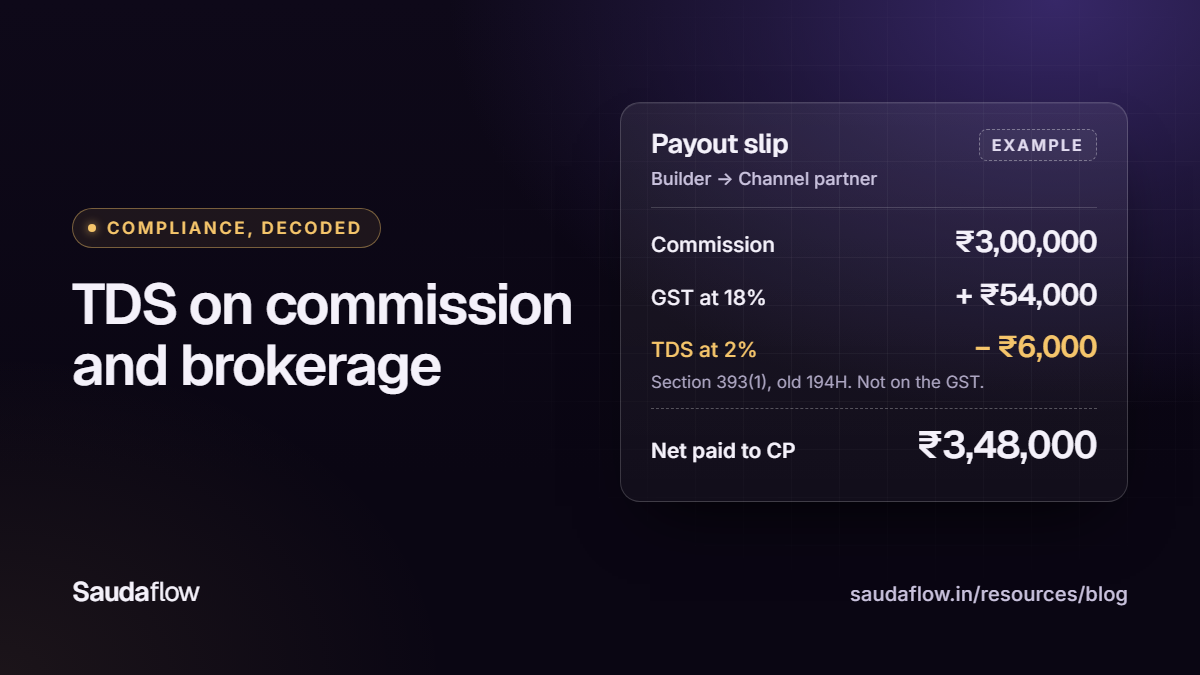
From 01/04/2026, TDS on commission and brokerage paid to a resident is deducted under section 393(1) of the Income-tax Act, 2025, the provision that took over from section 194H of the 1961 Act. The rate is 2%. The threshold is ₹20,000 in a tax year: once a channel partner's total crosses it, the payer deducts 2% on the entire amount, at credit or payment, whichever comes first.
The numbers did not change on 01/04/2026. The section number, the forms and some of the vocabulary did. If you came here searching "194H", this is the same rule at its new address.
TDS on commission in 2026, at a glance
| Question | Answer from 01/04/2026 | Where it is written |
|---|---|---|
| Which section? | Section 393(1), Table serial 1(ii): commission (other than insurance commission) or brokerage | Income-tax Act, 2025, section 393 |
| Who deducts? | A "specified person": any payer that is not an individual or HUF, plus individuals and HUFs above a turnover limit | Section 402(37) |
| Rate | 2% | Section 393(1) |
| Threshold | ₹20,000 in the tax year; once crossed, TDS on the entire amount | Section 393(1)(a) |
| When | On credit or payment, whichever is earlier | Section 393(1)(c) |
| No PAN | 20% | Section 397(2) |
| Deposit | Within seven days from the end of the month; by 30 April for March | Rule 218, Income-tax Rules, 2026 |
| Quarterly statement | Form 140 | Rule 219 |
| Certificate to the CP | Form 131, within 15 days of the statement's due date | Rule 215 |
Why 194H became section 393(1)
The Income-tax Act, 2025 came into force on 01/04/2026 (section 1(3)) and replaced the Income-tax Act, 1961. The old Act gave each kind of TDS its own numbered section. The new Act puts most TDS on non-salary payments to residents into a single table inside section 393(1).
Commission and brokerage sit at serial 1 of that table. Serial 1(i) is insurance commission, which follows its own rate and is not covered here. Serial 1(ii) is everything else: "any income by way of commission … or brokerage". That is the line a builder uses when it pays a CP.
Two pieces of new vocabulary help:
- Tax year. Section 3 defines the tax year as the twelve months of the financial year starting 1 April. In practice, it is the same April-to-March year your accounts already use.
- Commission or brokerage. Section 402(7) defines it to include any payment received or receivable, directly or indirectly, by a person acting on behalf of another person: for services (not professional services), for services in buying or selling goods, or "in relation to any transaction relating to any asset, valuable article or thing, not being securities". A CP's fee for bringing a buyer to a flat fits that last limb.
This post covers CPs resident in India. Payments to a non-resident fall under section 393(2), a different table with different rules.
Who must deduct TDS on brokerage
The payer named in serial 1(ii) is a "specified person". Section 402(37) defines that as:
- any person that is not an individual or a Hindu undivided family (HUF), which covers every builder or developer company, LLP and partnership firm; and
- an individual or HUF whose total sales, gross receipts or turnover exceeded ₹1 crore from business, or ₹50 lakh from a profession, in the tax year before the one in which the commission is credited or paid.
An individual or HUF below those limits is not entirely outside the net. Serial 6(ii) of the same table asks them to deduct 2% on commission, brokerage, contract work and professional fees, but only once such payments cross ₹50 lakh in the tax year. Instead of a quarterly Form 140, they pay and report that tax through a challan-cum-statement in Form 141, within 30 days from the end of the month of deduction (rule 219(5)).
The rule runs down the chain. A CP firm that pays sub-brokers or freelance agents is itself paying commission, and the same tests apply to it.
Commission TDS rate and the ₹20,000 limit
The commission TDS rate is 2%. The ₹20,000 threshold is not per invoice and not per project. It is the total credited or paid to that payee during the tax year.
Below ₹20,000 for the year, there is no TDS. Once the total crosses ₹20,000, section 393(1)(a) applies TDS "on the entire amount", including the earlier, smaller payouts.
If a CP gives you a certificate for lower or nil deduction issued under section 395(1), the successor to section 197, deduct at the rate the certificate states. The CP applies for it on Form 128, which replaced Form 13.
When to deduct: credit or payment, whichever comes first
TDS is due at the earlier of two moments: when the commission is credited to the CP's account in your books, or when it is paid (section 393(1)(c)).
- Booked first, paid later. The usual case. The CP raises an invoice, accounts books it to the CP's ledger, and the transfer follows weeks later. TDS is due on the booking date.
- Paid first. An advance against expected brokerage, before any invoice. TDS is due on the advance.
- Year-end entries. Section 393(11) treats a credit to a "suspense account", or to an account by any other name, as a credit to the payee. A March entry to a "commission payable" account can trigger TDS.
TDS is on the commission, not on the GST
A CP registered for GST adds 18% GST to its brokerage invoice. TDS is calculated on the commission alone, not on commission plus GST, provided the GST is shown separately.
The authority is CBDT Circular No. 23/2017 of 19/07/2017. Where the agreement or contract between payer and payee indicates the "GST on services" component separately, tax is deducted on the amount paid or payable "without including such 'GST on services' component". The circular counts IGST, CGST, SGST and UTGST as GST.
The circular was issued under the 1961 Act. Section 536(2)(j) of the 2025 Act keeps circulars issued under the old Act in force, as if issued under the corresponding new provisions, so far as they are not inconsistent with the new Act. We found no CBDT document withdrawing or restating Circular 23/2017 as of 16/10/2026.
The condition matters. If the CP agreement says "₹3,54,000 inclusive of all taxes" and the invoice does not split out GST, the safe reading is that TDS applies to the whole ₹3,54,000. Ask CPs for invoices that show the taxable value and the GST on separate lines.
No PAN: 20%
If the CP does not furnish a PAN, section 397(2) applies: tax is deducted at the highest of the rate in the Act, the rates in force, and 20%. For commission, that means 20% instead of 2%. On a ₹3,00,000 commission, that is ₹60,000 instead of ₹6,000, which is why collecting the PAN belongs in CP onboarding, not in payout week.
Worked example: ₹3,00,000 commission on a ₹1 crore flat
Deposit, Form 140 and Form 131
Three deadlines follow every deduction.
- Deposit. Within seven days from the end of the month in which you deducted (rule 218). Tax deducted on amounts credited or paid in March is due by 30 April.
- Quarterly statement. Form 140, the successor to Form 26Q, reports TDS on payments other than salary to residents (rule 219).
- Certificate. Form 131, the successor to Form 16A, goes to the CP within 15 days from the due date of the quarterly statement (rule 215).
| Quarter | Form 140 due | Form 131 due |
|---|---|---|
| April to June | 31 July | 15 August |
| July to September | 31 October | 15 November |
| October to December | 31 January | 15 February |
| January to March | 31 May | 15 June |
What changed on 01/04/2026, and what did not
The rate and the threshold were settled before the new Act arrived. The 2% rate applies from 01/10/2024, when the Finance (No. 2) Act, 2024 cut it from 5%. The ₹20,000 threshold applies from 01/04/2025, when the Finance Act, 2025 raised it from ₹15,000. The 2025 Act carried both over unchanged.
| Item | FY 2025-26 (Income-tax Act, 1961) | From 01/04/2026 (Income-tax Act, 2025) |
|---|---|---|
| Section | 194H | 393(1), Table serial 1(ii) |
| Rate | 2% | 2% |
| Threshold | ₹20,000 in the financial year | ₹20,000 in the tax year |
| Individual or HUF payers covered | Above ₹1 crore (business) or ₹50 lakh (profession) in the preceding financial year | Above ₹1 crore (business) or ₹50 lakh (profession) in the preceding tax year |
| No PAN | 20% (section 206AA) | 20% (section 397(2)) |
| Quarterly statement | Form 26Q | Form 140 |
| Certificate to the payee | Form 16A | Form 131 |
| Lower or nil deduction certificate | Section 197, Form 13 | Section 395(1), Form 128 |
| Interest: late deduction / late deposit | 1% / 1.5% a month (section 201(1A)) | 1% / 1.5% a month (section 398(3)) |
| Expense disallowed if TDS is not deducted or deposited | 30% (section 40(a)(ia)) | 30% (section 35(b)(i)) |
Commission credited or paid up to 31/03/2026 was governed by section 194H. For the handover quarter, check with your CA how your TDS software split old-Act and new-Act entries.
Common mistakes in builder–CP payouts
- Deducting on the GST. 2% of ₹3,54,000 instead of 2% of ₹3,00,000. The CP receives ₹1,080 less in cash and gets it back only as a tax credit, and someone has to reconcile it later.
- Waiting for the payment date. If the invoice was booked in November and paid in January, TDS was due in November.
- Treating each tranche as its own threshold. Milestone payouts, on booking, agreement or registration, add up across the tax year. The ₹20,000 test is on the total.
- Paying advances without TDS. An advance against expected brokerage is a payment, and TDS applies to it.
- Collecting the PAN at payout time. Without it the rate is 20%. Withholding ₹60,000 instead of ₹6,000 from a ₹3,00,000 payout is a relationship problem, not just a tax one.
- Old sections and forms after 01/04/2026. New-Act deductions go into Form 140 under section 393, not Form 26Q under 194H. The CP reconciles against what you file.
- Forgetting Form 131. The CP needs the certificate to match the TDS against its own records.
- Ignoring non-cash incentives. A trip, gold coin or gadget given to a top-performing CP is a business benefit. Section 393(1), Table serial 8(iv) (old section 194R) requires a specified person to account for TDS at 10% of its value once the year's total for that CP crosses ₹20,000.
What it costs to get it wrong
- Interest. Section 398 charges 1% for every month or part of a month from the date TDS should have been deducted to the date it is deducted, and 1.5% for every month or part of a month from deduction to deposit. On ₹6,000 deducted but not deposited, that is ₹90 for each month or part-month.
- Assessee in default. The payer is deemed an assessee in default for the tax it failed to deduct or deposit.
- Expense disallowed. Under section 35(b)(i), if TDS is not deducted, or is deducted but not paid by the due date for filing the return, 30% of the commission is not allowed as an expense that year. On ₹3,00,000, that is ₹90,000 added back. It is allowed in the tax year in which the TDS is finally paid.
- Late statement fee. Section 427 charges ₹200 for every day Form 140 is late, capped at the amount of TDS.
- Penalty. Section 461 allows a penalty of ₹10,000 to ₹1,00,000 for not filing the statement in time or for filing incorrect details. There is no penalty for late filing if the TDS, fee and interest are paid and the statement is filed within one month of the due date.
Keeping the payout trail in one place
These mistakes are easier to make when a commission number lives in three places: the CP agreement, a spreadsheet and the accounts ledger. Saudaflow is a CRM for Indian builders and channel partners, so here is what our own pages say it does about that.
On the builder side, the CRM for builders and developers describes brokerage accruing on booking at the rate agreed with each partner. The channel partner module shows each commission as Accrued, Scheduled or Paid, and says plainly that TDS and GST tracking needs the correct partner, project and tax settings, reviewed with your finance team. That module and the commission ledger are on the Professional Team and Custom plans; see pricing.
On the CP side, a partner sees these figures only where the builder runs Saudaflow and gives them a partner login: the brokerage and commission tracking page describes each tranche with its GST, its TDS and the net worked out before anything is paid. Saudaflow does not raise the invoice or track TDS certificates. The CRM for channel partners page covers the same flow from the broker's desk.
None of that replaces your CA. It means the numbers your CA checks come from one record.
Checked against the Income-tax Act, 2025 (sections 1, 3, 35, 393, 395, 397, 398, 402, 427, 461 and 536), the Income-tax Rules, 2026 (rules 215, 218 and 219), Forms 128, 131 and 140, CBDT Circular No. 23/2017, and sections 40, 194H, 194R and 206AA of the Income-tax Act, 1961 with their amendment notes, on incometaxindia.gov.in on 16/10/2026. General information, not tax advice; ask your CA for your case.
Frequently asked questions
What is the TDS rate on commission in 2026?
2%. From 01/04/2026 it is deducted under section 393(1) of the Income-tax Act, 2025 (Table serial 1(ii)), once the payee's commission for the tax year crosses ₹20,000. Without a PAN the rate is 20%.
Is section 194H still applicable?
Not to commission credited or paid from 01/04/2026. The Income-tax Act, 2025 replaced the 1961 Act on that date, and TDS on commission and brokerage moved to section 393(1). The 2% rate and ₹20,000 threshold stayed the same.
What is the TDS on commission limit?
₹20,000 in a tax year, counted across all credits and payments to that payee. Once the total crosses ₹20,000, TDS applies to the entire amount, including the earlier payouts.
Is TDS deducted on the GST part of a brokerage invoice?
No, if the agreement or contract shows the GST separately. CBDT Circular No. 23/2017 says TDS is deducted on the amount without the GST component, and section 536(2)(j) of the 2025 Act keeps old-Act circulars in force where they are consistent with it.
When must a builder deposit TDS deducted from a CP's commission?
Within seven days from the end of the month of deduction, and by 30 April for March (rule 218 of the Income-tax Rules, 2026). The quarterly statement is Form 140 and the CP's certificate is Form 131.
Does a proprietor CP have to deduct TDS when paying sub-brokers?
Yes, under serial 1(ii), if the CP's turnover exceeded ₹1 crore from business (or ₹50 lakh from a profession) in the previous tax year. Below that, serial 6(ii) applies only once such payments cross ₹50 lakh in the tax year.
Sources
- Section 393, Income-tax Act, 2025: Tax to be deducted at source
- Section 402, Income-tax Act, 2025: Interpretation (clauses 7 and 37)
- Section 1, Income-tax Act, 2025: Short title, extent and commencement
- Section 3, Income-tax Act, 2025: Definition of tax year
- FAQs on higher rate of TDS under section 397(2)
- Section 398, Income-tax Act, 2025: Consequences of failure to deduct or pay
- Section 427, Income-tax Act, 2025: Fee for default in furnishing statements
- Section 461, Income-tax Act, 2025: Penalty for failure to furnish statements, etc.
- Section 35, Income-tax Act, 2025: Amounts not deductible in certain circumstances
- Section 536, Income-tax Act, 2025: Repeal and savings
- Rule 218, Income-tax Rules, 2026: Time and mode of payment of tax deducted at source
- Rule 219, Income-tax Rules, 2026: Statement of deduction of tax at source
- Rule 215, Income-tax Rules, 2026: Certificate of tax deducted at source
- Form No. 140: Quarterly statement of TDS on payments other than salary to residents
- Forms No. 130 to 133 (earlier Forms 16, 16A, 16B to 16E and 27D)
- Form No. 128: Application for lower or nil deduction certificate under section 395(1)
- CBDT Circular No. 23/2017 dated 19/07/2017: TDS on GST component
- Section 194H, Income-tax Act, 1961, with amendment notes (rate and threshold)
- Section 194R, Income-tax Act, 1961: Deduction of tax on benefit or perquisite in respect of business or profession
- Memorandum explaining the provisions in the Finance (No. 2) Bill, 2024: rationalisation of TDS rates
- The Finance (No. 2) Act, 2024 (No. 15 of 2024), Gazette of India
- Section 1, Finance Act, 2025 (Act No. 7 of 2025)
- Higher deduction of tax at source in certain cases: section 206AA, Income-tax Act, 1961
- Section 40, Income-tax Act, 1961: Amounts not deductible
- Interest for delay in payment of TDS/TCS (section 201(1A), Income-tax Act, 1961)
Checked against the primary sources listed above on . This is general information, not tax/legal advice; ask your CA/advocate for your case.
Comments
No sign-up and no email address. Comments appear as soon as you post them; obvious spam is held back.