
PLC in real estate and floor rise charges: the flat cost sheet line by line
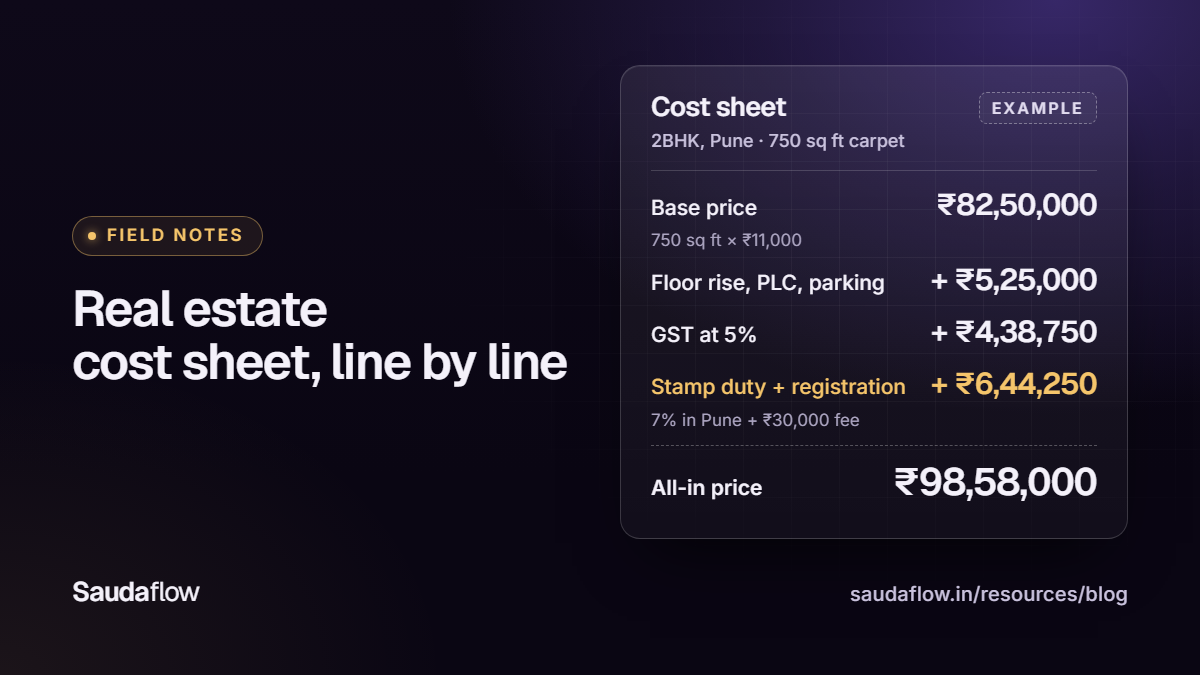
On the Pune example below, a ₹11,000 per sq ft headline rate becomes ₹13,144 per sq ft of carpet once floor rise, PLC, parking, GST, stamp duty and registration are added. Here is each line, and which ones the law fixes.
What is PLC in real estate?
In a builder's rate card, PLC, or preferential location charges, is the premium for position: a better-placed unit costs more than an identical one elsewhere in the same tower. It is a commercial price, so it can be negotiated, and your unit's PLC belongs in the agreement for sale.
Builders charge it for a park, garden or pool view, a corner unit or a short walk to the clubhouse, either per square foot or as one lump sum. A flat with two or three of these can carry a premium for each, as builder Casagrand's PLC explainer sets out. On a per-square-foot PLC, ask which area it is multiplied by, for the same reason as the base rate below.
How floor rise charges are calculated
Floor rise charges are a premium for height that steps up with the floor, from the same rate card. Ask for your floor's slab and check the arithmetic: ₹100 per sq ft on 750 sq ft of carpet is ₹75,000, the figure used in the worked example below.
Can the PLC change after you book?
Once the agreement for sale states your unit's PLC, it is part of the price you agreed (see the escalation red flag below). The location you pay for is protected only as far as the sanctioned plans go.
That protection comes from section 14(2) of the RERA Act. Once the sanctioned plans, layout plans and specifications have been disclosed to you, the builder can't alter them for your apartment without your previous consent, leaving aside the minor changes the Act allows, and any other change to the buildings or common areas needs the written consent of at least two-thirds of the allottees. It only covers the project's own plans and not land outside it, so if you're paying a premium for a park or open space, ask to see it on the sanctioned layout plan first.
Car parking: garage, covered slot or open parking
Under the RERA Act, open parking areas are common areas (section 2(n)(iii)), which the builder conveys to the association of allottees (section 17). A garage, a place "having a roof and walls on three sides", is defined separately (section 2(y)), and the builder declares the garages for sale when it registers the project (section 4(2)(i)). Maharashtra's RERA Rules, 2017 also define a covered parking space in a basement, stilt, podium or mechanised system (rule 2(1)(j)). A priced, numbered garage or covered slot is normal. A charge for open parking deserves a question.
What a real estate cost sheet shows
A cost sheet for an under-construction flat has three blocks:
- The price of the flat: base price, preferential location charges (PLC), floor rise and parking, all set by the builder.
- The builder's other charges: club or amenity charges, maintenance deposits, legal or documentation charges.
- Government levies: GST, stamp duty and the registration fee, set by law.
TDS belongs on your list too, although it is not an extra cost: on a flat of ₹50 lakh or more, you deduct 1% from your payments to the builder and pay it to the government. Ask for a dated sheet for the exact unit, with the payment schedule attached. A sheet for "a 2BHK" in general cannot be checked.
Base price: the rate on RERA carpet area
The base price is a rate per square foot multiplied by the flat's area. What matters is which area.
The one to ask about is RERA carpet area. Section 2(k) of the RERA Act, 2016 defines it as "the net usable floor area of an apartment", which leaves out the external walls, the service shafts and the exclusive balcony, verandah and open terrace, but counts the internal partition walls in. The builder also has to disclose the carpet area of every apartment for sale when it registers the project, under section 4(2)(h).
The agreement for sale must follow the form your state's rules prescribe (section 13(2)). Haryana's model agreement for sale, for example, states the Total Price "based on the carpet area", with a rate per square foot. If the carpet area changes on completion, the price is recalculated at that rate: a smaller flat gets a refund with interest, and an increase of up to 5% can be charged (clause 1.7). Check the matching clause in your own state's form before relying on these figures.
If a sheet quotes a rate on "super built-up" or "saleable" area, ask for the RERA carpet area and the rate per square foot of carpet, and compare projects on that.
Club, maintenance, legal and other charges
This is the part of the sheet where builders differ the most. The Finance Ministry's 2019 GST FAQ on real estate lists amenity, society formation, advance maintenance and legal charges among the ones builders generally recover from buyers. Take them one at a time, find out what each one pays for and whether you get the money back later, and check that it's in the agreement for sale.
- Club or amenity charges can be a membership, a deposit or simply part of the price, so ask which it is, and how GST is charged on it.
- Maintenance deposit and advance maintenance are worth asking about. Until the association of allottees takes over, the builder has to provide and maintain the essential services "on reasonable charges" (RERA Act, section 11(4)(d)), so ask how many months they're collecting in advance and at what rate, and who will hold any deposit once the society is formed.
- Development, electricity, water and similar charges may already be inside the price, so check that first. Haryana's model agreement, for instance, puts development charges, electric wiring and connectivity, lifts, water lines, common-area fire-fighting equipment and maintenance charges into its Total Price (Explanation (iv) to clause 1.2).
GST on a flat: 5%, 1% or nothing
GST comes in when you buy from the builder before completion. For a residential project that began on or after 01/04/2019, you're looking at Notification No. 11/2017-Central Tax (Rate) as amended from that date, which sets two rates, neither with input tax credit.
- 5% on a flat that isn't "affordable". That's 3.75% CGST plus 3.75% SGST, worked out on just two-thirds of the amount charged, because paragraph 2 of the notification deems the other one-third to be the value of the land.
- 1% on an "affordable residential apartment", which is 0.75% CGST plus 0.75% SGST on the same two-thirds.
For the 1% rate, the flat's carpet area has to be at most 60 square metres in a metropolitan city or 90 square metres anywhere else, and the gross amount charged can't be more than ₹45 lakh. Metropolitan here means Bengaluru, Chennai, Delhi NCR (limited to Delhi, Noida, Greater Noida, Ghaziabad, Gurgaon and Faridabad), Hyderabad, Kolkata and Mumbai's whole MMR. The FAQ above says that gross amount includes PLC, development, parking and common facility charges, but not stamp duty or maintenance charges and deposits. If the project was already under way on 31/03/2019, it could opt for the older 12% and 8% rates with input tax credit, so ask which one applies.
If the entire consideration is paid after the completion certificate or first occupation, whichever is earlier, there's no GST at all. That's because the CGST Act, 2017 treats construction as a service except in that case (Schedule II, paragraph 5(b)), and treats the sale of a building as neither goods nor services (Schedule III, paragraph 5). As for rate changes, the 56th GST Council meeting on 03/09/2025 changed the rates for three kinds of works contract but left residential apartments alone, and the 57th, on 08/10/2026, didn't change them either.
Stamp duty and registration charges
Stamp duty and the registration fee are state levies, and the buyer pays them when the agreement for sale or the sale deed is registered, depending on the state. Rates, surcharges and concessions differ by state, and sometimes by city, so take these two states as examples, checked on 16/10/2026.
- Maharashtra, stamp duty: 5% of market value in a municipal corporation area (Article 25(b)(i) of the Maharashtra Stamp Act), and an agreement to buy a flat from a developer bears the same duty as a conveyance (Article 5(g-a)(ii)), per IGR Maharashtra's schedule of 22/07/2026. Market value is the higher of the open-market value and the consideration in the document (section 2(na)), so a discount below the ready reckoner value does not cut the duty.
- Maharashtra, surcharges: on top of the 5% there's 1% under section 149A of the Maharashtra Municipal Corporations Act, plus 1% under section 149B in a city where a vital urban transport project is carried out (Maharashtra Government Gazette, 27/10/2020). Pune counts, because the state declared the Pune Metro such a project on 10/05/2018 (notification), and that's how a Pune flat gets to 7%. Still, confirm the total for your own document before you rely on it.
- Maharashtra, women buyers: under Article 25(b), a woman buying a residential unit pays 1 percentage point less, on the conditions of the government order of 31/03/2021 that the IGR schedule cites.
- Maharashtra, registration fee: ₹100 plus ₹10 for every ₹1,000 above ₹10,000, capped at ₹30,000 (table of fees). The cap applies from ₹30 lakh.
- Karnataka, registration fee: raised from 1% to 2% of the value from 31/08/2025 (notification of 29/08/2025). That's why a sheet template somebody made last year can be wrong today. For Karnataka's stamp duty, check with the department before you quote.
TDS when the price is ₹50 lakh or more
From 01/04/2026, the buyer's TDS on a property purchase falls under section 393(1) of the Income-tax Act, 2025, Table serial 3(i) (old section 194-IA). The Income Tax Department's section map confirms the move.
- Rate: 1% of the consideration or the stamp duty value, whichever is higher, when either is ₹50 lakh or more; agricultural land is excluded. With joint buyers or more than one seller, what all the buyers pay all the sellers is added together for the threshold (Note 1 to the table).
- Base: section 402(9) counts club membership, car parking, electricity or water facility, maintenance and advance fees as part of the consideration.
- Process: deduct at payment, or at credit if that comes first (section 393(1)(c)), and pay with Form 141, which replaced Form 26QB, within 30 days from the end of that month. No TAN is needed, and you download a Form 132 certificate from TRACES for the builder (Form 141 FAQs).
TDS does not add to the all-in price. Part of what you owe the builder goes to the government instead, credited against the builder's PAN.
Worked example: a Pune flat, line by line
Which lines are negotiable, and which are fixed by law
| Line | Set by | Negotiable? | Check |
|---|---|---|---|
| Base rate | Builder | Yes | Rate per sq ft of carpet; any discount written into the agreement |
| PLC | Builder | Yes | The unit's actual position; GST at the flat's rate |
| Floor rise | Builder | Yes | The slab for your floor |
| Garage or covered parking | Builder | Yes | A numbered slot, not open parking |
| Club, maintenance, legal | Builder | Ask, line by line | What each covers; refundable or not |
| GST | Central notification | No | 5%, 1% or nil, by the project's status |
| Stamp duty and surcharges | State law | No | On market value; concessions only as notified |
| Registration fee | State fee table | No | ₹30,000 cap in Maharashtra; 2% in Karnataka |
| TDS | Income-tax Act, 2025 | No | 1% at ₹50 lakh or more; not an extra cost |
Every rupee off the agreement value also comes off the GST, and off the stamp duty while the price stays above the ready reckoner value.
Red flags in a cost sheet
- A rate on super built-up or "saleable" area, with no carpet area.
- Charges missing from the agreement for sale. A line that appears only on the sheet, or first appears in a demand letter, is the one to question.
- "All-inclusive" without stamp duty and registration. Ask exactly which lines the word covers.
- A charge for open parking, which is a common area under section 2(n) of the RERA Act.
- An escalation clause. Haryana's model agreement keeps the Total Price escalation-free except for higher development charges and other levies imposed by the competent authority (clause 1.3).
- More than 10% before a registered agreement. A builder can't take more than 10% of the cost as an advance or application fee before the agreement for sale is signed and registered, because section 13(1) of the RERA Act bars it, so question any plan asking for more up front.
- No date, no unit number, no name. Nobody can be held to a sheet like that.
For CPs and sales teams: a sheet you can stand behind
A wrong sheet comes back to bite you twice, once when the buyer sees a different number at booking and again when somebody has to sit down and decide who absorbs the difference. So quote the exact unit from the current rate card and date the sheet. Show the state, the city and the rate behind every statutory line, and keep every version you send. If you're a channel partner selling a builder's flats, get the builder's current rate card before you quote anything.
If your team uses Saudaflow, its cost sheets are worked out from each unit's own rate and premiums in inventory management. By default it prices on the unit's super built-up area if your team records one, else the built-up area, else carpet, and yes, that's the first red flag above, so check which area each sheet used. To quote on RERA carpet area, as this guide recommends, open the project's Setup tab and set "Price is computed on" to RERA carpet area. A unit with no RERA carpet figure then gets no price until someone enters one.
GST is picked up from each project's template, so the sheet never decides that rate for you. Stamp duty and registration come from that template too, and each sheet is compared with your workspace's rule for its state, so both need updating when rates change. Check on every sheet that both are worked out on the flat's price only, not on maintenance, corpus or deposit lines.
Each sheet gets saved with who made it, when, and its exact figures, and nobody can share it until a second person has approved it. If you'd like to see one built on demo data, book a demo. For CP firms that sell for several builders, each builder's project keeps its own unit prices and cost-sheet template in Saudaflow. If any term here is new to you, the Saudaflow glossary explains carpet area, PLC and floor rise in plain language.
This guide was checked on 16/10/2026 and 22/10/2026 against the Acts, rules, circulars, orders and other sources linked above. It's general information and not tax or legal advice, so take your own case to your CA or advocate.
Frequently asked questions
What is PLC in real estate?
PLC is short for preferential location charges, the premium a builder adds for a better-placed unit, say park-facing, on a corner or with a better view. It comes from the builder's rate card, per square foot or as a lump sum, so it can be negotiated, and you should check that it's written into the agreement for sale. When it's charged with an under-construction flat, it takes the flat's GST rate under a CBIC circular of 11/10/2024.
How are floor rise charges calculated?
The builder's rate card has a floor rise premium that steps up with the floor, and you multiply it by the area, so at, say, ₹100 per sq ft on 750 sq ft of carpet area, it comes to ₹75,000. Ask which slab your floor falls in, and check that the agreement for sale shows the same figure.
What is the GST on an under-construction flat?
It is 5% without input tax credit, or 1% for an affordable residential apartment, meaning a carpet area of up to 60 square metres in the notified metropolitan cities or 90 square metres elsewhere, and a gross amount of ₹45 lakh or less. If the entire consideration is paid after the completion certificate or first occupation, whichever is earlier, there is no GST at all.
Is stamp duty charged on the agreement value or the ready reckoner value?
In Maharashtra it's whichever is higher, the agreement value or the ready reckoner value. The Maharashtra Stamp Act charges duty on market value, which is the higher of the open-market value and the consideration stated in the document, so a discount below the ready reckoner value won't reduce the duty. Other states have their own rates, surcharges and concessions, so whichever state the flat is in, check with its registration department.
Who deducts TDS when buying a flat worth ₹50 lakh or more?
The buyer does. Under section 393(1) of the Income-tax Act, 2025, Table serial 3(i), the old section 194-IA, you deduct 1% of the consideration or the stamp duty value, whichever is higher, and pay it with Form 141 within 30 days from the end of the month. No TAN is needed, and it isn't an extra cost, since it comes out of what you owe the builder.
What should an all inclusive price for a flat include?
Every line you will pay to own the flat, so the base price, PLC, floor rise, parking, the builder's other charges, GST, stamp duty and registration. When a quote says all-inclusive, ask whether that covers stamp duty, registration and maintenance deposits, and compare quotes only on the same set of lines.
Sources
- The Real Estate (Regulation and Development) Act, 2016 (No. 16 of 2016), sections 2(k), 2(n), 2(y), 4(2)(h), 4(2)(i), 11(4)(d), 13 and 17
- Haryana Real Estate (Regulation and Development) Rules, 2017, Annexure A: agreement for sale (clauses 1.2, 1.3 and 1.7)
- Maharashtra Real Estate (Regulation and Development) (Registration of real estate projects, Registration of real estate agents, rates of interest and disclosures on website) Rules, 2017, rule 2(1)(j)
- Notification No. 11/2017-Central Tax (Rate), updated version as amended up to 01/04/2019 (heading 9954, items (i) and (ia); paragraphs 2 and 4(xvi))
- FAQs (Part II) on real estate, F. No. 354/32/2019-TRU dated 14/05/2019
- The Central Goods and Services Tax Act, 2017: Schedule II paragraph 5(b) and Schedule III paragraph 5
- M/s DLF Limited: Haryana Appellate Authority for Advance Ruling, Order No. HAAAR/2020-21/07 dated 28/03/2022 (rulings on questions 1 and 2: PLC at 18%, SAC 997222; quashed by the Punjab and Haryana High Court on 13/05/2026)
- Recommendations of the 56th Meeting of the GST Council (press release, 03/09/2025)
- Maharashtra Stamp Act, article-wise schedule dated 22/07/2026 (Articles 5(g-a)(ii) and 25(b), with the note on the 1% concession for women)
- Maharashtra Stamp Act, section-wise text dated 13/07/2026 (section 2(na), market value)
- Mumbai Municipal Corporation, Maharashtra Municipal Corporations and Maharashtra Municipal Councils (Amendment) Ordinance, 2020 (Mah. Ord. XVI of 2020), Maharashtra Government Gazette 27/10/2020: statement on the 1% surcharges under sections 149A and 149B
- Notification No. PMR-3318/CR 25(2)/UD-7 dated 10/05/2018: Pune Metro declared a project for section 149B of the Maharashtra Municipal Corporations Act
- Table of fees under the Registration Act, 1908, Maharashtra (Article I(4)(a))
- Notification No. RD/46/MNMU/2025 dated 29/08/2025: registration fee substituted from 31/08/2025
- Section 393, Income-tax Act, 2025: Tax to be deducted at source (Table, Sl. No. 3(i), transfer of immovable property; Notes 1 and 3)
- Section 402, Income-tax Act, 2025: Interpretation (clause 9, consideration for transfer of immovable property)
- Section mapping, Income-tax Act, 1961 to the new Income-tax law (194-IA to 393(1), Table S.No. 3(i))
- FAQs on Form No. 141 (challan-cum-statement replacing Forms 26QB, 26QC, 26QD and 26QE)
- Cost sheet software for Indian real estate
- Circular No. 234/28/2024-GST dated 11/10/2024: clarifications regarding applicability of GST on certain services (paragraph 8, preferential location charges)
- DLF Limited v. The Commissioner of Central Goods and Service Tax and others, CWP No. 17530 of 2022, decided 13/05/2026 (orders of 28/08/2020 and 28/03/2022 quashed)
- Recommendations of the 57th Meeting of the GST Council (press release, 08/10/2026)
- The Real Estate (Regulation and Development) Act, 2016: section 14(2), alterations to sanctioned plans, layout plans and specifications
- PLC in Real Estate: How They Impact Property Cost (builder's explainer, 20/05/2026: PLC factors; per sq ft, lump sum or combined)

Comments
No sign-up and no email address. Comments appear as soon as you post them; obvious spam is held back.