
GST on brokerage and commission: the 18% rate, the commission SAC code, the invoice and who pays
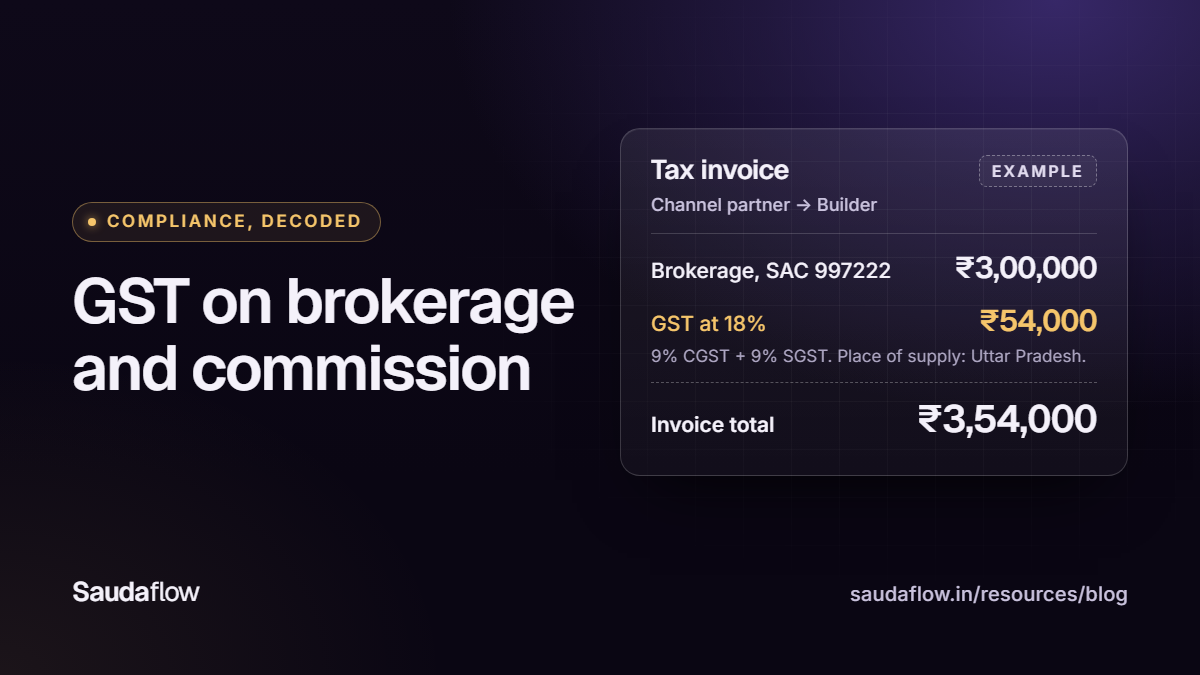
GST on real-estate brokerage is 18%: 9% CGST plus 9% SGST when the channel partner and the property are in the same state, or 18% IGST when they are not. The commission SAC code for brokerage on flats, houses and other buildings is 997222, "building sales on a fee/commission basis or contract basis". For plots and land it is 997223. At four digits, both sit under heading 9972, real estate services.
A CP registered for GST charges the tax on its own invoice to the builder. Brokerage is not on the reverse-charge list, so the builder does not pay it in the CP's place.
GST on brokerage at a glance
| Question | Answer | Where it is written |
|---|---|---|
| Service code, brokerage on buildings | 997222 | Scheme of Classification of Services |
| Service code, brokerage on land | 997223 | Scheme of Classification of Services |
| GST rate | 18%: 9% CGST + 9% SGST, or 18% IGST | Notification 11/2017-Central Tax (Rate), serial 16(iii); Notification 8/2017-Integrated Tax (Rate) |
| Who pays it to the government | The registered CP (forward charge) | No brokerage entry in Notification 13/2017-Central Tax (Rate) |
| Registration threshold | Aggregate turnover above ₹20 lakh a year (₹10 lakh in special category states) | Section 22, CGST Act |
| Place of supply | The state where the property is | Section 12(3)(a), IGST Act |
| TDS on the same payout | 2% on the commission only, not on GST shown separately | Section 393(1), Income-tax Act, 2025; CBDT Circular No. 23/2017 |
The commission SAC code, and why invoices say "HSN"
GST classifies services under a scheme adapted from the United Nations Central Product Classification. Real-estate services are heading 9972. Inside it, group 99722 is "real estate services on a fee/commission basis or contract basis": the work of a broker or CP, as opposed to a builder selling flats it owns.
| Code | Description in the scheme | Use it for |
|---|---|---|
| 997221 | Property management services on a fee/commission basis or contract basis | Managing a property for its owner |
| 997222 | Building sales on a fee/commission basis or contract basis | Brokerage on flats, villas, offices and shops, including renting them out |
| 997223 | Land sales on a fee/commission basis or contract basis | Brokerage on vacant plots and land |
| 997224 | Real estate appraisal services on a fee/commission basis or contract basis | Valuation |
The explanatory notes to the scheme say 997222 covers real estate agency and brokerage services related to buildings, and "similar intermediation services involving buying, selling and renting of buildings and associated land". Rental brokerage on a flat or a shop goes under the same code.
Not every commission is real-estate brokerage. For other kinds of commission, these are the nearest entries in the scheme:
| Code | Description in the scheme | Typical use |
|---|---|---|
| 996111 | Services provided for a fee or commission or on contract basis on wholesale trade | A commission agent selling goods for a principal |
| 996211 | Services provided for a fee or commission or on contract basis on retail trade | Commission on retail sales of goods |
| 997159 | Other services auxiliary to financial services, which the explanatory notes say includes mortgage and loan brokerage | A home-loan referral fee from a bank or NBFC |
| 997161 | Insurance brokerage and agency services | Insurance commission |
People search for a "commission HSN code" or "brokerage HSN code" because rule 46 of the CGST Rules calls the field on a tax invoice the HSN code "for goods or services". For a service, what goes in that field is the service code above, commonly called the SAC.
How many digits: under Notification 78/2020-Central Tax, a business whose aggregate turnover in the previous financial year was up to ₹5 crore must show at least four digits (9972) on invoices to registered buyers. Above ₹5 crore, it must show six (997222). Below ₹5 crore, 9972 meets the rule; 997222 tells the builder's accounts team more.
Commission GST rate: 18%
The rate comes from serial 16 of Notification 11/2017-Central Tax (Rate), the master list of GST rates on services. Item (iii) reads "Real estate services other than (i) and (ii) above", at 9% central tax. Items (i) and (ii) deal with leases of land, so brokerage falls in (iii). A matching 9% state tax (SGST, or UTGST in some union territories) applies alongside. For inter-state supplies, the integrated-tax version of the same entry is 18% IGST (Notification 8/2017-Integrated Tax (Rate)).
The September 2025 changes to GST rates on services (Notification 15/2025-Central Tax (Rate), effective 22/09/2025) did not touch serial 16, and neither did the January 2025 amendment (Notification 05/2025-Central Tax (Rate)). We found no later amendment to this entry as of 16/10/2026.
Who charges GST on brokerage, and when a CP must register
The CP does. Brokerage is supplied under forward charge: the CP adds GST to its invoice, collects it from the builder along with the commission, and pays it to the government.
A CP needs GST registration once its aggregate turnover in a financial year exceeds ₹20 lakh, or ₹10 lakh if it supplies from one of the special category states defined in section 22 of the CGST Act.
Working across a state line does not, by itself, force a small CP to register. Notification 10/2017-Integrated Tax exempts persons making inter-state supplies of taxable services from registration while their aggregate turnover, computed on an all-India basis, stays within ₹20 lakh (₹10 lakh for special category states other than Jammu and Kashmir).
An unregistered CP must not add GST to its bill. Section 32(1) of the CGST Act bars a person who is not registered from collecting any amount by way of tax.
Is there reverse charge on brokerage?
No. Notification 13/2017-Central Tax (Rate), as amended, lists the services on which the recipient pays GST instead of the supplier: goods transport agencies, advocates, arbitral tribunals, company directors, insurance agents, recovery agents and a few others. Real-estate brokerage is not on that list.
There is one reverse charge a builder should know about, and it can touch CP payouts indirectly. A builder selling residential flats at the concessional GST rates in force since 01/04/2019 must buy at least 80% of its inputs and input services, by value, from registered suppliers. Development rights, long-term leases of land, FSI, electricity, high-speed diesel, motor spirit and natural gas are left out of that count. On any shortfall, the builder pays GST at 18% itself under reverse charge (Notification 07/2019-Central Tax (Rate), read with Notification 11/2017-Central Tax (Rate)).
Whether brokerage paid to unregistered CPs counts as an input service in your project's 80% test is a question for your CA. If it does, a large unregistered CP network can surface as a tax bill once the year's purchases are totalled.
Place of supply: where the property is
For services "directly in relation to an immovable property", section 12(3)(a) of the IGST Act sets the place of supply at the location of the property, and it names "estate agents" in that list. So the question is not where the builder's office is, but where the flat is.
Compare that state with the state the CP is registered in:
| CP registered in | Project located in | Tax on the invoice |
|---|---|---|
| Uttar Pradesh (Noida) | Uttar Pradesh (Noida) | 9% CGST + 9% SGST |
| Delhi | Uttar Pradesh (Noida) | 18% IGST |
| Maharashtra (Pune) | Maharashtra (Mumbai) | 9% CGST + 9% SGST |
| Uttar Pradesh (Agra) | Haryana (Gurugram) | 18% IGST |
Rule 46 also asks for the place of supply, with the name of the state, on every inter-state invoice.
What a CP's GST invoice must show
Rule 46 of the CGST Rules lists what a tax invoice must carry. For a brokerage invoice to a builder, that means:
- your name, address and GSTIN;
- a consecutive invoice number of up to 16 characters, unique for the financial year, and the date;
- the builder's name, address and GSTIN;
- the service code, 9972 or 997222, and a description that ties the fee to the deal (for example, "Brokerage: Flat B-1204, Tower B, booked 20/11/2026");
- the taxable value (the commission) and the total value;
- the rate and amount of each tax: CGST and SGST, or IGST;
- the place of supply with the state's name, for an inter-state invoice;
- whether tax is payable on reverse charge (for brokerage, no);
- your signature or digital signature.
Two additions depend on your size and your client. If your aggregate turnover in any financial year since 2017-18 has crossed ₹5 crore, the e-invoicing threshold since 01/08/2023 (Notification 10/2023-Central Tax), invoices to registered businesses must be e-invoices carrying the IRN and QR code. If you bill someone who is not registered, say a resale buyer paying your fee, the invoice must carry their name, address and state when the taxable value is ₹50,000 or more.
TDS and GST on one payout
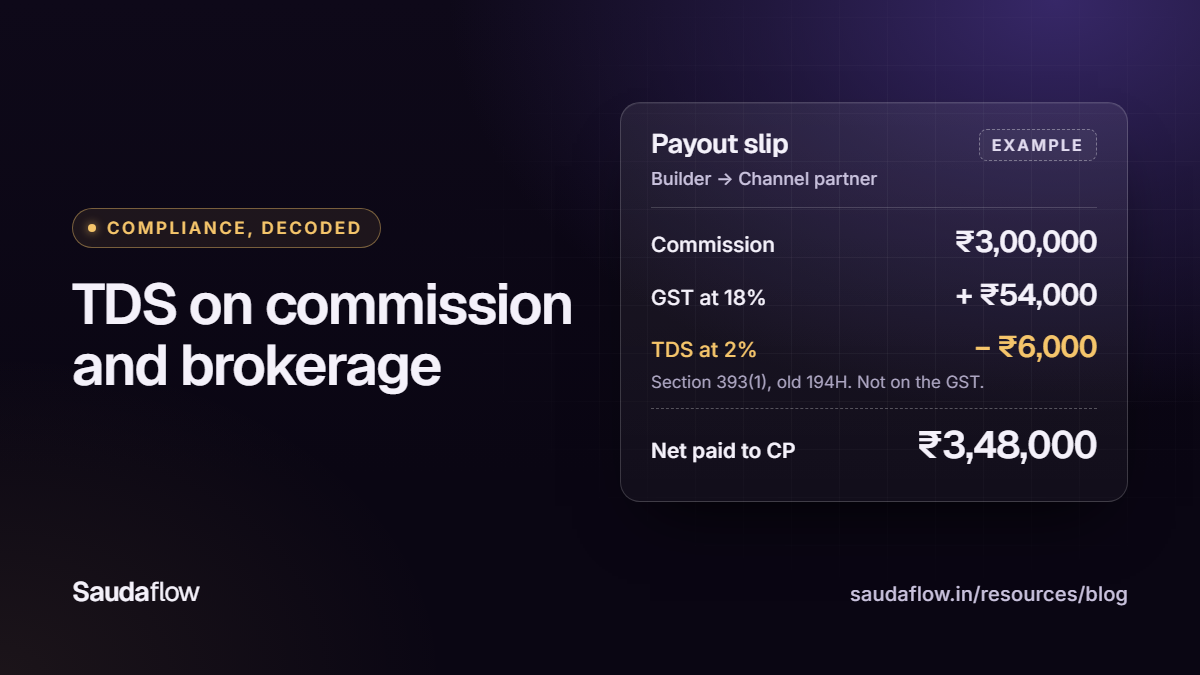
From 01/04/2026, the builder deducts TDS on commission under section 393(1) of the Income-tax Act, 2025, the successor to section 194H: 2%, once the CP's total for the tax year crosses ₹20,000.
That 2% is worked out on the commission, not on commission plus GST. CBDT Circular No. 23/2017 says that where the agreement or contract shows the "GST on services" component separately, tax is deducted on the amount "without including such 'GST on services' component". Section 536(2)(j) of the 2025 Act keeps old-Act circulars in force where they are consistent with the new Act.
The two taxes do not offset each other. TDS is the CP's own income tax, collected in advance. GST is a tax the CP collects for the government. The CP still pays the full GST on its invoice, even though the builder paid it the TDS amount less.
Worked example: one ₹1 crore flat, two CPs
Can the builder claim the GST back?
Sometimes. Under section 16(2) of the CGST Act, a recipient can take input tax credit only if, among other conditions, it holds the tax invoice, the supplier has furnished the invoice in its statement of outward supplies so that it is communicated to the recipient, and the tax has actually been paid to the government. A CP that files late, or leaves an invoice out, holds up the builder's credit.
A builder on the concessional residential rates in force since 01/04/2019 generally cannot take this credit: those rates apply on the condition that input tax credit is not taken, except to the limited extent the notification's annexures allow. For those builders, the 18% on every CP invoice is a cost of sale, and it belongs in the project budget.
Common mistakes on brokerage invoices
- Charging GST without a GSTIN. An unregistered CP cannot collect GST (section 32(1) of the CGST Act).
- CGST and SGST on an inter-state invoice. A Delhi CP billing for a Noida flat charges IGST, because the place of supply is the property's state.
- A vague description. "Professional charges" with no project or unit invites questions from the builder's accounts team. Tie each invoice to a deal.
- TDS on the GST. When GST is shown separately, the builder deducts 2% on the commission only.
- The wrong service code. Real-estate brokerage is 9972 or 997222 (997223 for land), not whatever "commission" code a search result suggests.
- Missing the e-invoice threshold. Once your aggregate turnover crosses ₹5 crore, invoices to registered businesses must be e-invoices with an IRN.
Where Saudaflow fits
Saudaflow is a CRM for Indian builders and channel partners. It does not raise brokerage invoices: the builder's commission ledger works out each tranche's base, 18% GST where the partner is GST-registered, and the TDS, and the partner raises the invoice from those figures, showing the GST as CGST plus SGST or as IGST. The brokerage and commission tracking page describes that ledger, and the CRM for channel partners page what a partner sees of it where the builder runs Saudaflow.
For builders, the channel partner module shows each commission as Accrued, Scheduled or Paid, and notes that TDS and GST tracking needs the correct partner, project and tax settings, reviewed with your finance team. If a term in this post is new to you, the Indian real estate glossary has plain definitions.
Checked against the Explanatory Notes to the Scheme of Classification of Services; Notifications 11/2017, 13/2017, 07/2019, 09/2024, 05/2025, 07/2025 and 15/2025-Central Tax (Rate); the Annexure to Notification 11/2017-Central Tax (Rate); Notification 8/2017-Integrated Tax (Rate); Notification 10/2017-Integrated Tax; Notifications 78/2020 and 10/2023-Central Tax; sections 16, 22 and 32 of the CGST Act; section 12 of the IGST Act; rule 46 of the CGST Rules; section 393 of the Income-tax Act, 2025; and CBDT Circular No. 23/2017, on 16/10/2026. General information, not tax advice; ask your CA for your case.
Frequently asked questions
What is the SAC code for real estate brokerage?
997222, building sales on a fee/commission basis or contract basis, for flats, houses, offices and shops, including rental brokerage. Brokerage on vacant land is 997223. Both sit under heading 9972, which is enough on invoices for businesses with turnover up to ₹5 crore.
What is the GST rate on commission and brokerage?
18% for real-estate brokerage: 9% CGST plus 9% SGST within a state, or 18% IGST between states, under serial 16(iii) of Notification 11/2017-Central Tax (Rate) and its integrated-tax counterpart.
Is GST on brokerage payable under reverse charge?
No. Real-estate brokerage is not on the reverse-charge list in Notification 13/2017-Central Tax (Rate). A registered CP charges GST on its own invoice and pays it to the government.
Does a channel partner need GST registration?
Yes, once aggregate turnover in a financial year exceeds ₹20 lakh, or ₹10 lakh in the special category states. Below that, Notification 10/2017-Integrated Tax exempts inter-state service suppliers too. An unregistered CP must not charge GST.
Is TDS on commission calculated on the amount including GST?
No, when the agreement or contract shows GST separately; keep it on a separate line on the invoice too. Under CBDT Circular No. 23/2017, a ₹3,00,000 commission with ₹54,000 GST attracts ₹6,000 TDS at 2%, not ₹7,080.
Can a builder claim input tax credit on CP brokerage?
Only on a GST rate that allows credit, and only if the section 16(2) conditions are met: invoice held, invoice furnished by the CP, tax paid. Builders on the concessional residential rates in force since 01/04/2019 generally cannot claim it.
Sources
- Explanatory Notes to the Scheme of Classification of Services (heading 9972, group 99722)
- Annexure to Notification No. 11/2017-Central Tax (Rate): Scheme of Classification of Services
- Notification No. 11/2017-Central Tax (Rate), as amended up to 01/04/2019 (serial 16, heading 9972; serial 3 conditions)
- Notification No. 8/2017-Integrated Tax (Rate), as amended up to 01/04/2019 (serial 16, heading 9972)
- Notification No. 05/2025-Central Tax (Rate) dated 16/01/2025
- Notification No. 15/2025-Central Tax (Rate) dated 17/09/2025 (copy of the Ministry of Finance notification hosted by IIT Hyderabad)
- Notification No. 13/2017-Central Tax (Rate) dated 28/06/2017: services under reverse charge
- Notification No. 09/2024-Central Tax (Rate): amends Notification 13/2017 (renting of non-residential property by an unregistered person)
- Notification No. 07/2025-Central Tax (Rate) dated 16/01/2025: amends Notification 13/2017
- Notification No. 07/2019-Central Tax (Rate) dated 29/03/2019: reverse charge on promoter's shortfall
- Section 22, CGST Act, 2017: Persons liable for registration
- Notification No. 10/2017-Integrated Tax dated 13/10/2017: registration exemption for inter-state service suppliers
- Integrated Goods and Services Tax Act, 2017 (section 12: place of supply)
- Central Goods and Services Tax Act, 2017 (section 32: prohibition of unauthorised collection of tax)
- Section 16, CGST Act, 2017: Eligibility and conditions for taking input tax credit
- Rule 46, CGST Rules, 2017: Tax invoice
- Notification No. 78/2020-Central Tax dated 15/10/2020: HSN digits on tax invoices
- Notification No. 10/2023-Central Tax dated 10/05/2023: e-invoicing threshold of ₹5 crore
- Section 393, Income-tax Act, 2025: Tax to be deducted at source
- CBDT Circular No. 23/2017 dated 19/07/2017: TDS on GST component
- Section 536, Income-tax Act, 2025: Repeal and savings
Checked against the primary sources listed above on . This is general information, not tax/legal advice; ask your CA/advocate for your case.
Comments
No sign-up and no email address. Comments appear as soon as you post them; obvious spam is held back.