
Real estate site visit: the checklist, feedback form and follow-up that turn visits into bookings
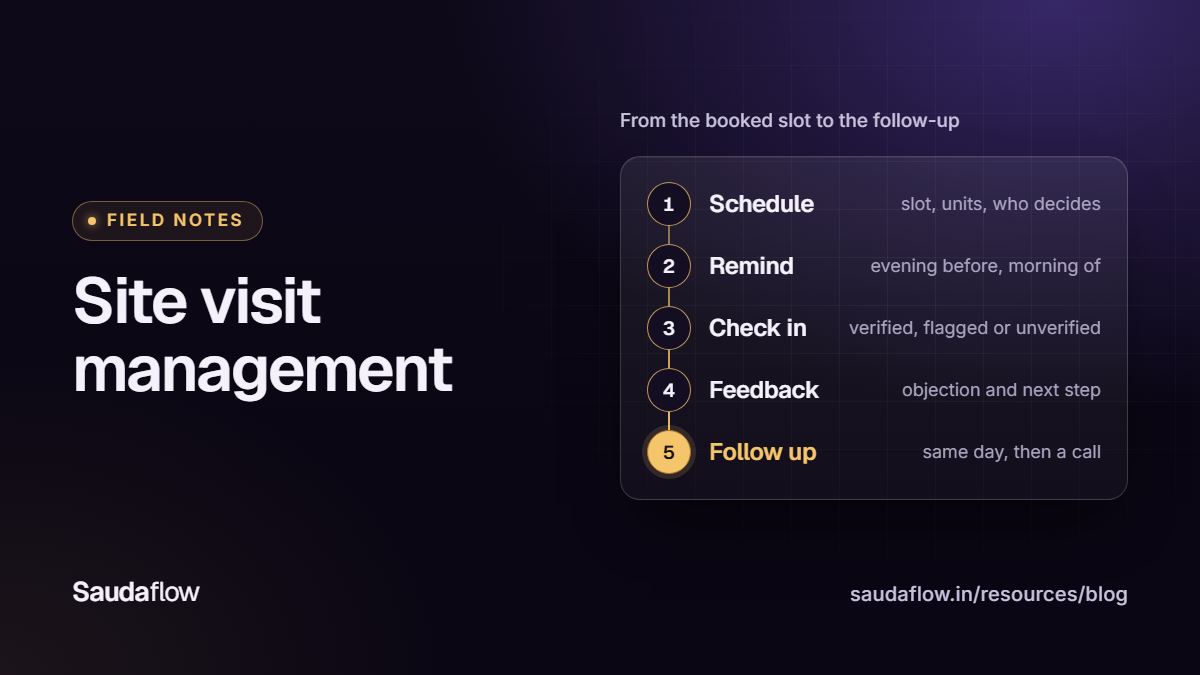
Quite often the sauda is lost after the buyer has left, not in the sample flat. So find out who decides before the visit, get the main objection and one dated next step written down before the buyer goes, and come back on that objection within 48 hours, then judge it all by buyers who booked divided by buyers with a completed visit.
In Indian primary sales the site visit is often the first time a buyer sees the project, the sample flat and a cost sheet together, so a visit that ends with nothing on record and no next step agreed is an easy way to lose a buyer who was ready to talk.
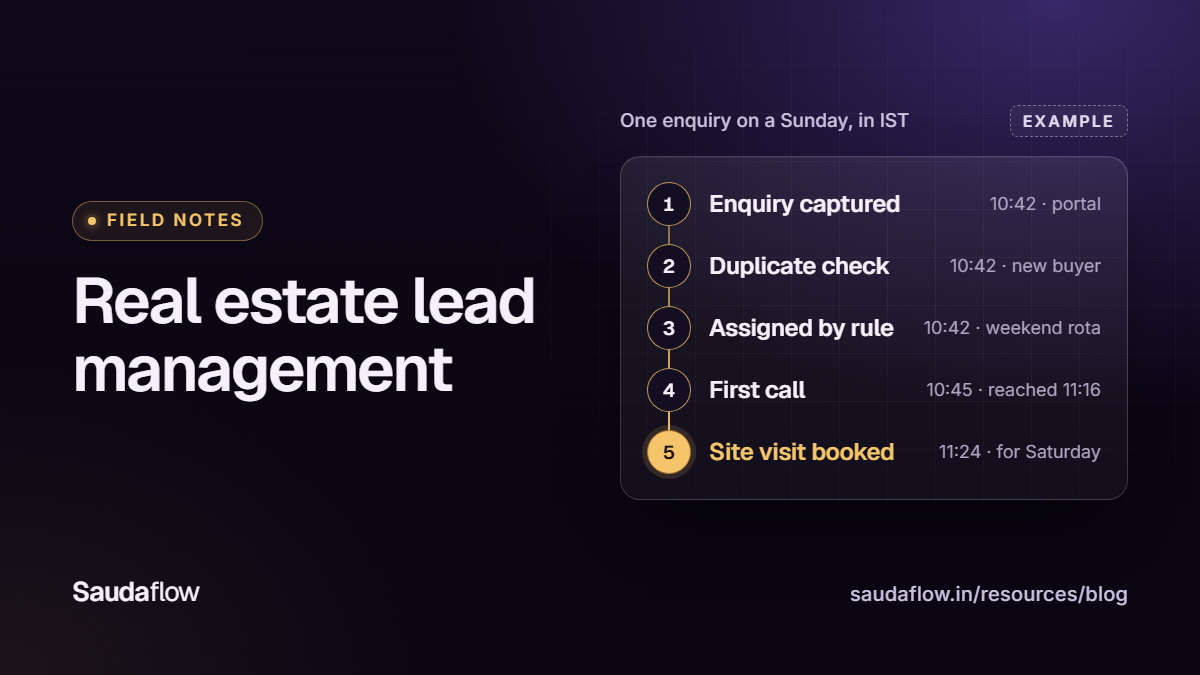
This is for sales managers, visit coordinators and the channel partners (CPs) who bring buyers in. The last section follows one buyer's visit hour by hour, from the confirmation call to the booking.
Real estate site visit: who does what
Set-ups differ from builder to builder, but here's roughly who does what in a typical sales office.
| Role | Job |
|---|---|
| Pre-sales and sourcing | Telecallers do the qualifying call and book the visit, and sourcing managers get visits in through CPs. |
| Site visit coordinator | Runs the visit calendar and the register, sends confirmations, sorts out pickup and drop, marks no-shows. |
| Closing manager | Shows the project, sample flat and cost sheet, then agrees the next step and owns the follow-up. |
| Channel partner | Registers the buyer with the builder first, often comes along, and makes sure the visit slip names the firm. |
| Sales manager | Spreads visits across closing managers and reviews flagged check-ins, feedback and the numbers. |
Then there's the family, since a spouse, a parent or the loan co-applicant who missed the visit can still say no.
Before the visit: confirm, remind, pin, prepare
- Confirm twice. Ring them the evening before, and on the morning of the visit send the time, a location pin for the sales office gate, a landmark and who will meet them. Look for a reply, since a sent reminder hasn't necessarily reached them.
- Ask who's coming. If the decision maker can't make it, keep the visit anyway and plan the family visit from now itself.
- Tell them to wear comfortable shoes for the site walk and, if they might block a unit that day, to carry the ID and payment details your booking process needs.
- Get the floor ready. Check the units you'll show are still available, make their cost sheets from the current price list, and see that the sample flat is open and clean.
- Brief the closing manager from the lead record on the source, the CP, the budget, the configuration and the last conversation. In Saudaflow, lead management keeps the buyer, project, source and assigned person together.
- Confirm before you send pickup, and give the buyer the driver's number.
If a CP is bringing the buyer, the builder should have acknowledged that CP's registration first. Our guide to channel partners in real estate covers registration and site-visit tagging. The visit backs up the registration but doesn't replace it.
During the visit: welcome, sample flat, cost sheet, objections
- Welcome them and fill in the visit slip or register with name, mobile number, time and the CP firm if any. The closing manager checks in.
- Start with their brief, which means the budget, configuration and timing, and whatever they liked or disliked elsewhere.
- Walk them to the actual tower and the sample flat rather than stopping at the model, and give the carpet area from the project's documents, never an estimate.
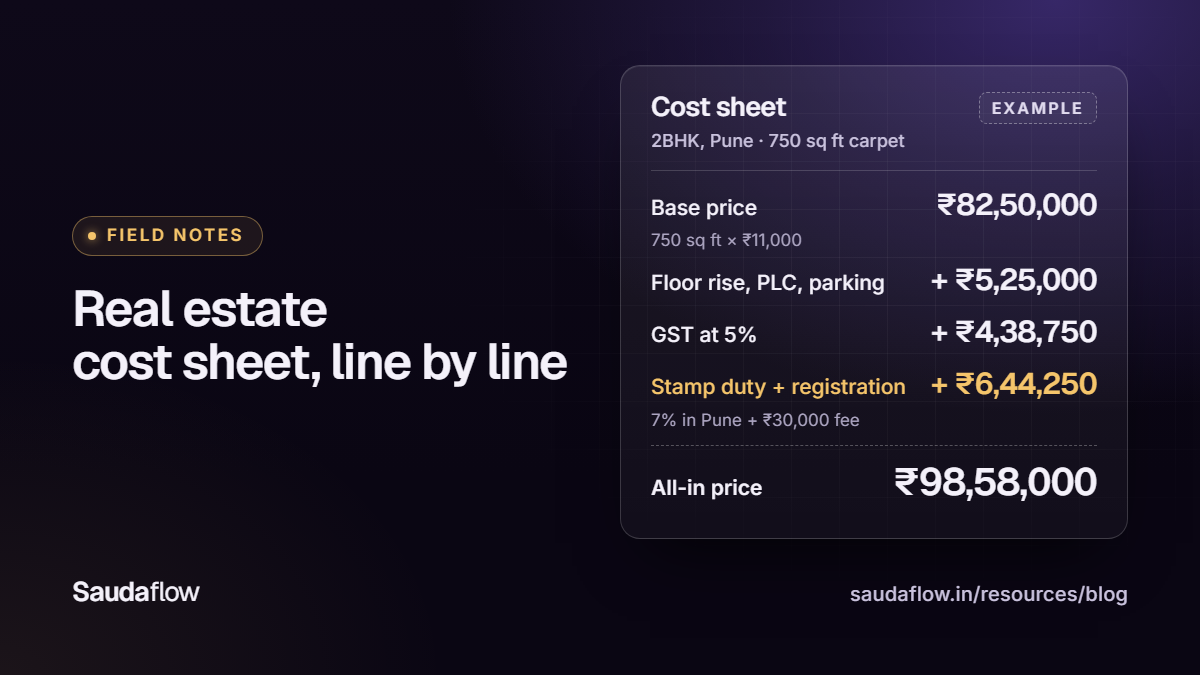
- Walk through the cost sheet line by line, base price, floor rise, preferential location charge (PLC), parking, other charges and GST, plus anything paid separately, like stamp duty and registration. Let them take a dated copy home, and don't promise a discount someone else has to approve.
- Get the objections out. Price, home loan eligibility, the possession timeline, carpet versus super built-up area, location, you'll hear all sorts, and each one goes down in the buyer's own words.
- End with one next step that says what, who and when. "I will send both cost sheets by 4 pm, and we speak on Monday at 11" is a next step, and "Let us know" is just a polite goodbye.
Recording the visit: what a slip, a GPS check-in and a photo prove
When a builder and a CP fight over who brought a buyer, the visit record is what everyone pulls out. It also shows which objections each closing manager keeps losing to, and the forecast leans on it, since that's built from visits where the budget fits, the decision maker came and a next step is dated.
| Evidence | What it shows | What it does not prove |
|---|---|---|
| Visit slip or register | The buyer, the date, the project and, if written on it, the CP firm, often signed by the buyer | The exact time; it can be filled in later |
| GPS check-in | Where the salesperson's phone was, when, and how accurate the fix was | Who came, or that the buyer was there at all |
| Photo | Who was present, if the buyer agreed to it | Where and when, unless the record ties it to the check-in |
| Structured feedback | What was shown and discussed, the objection and the next step | Attendance, on its own |
Remember that a GPS fix is an area on the map and not one exact spot. Android's developer documentation defines the accuracy of a location as a radius in metres, with a 68% chance that the phone's true position is inside it. GPS.gov says GPS-enabled smartphones are typically accurate to within a 4.9 m radius under open sky, and that accuracy gets worse near buildings, bridges and trees, and indoors or underground, as in a basement sales lounge. So a weak fix doesn't prove the visit was fake, and a strong one doesn't prove the buyer was there. If you're choosing software, our real estate CRM guide lists the check-in questions to ask in a demo.
How Saudaflow records a check-in
Saudaflow's site visits module records each check-in as verified, flagged or unverified. It's verified when "the recorded location met the configured checks". It's flagged when something needs attention, a location mismatch for example, and a manager reviewing it doesn't remove the flag. It's unverified when there was no usable location fix or the project's location wasn't available, and the page says that result "must not be presented as a GPS-verified visit", adding that "a check-in is not automatically proof of attendance."
In the Android field app the check-in records the time and any available coordinates and accuracy, while a photo, a note and who came along are optional. A verified or flagged result needs the project's site pin, which a manager sets once per project, and until that pin exists, check-ins at that site are recorded as unverified. If a position looks wrong it gets flagged for a manager to review, but it never blocks the rep at the gate. The app is Android-only and installed from the Saudaflow download page, not from Google Play, and there is no iPhone app.
Site visit feedback form: what to record before the visit closes
Nobody can count, compare or coach a note like "positive, will revert", so record the same fields after every visit, ideally before the buyer leaves.
| Field | Record it as | Why it matters |
|---|---|---|
| Who came | Names and relation, and whether the decision maker was there | If not, the next step is usually a family visit |
| Units shown | Unit numbers | Holds and cost sheets attach to units |
| Budget fit | Fits, stretches (by how much) or does not fit | Another unit, or a loan conversation |
| Configuration | Bedrooms, floor band, facing | Narrows the next shortlist |
| Main objection | Picked from a fixed list, or typed | A fixed list lets you count which objections lose deals |
| Decision timeline | This week, this month, later | Feeds the forecast |
| Next step | One action, an owner, a date and time | It can be checked, and "will call" can't |
By default, a rep can't close a visit in Saudaflow until the feedback is in, so before a visit can reach Completed, three things have to be recorded: how interested the buyer is, the outcome and the next step. The same sheet asks who actually came, what was shown and handed over, and the objections, picked from fifteen named ones that include price, loan eligibility, possession timeline and carpet versus super built-up. For the handover list, the app's own words are: "Anything you don't tick is recorded as not shared."
No-shows and revisits
If a buyer doesn't show, don't delete the slot. Mark it as a no-show, since that's an outcome in its own right, and ring them within the hour. Keep the tone easy, because all you want to know is what came up and when they can come instead. People miss visits for very ordinary reasons, a jam on the expressway or a family plan running late, and a buyer willing to fix a new time is still interested. Offer two new slots, tell the CP the same day if a CP brought the buyer, and put the lead back into follow-up with a date. After a second miss, slow down instead of booking more slots.
In Saudaflow's app a no-show "goes back into follow-up instead of leaving a visit hanging", and the Visits tab lists today's, upcoming, overdue and no-show visits.
A revisit is the same buyer coming back, often with the family in tow. Log it as a new visit on the same lead rather than editing the first, or the first visit's feedback is lost. Plan it from the first visit's feedback, so you bring the missing decision maker, answer the objection with documents and show the unit they liked plus one alternative. Whether a revisit stretches a CP's attribution window is down to the builder's written CP policy.
The follow-up that closes
Your buyers set the pace, but here's a fair place to start.
- The same day, a short message to say thanks, carrying the cost sheet for every unit they saw, the floor plans and the next step you agreed, in writing.
- Within 48 hours, call them back with a real answer to the main objection. For a loan worry that could mean an eligibility check with the buyer's bank, for possession a construction update, and for a budget gap another unit.
- For the second visit, if the decision maker was missing, invite them personally and sort out the pickup.
- For holds, if the buyer wants a unit kept, use your hold process with an owner and an expiry, because a verbal "I will keep it for you" is how one flat gets promised to two buyers.
- After that, follow their timeline. Someone deciding this month is worth a weekly touch, but someone deciding later needs a date in the diary, not daily messages. And if a buyer asks you to stop, then stop, and put it on record.
Saudaflow's app puts this work on its Today screen, with visits due, follow-ups due, callbacks and attribution windows about to close. When there's no signal it queues check-ins, no-shows and visit feedback with their real time, but as the site visits page warns, "Queued work is not confirmation that the manager already has the update."
Site visit to booking ratio and the other numbers to watch
Before these numbers reach a review meeting, write down how each one is counted, or one month will give you different answers.
| Number | How to count it | What it tells you |
|---|---|---|
| No-show rate | No-shows ÷ visits scheduled for slots that have passed | Whether confirmations are working, and which sources send buyers who don't come |
| Visit-to-booking ratio | Buyers who booked ÷ buyers with a completed visit, within a stated window, such as 60 days from the first visit | How well visits convert, by project, source and closing manager |
| Revisit rate | Buyers with two or more completed visits ÷ buyers with at least one | Whether first visits get the family back |
| Feedback completion | Completed visits with structured feedback ÷ completed visits | Whether the rest of the numbers can be trusted |
| Check-in results | Share of check-ins verified, flagged and unverified | Missing project pins and weak signal, so it checks your data, not the rep |
There's deliberately no benchmark here, because these numbers swing with the project, the price band, the source mix and even the season. So put a project next to its own last month, or closing managers on the same project side by side. And for conversion go by buyers, since counting visits lets every revisit drag the rate down.
Worked example: one buyer's visit, feedback and follow-up
Product details checked against Saudaflow's site visits, Android field app, lead management and download pages, and against the app's own visit feedback rules; GPS facts against GPS.gov and Android's documentation; all on 22/10/2026.
Frequently asked questions
How do you reduce site visit no-shows?
Confirm twice, with a call the evening before and a message that morning giving the time, a location pin for the sales office gate, a landmark and who will meet them, and look for a reply. Send pickup only once they confirm, and track no-shows by source to see which sources send buyers who don't come.
Does a GPS check-in prove that the buyer visited the site?
No. It only tells you where the salesperson's phone was, at what time and how good the fix was, and the buyer could have been anywhere. Use it alongside the visit slip or register and the structured feedback. A check-in with no usable fix or no project location should stay unverified instead of passing as verified.
What should a site visit feedback form include?
Who came, and whether the decision maker was one of them. Then which units you showed, how the budget fits, the configuration they want and the main objection, picked from a fixed list or typed the way the buyer put it. Last, when they expect to decide and one next step with an owner, a date and a time.
How soon should you follow up after a site visit?
Message them the same day with the cost sheets and the next step you agreed, and ring within 48 hours with a real answer to their main objection. That's only a starting point, though, so fix the exact time with the buyer before they leave the site.
How do you calculate the site visit to booking ratio?
Divide the buyers who booked by the buyers with a completed visit, inside a window you state, for example bookings within 60 days of the first visit. Count buyers and not visits, or the revisits will pull the ratio down.
What should a channel partner do at a site visit?
Get the buyer registered with the builder through the official channel before the visit. Try to come along for the first visit, check that your firm's name is on the visit slip and keep a copy, because the visit only backs up your registration and can't replace it.
Sources
- Site visit scheduling and check-in evidence
- The Android field app
- Real estate lead management
- Download the Saudaflow Android app (APK): direct install, not a Play Store release
- GPS Accuracy (FAQs: how accurate is GPS, and why GPS sometimes shows the wrong place)
- android.location.Location: getAccuracy(), horizontal accuracy radius at the 68th percentile confidence level
Comments
No sign-up and no email address. Comments appear as soon as you post them; obvious spam is held back.