
How to start a real estate business in India: RERA, GST and the first 90 days
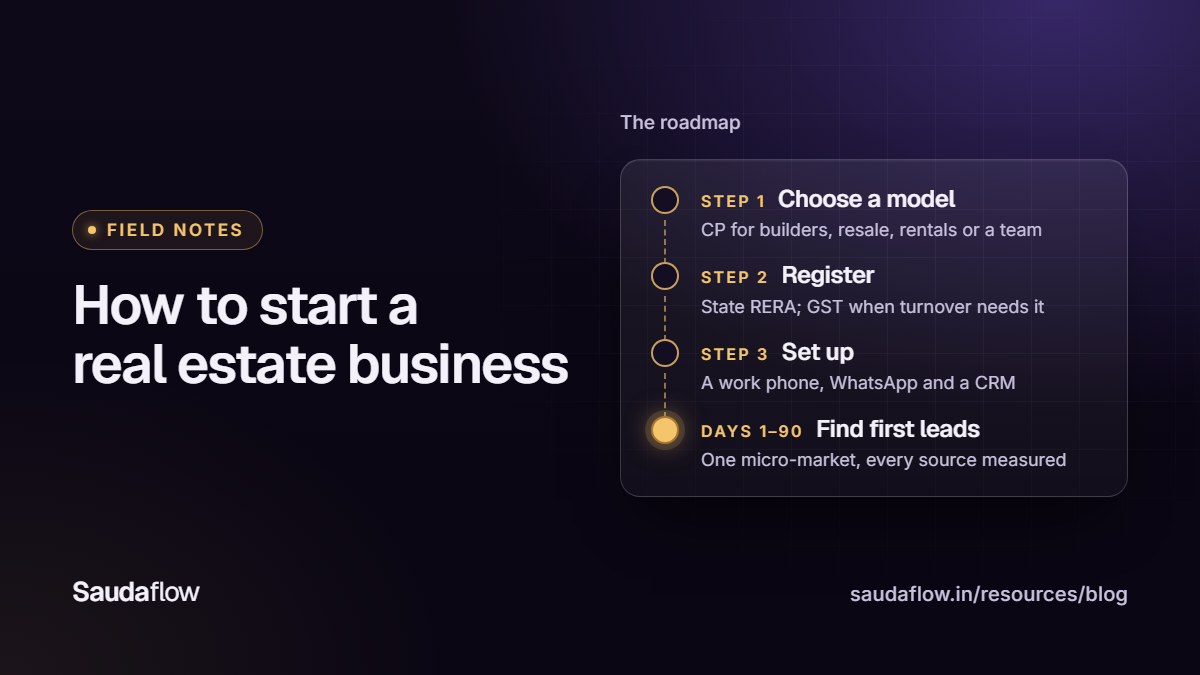
If you're working out how to start a real estate business in India, first decide whether you'll sell new units for builders as a channel partner, resale, rentals or a mix. Your registrations, your costs, even how long you wait to get paid, all hang on that.
A real estate business can earn from property in four ways. Builders develop it (RERA's word for them is promoters). Brokers and channel partners sell it for other people. Then there's renting or managing property, and plain investing. Broking needs little capital beyond registration, a phone and travel, so this guide is about starting as a broker.
It's written for someone going solo or with one partner, in Agra, Pune, Noida or anywhere else in India.
How to start a real estate business: choose your model first
Within broking there are four quite different jobs, and it's far easier to learn one properly, and get it paying, before you take on a second.
| Model | What you sell | Who pays you | What you need first |
|---|---|---|---|
| Channel partner (CP) for builders | New units in builder projects | The builder, as your CP agreement says | RERA agent registration, a CP agreement with one or two builders, deep knowledge of their projects |
| Resale broker | Ready flats, plots and shops | The buyer, the seller or both, as agreed in writing | Owner relationships, know-how on title, approvals and home loans, a written fee agreement |
| Rental broker | Homes and shops on rent | Tenant, owner or both, whatever you agreed in writing | Fresh listings, viewings at short notice, a written fee agreement |
| A small team | Any of the above | Same as above | Clear rules on whose lead is whose, shared records, and cash for salaries until commission comes in |
CP work pays when you know a few projects better than anyone. Resale needs street knowledge, owners and paperwork. Rentals go to whoever shows the flat first. A team needs systems, or two people call the same buyer twice.
Registrations: RERA, GST, your business form and your office
RERA agent registration
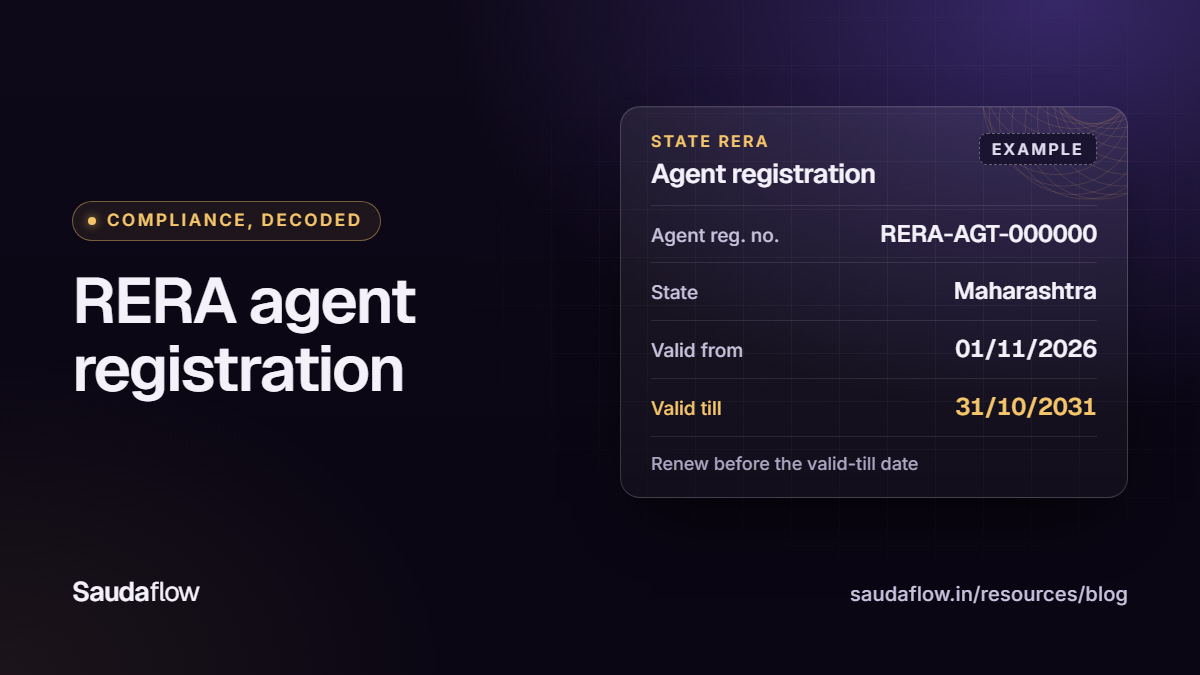
It starts with section 9 of the Real Estate (Regulation and Development) Act, 2016. If a builder is selling a RERA-registered project and you want to facilitate the sale or purchase of a plot, apartment or building in it, you have to register with your state's Real Estate Regulatory Authority first. Your registration number then has to be quoted in every sale you facilitate (section 9(5)).
Section 10 sets the rules once you're registered. Don't facilitate sales in any project that isn't registered with the Authority, keep the books of account, records and documents your state prescribes, and never make false or misleading claims about your services or affiliations. Breaking section 9 or 10 can cost ₹10,000 for every day the default continues, up to 5% of the property's cost (section 62).
The form, fee and documents, and how long a registration stays valid, are set by each state's rules (sections 9(2) and 9(6)). Some states also require training before you apply: MahaRERA's certificate of competency in Maharashtra, and UP RERA's training and exam in Uttar Pradesh. LiveLaw reported that a UP RERA order of 05/01/2026 makes that training a condition for a new registration or a renewal. The fees, documents and renewal are in our guide to RERA agent registration. Even if you'll only do resale or rentals, ring your state authority and ask what it expects before you decide you can skip registration.
GST registration
With GST it mostly comes down to turnover. Once your aggregate turnover in a financial year crosses ₹20 lakh, registration becomes compulsory, and the limit is ₹10 lakh if you supply from Manipur, Mizoram, Nagaland or Tripura (section 22 of the CGST Act, and CBIC's guide to registration). You can register voluntarily below that limit, which helps if a builder you'd like to work with asks for your GSTIN.
Turnover isn't the only trigger, though, because section 24 lists cases where registration is compulsory whatever your turnover is. CBIC's guide notes that people making inter-State supplies of taxable services within the threshold are exempt from registering (notification 10/2017-Integrated Tax), but if you will bill a builder in another state, confirm your position with your CA before the first invoice.
Your business form
- Sole proprietorship is the simplest start, since the business is just you, under your own PAN.
- Partnership means two or more of you working under a partnership deed.
- A limited liability partnership (LLP) needs at least two partners and at least two designated partners who are individuals, one of them resident in India, but each partner's liability stays limited to their agreed contribution (Ministry of Corporate Affairs).
- And a private limited company is a separate company altogether, registered with the Ministry of Corporate Affairs.
Whichever you pick changes your tax, your liability and your yearly filings, so it's a call to take with your CA.
Your office: shops and establishments
If you do open an office, your state's shops and establishments law may require you to register it. We checked Maharashtra, where since 01/10/2025 an establishment needs registration only when it has twenty or more workers (it was ten before a 2025 amendment), while a smaller office just files an online intimation instead. Other states have their own Acts and thresholds, so check your state labour department's portal.
Whatever you choose, open a separate bank account for the business on day one itself. Builder payouts, TDS and GST are far easier to reconcile when nothing personal is mixed in.
What it costs to start
We are not going to print a "typical" startup budget: costs vary too much by city and model, and an invented average would mislead you. Here's what you'll pay for instead.
- Registrations: the RERA agent registration fee your state sets, any training your state requires first, and your CA's fees for GST and your business form.
- Phone and data: a dependable smartphone and a plan that survives a full day of calls and maps.
- Workspace: your home to begin with, a co-working seat, or a small office with rent and a deposit.
- Marketing: portal listings if you choose them, local ads, visiting cards, a simple website or a WhatsApp catalogue.
- Travel: site visits every week mean fuel or cabs. It is an easy line to under-budget.
- Software: a CRM, which you can pay for monthly or yearly (the tools section below prices one).
- A cash buffer: several months of costs, because commission only shows up after a deal closes and the landlord won't wait.
Where your first leads come from
Builder empanelment
Start small, with one or two builders whose RERA-registered projects sit in your localities. Carry a one-page profile to the first meeting, with your RERA agent registration number, PAN, bank details, GSTIN if you have one and the areas you cover.
Then read the CP agreement properly before you sell anything. You're looking for the commission rate, the payout trigger (booking, a payment milestone or the registered agreement), how a buyer registration gets recorded and how long it protects you, and what happens to your commission if the buyer cancels. Our guide to how CP registration, attribution and payouts work goes through each of these.
Your own network and referrals
Your own circle counts too. Tell relatives, old colleagues and neighbours that you're in property now, which areas you cover and which buyers you can help, and ask every client you help for one introduction, noting who referred whom.
Property portals
Any resale or rental property you hold directly can go onto the portals. If you're paying for a package, get its terms in writing first, meaning how many listings, which localities and for how long. Answer every enquiry fast; the buyer who filled in your form may have filled in others too.
Local ads, within RERA's rules
- However tempting the launch offer, never market a project that isn't registered with RERA, because section 3(1) bars the builder from advertising or selling it and section 10(a) bars you from facilitating its sale.
- Section 11(2) requires the builder's ads for a registered project to show the project's registration number and the Authority's website. So use the builder's approved material with those details on it rather than your own.
- Never claim anything false or misleading about a project, its approvals or your own affiliation, however small (section 10(c)).
- On WhatsApp, only message people who've shared their number with you and given opt-in permission, and if someone asks you to stop, stop (WhatsApp Business Messaging Policy).
We will cover property-ad rules in detail in a later post.
Tools: a phone, WhatsApp and a CRM
You can run your first year on three tools:
- A work number that never changes. It goes on every listing, card and CP registration.
- WhatsApp on that number, for photos, locations and documents, but not as your record of who said what.
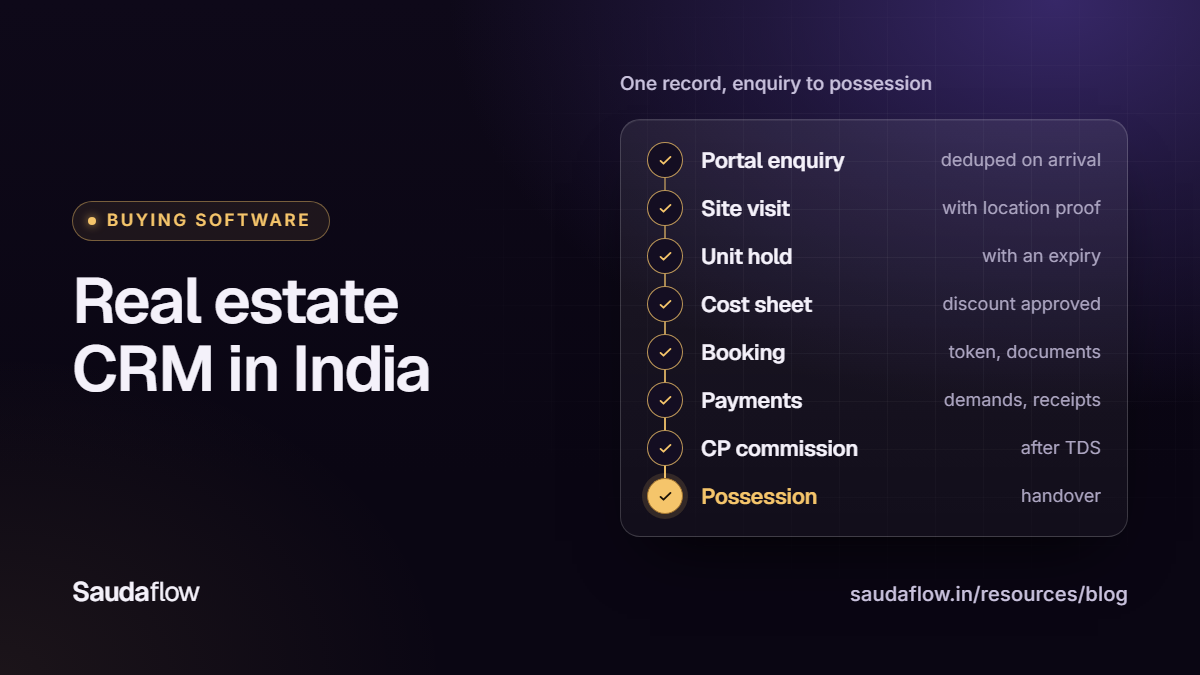
- A CRM from the first lead: every enquiry with its source, budget, configuration, next follow-up and site visits and, for CP work, the date you registered the buyer with the builder. Our guide on how to choose a real estate CRM lists what to test in a demo.
Saudaflow has a one-seat Solo plan: ₹599 a month for one person, or ₹6,468 for the year, plus 18% GST. It covers lead capture with duplicate checks and attribution, follow-ups, site visits with GPS check-in, inventory, cost sheets built in the web app, bookings and payments, and the Android app. See Saudaflow for solo brokers and Saudaflow pricing.
Know where it stops before you pay. Solo is exactly one person, and since sharing a cost sheet needs a second person to approve it, a cost sheet you build on Solo can't be shared. Saudaflow also doesn't keep a ledger of the brokerage builders owe you, on Solo or any other plan, because its commission ledger is for a builder paying its channel partners. And the app is Android-only, installed directly rather than from Google Play, and there is no free trial, as payment comes before setup.
A worked example of the monthly numbers
Every figure below is an assumption chosen to show the arithmetic. None of it is market data or a promise of earnings; replace each line with your own.
| Line | Assumption | ₹ a month |
|---|---|---|
| CP commission | ₹1,00,000 per booking (2% of ₹50 lakh), but only one every two months | 50,000 |
| Rental fees | 2 rentals at ₹10,000 each | 20,000 |
| Average income | 70,000 | |
| Co-working seat | Assumed | 6,000 |
| Phone and data | Assumed | 1,000 |
| Fuel and travel for site visits | Assumed | 8,000 |
| Portal listings | Assumed | 4,000 |
| Local marketing | Assumed | 3,000 |
| CRM | Saudaflow Solo on 16/10/2026: ₹599 a month plus 18% GST, rounded | 707 |
| CA and compliance | Assumed | 2,000 |
| Total costs | 24,707 | |
| Average surplus, before tax | 45,293 |
What the average hides:
- Lumpy months. In a month without a booking, income is ₹20,000 against ₹24,707 of costs, ₹4,707 short. That is what the cash buffer is for.
- Timing. The ₹1,00,000 comes only when your CP agreement's payout trigger is met, which can be well after the token cheque and the booking. So raise a complete invoice the same day each trigger is met, with the RERA number, PAN, GSTIN if registered, booking details and your registration proof on it. Builders pay against invoices, net of TDS, so in this example the ₹1,00,000 lands as ₹98,000.
- TDS. Once your commission from that builder crosses ₹20,000 in a tax year, the builder keeps back 2% as TDS on commission under section 393(1) of the Income-tax Act, 2025. People still search for it as section 194H, and if an older article tells you 5%, it was written before the cut to 2% on 01/10/2024. On ₹1,00,000 that's ₹2,000, deposited against your PAN. It counts towards your income tax when you file your return; it is not money lost.
- GST. If you are registered, GST at 18% is charged on top of your commission and paid over to the government. It is not your income. At ₹8.4 lakh a year, this example stays below the GST registration threshold.
- Sensitivity. One extra booking a quarter adds about ₹33,333 a month to the average. A commission of 1.5% instead of 2% takes ₹12,500 a month away.
Your first 90 days
Days 1 to 30: setting up
- Before anything else, settle on your model and just two or three localities.
- Get the paperwork done, meaning RERA agent registration if you'll sell in registered projects, PAN, a separate bank account, your business form, and GST if you need it.
- Visit every registered project in your localities that you might sell, sit in the sales lounge a while, and come back with price lists, payment plans and floor plans.
- Somewhere in this first month, approach two or three builders for empanelment, and read each CP agreement before you sign.
- By the end of the month you want the work number, WhatsApp and the CRM running, plus one fee agreement for resale and rental clients.
Days 31 to 60: the first leads
- Early in month two, put your resale and rental listings up, with honest photos and correct prices.
- From now on, every enquiry gets a same-day reply, within minutes if you can, and every call a log of what happened and what's next.
- Each buyer you introduce gets registered with the builder in writing that same day, and you keep the proof.
- Book site visits, and after each one, while you're still in the parking, note down how keen they were, what put them off and the next step.
Days 61 to 90: count, then decide
- In month three, count enquiries, site visits and bookings per source, and with no bookings yet, count the site visits.
- Then work out each source's cost per site visit, and per booking once bookings start, and drop the ones bringing enquiries but no visits.
- Check the cash as well, meaning commission earned, received and still due, and how many months your buffer has left.
- Then decide what the next quarter adds, maybe a second builder, a second model or a second person.
Mistakes that sink new brokers
- Selling before you are registered, or without the training your state requires. In May 2024, PTI reported that MahaRERA had suspended the registrations of 20,000 agents for not obtaining its certificate of competency. Diary your renewal date as well.
- Introducing a buyer without registering them with the builder in writing that day. The timestamp on your client registration is what a commission claim stands on.
- Doing resale or rental work without a written fee agreement. The RERA Act does not fix a rate, so the agreement is your proof of what was promised.
- Promoting a pre-launch or unregistered project. The law is plain on this one, since sections 3(1) and 10(a) bar it and section 62 sets the agent's penalty.
- Paying for leads without counting site visits for each source. A source that brings enquiries but no visits is only costing you money.
- Spending as if commission arrives at booking. It arrives after the payout trigger and your invoice, so keep the buffer.
A one-page real estate business plan
A brokerage doesn't need a fifty-page business plan. One page is plenty if it covers the points below and you check it against your actual numbers every month.
- What you sell and where, which for the first 90 days means one micro-market.
- Who you're selling to (buyer or tenant), with their budget, configuration and timeline.
- The builders, projects and owners you work with, by name.
- Where enquiries will come from, and what you're putting into each source every month.
- Monthly targets for enquiries, site visits and bookings, the kind you can actually hit.
- Money, counted honestly (monthly costs, the commission you expect per deal and when it actually lands, and how many months of buffer you have).
- Where you stand on RERA agent registration, your GST position and written fee and CP agreements.
- A daily routine, with fixed hours for calls, site visits and follow-ups.
How to become a real estate agent in India
The legal step is registration with your state's RERA authority before you facilitate sales in registered projects (section 9). Some states also make you do training first, so in Maharashtra that's MahaRERA's certificate of competency, and in Uttar Pradesh UP RERA needs its training and exam before it accepts a new application, and agents already registered must have it by 31/12/2026. Your state sets the fees and documents, and our RERA agent registration guide lists them. The rest is craft:
- learn the paperwork: project RERA registration, title, approvals, payment plans and home-loan steps;
- learn the inventory in your localities better than anyone you compete with;
- work with one builder or an established firm before you go wide;
- and from the first day, keep every lead, call and visit on record.
If you want to see a one-person setup working, book a 20-minute demo and we'll show it on demo data and talk through your own listings.
Frequently asked questions
What is a real estate business?
It's a business that earns from property in four ways. A builder developing a project counts (a promoter, in RERA terms), and so do brokers and channel partners selling for others, people renting out or managing property, and investors.
Do I need a licence to start a real estate business in India?
If you'll facilitate sales in RERA-registered projects, you'll have to register as an agent with your state's authority first, since section 9 of the RERA Act requires it, and states such as Maharashtra and Uttar Pradesh require training before that. Fees, documents and validity are set by each state's rules. Depending on your turnover and office, you may also need GST and shops and establishments registration.
When does a property broker need GST registration?
As soon as your aggregate turnover in a financial year goes past ₹20 lakh, or ₹10 lakh in Manipur, Mizoram, Nagaland and Tripura, and also in the cases where section 24 of the CGST Act makes it compulsory. You can register voluntarily earlier. If you will bill a builder in another state, check your position with your CA.
How much money do I need to start a real estate business?
There's honestly no single figure, since it changes with your city and your model. Plan two numbers: one-time costs (your state's RERA agent fee and any required training, your CA, a phone) and monthly running costs, about ₹25,000 in this guide's worked example, which uses assumed figures. Keep several months of running costs in hand as well, since commission only comes in once deals close.
How do builders pay channel partners?
It's all down to your CP agreement, which sets the rate, the payout trigger and what happens if the buyer cancels. Once its commission to you crosses ₹20,000 in a tax year, the builder also keeps back 2% as TDS, under section 393(1) of the Income-tax Act, 2025 (the old section 194H).
How much commission does a real estate agent earn in India?
The RERA Act does not fix a rate. For new units, the builder's CP agreement sets the commission; for resale and rentals, you agree the fee with your client, so put it in writing before the first site visit.
Sources
- The Real Estate (Regulation and Development) Act, 2016 (Act No. 16 of 2016), sections 3, 9, 10, 11 and 62
- CGST Act, 2017, section 22: Persons liable for registration
- CGST Act, 2017, section 24: Compulsory registration in certain cases
- Registration under GST Law (GST flyer)
- Income-tax Act, 2025, section 393: Tax to be deducted at source (Table, serial 1(ii), commission or brokerage)
- Income-tax Act, 2025 comes into force from 1st April, 2026
- Section mapping, Income-tax Act, 1961 to the new Income-tax law (194H to 393(1), Table S.No. 1(ii))
- Section 194H, Income-tax Act, 1961: rate amendment note ("five" substituted by "two" per cent by Act No. 15 of 2024, with effect from 01/10/2024)
- Notification No. 11/2017-Central Tax (Rate), as amended up to 01/04/2019: serial 16(iii), heading 9972, real estate services at 9% central tax (18% with the matching state tax)
- New Corporate Form: LLP
- Maharashtra Shops and Establishments (Regulation of Employment and Conditions of Service) Act, 2017 (Maharashtra Act No. LXI of 2017), sections 6 and 7
- Maharashtra Ordinance No. VIII of 2025: Maharashtra Shops and Establishments (Regulation of Employment and Conditions of Service) (Amendment) Ordinance, 2025 (sections 6 and 7: "ten" substituted by "twenty"; in force at once, gazette dated 01/10/2025)
- L.A. Bill No. LXXXIX of 2025: Bill to replace Ordinance VIII of 2025, deemed in force from 01/10/2025 (introduced in the Maharashtra Legislative Assembly on 08/12/2025)
- MahaRERA suspends registration of 20,000 real estate brokers (for not obtaining MahaRERA's certificate of competency), PTI, 23/05/2024
- UP RERA makes training mandatory for real estate agents; certificate now compulsory for registration and renewal (order dated 05/01/2026), 10/02/2026
- WhatsApp Business Messaging Policy
- Real estate CRM pricing: Solo, Professional Team and Custom

Comments
No sign-up and no email address. Comments appear as soon as you post them; obvious spam is held back.