
DLT registration for SMS: steps, fees, sender ID and templates, with real estate examples and fixes when OTPs don't arrive
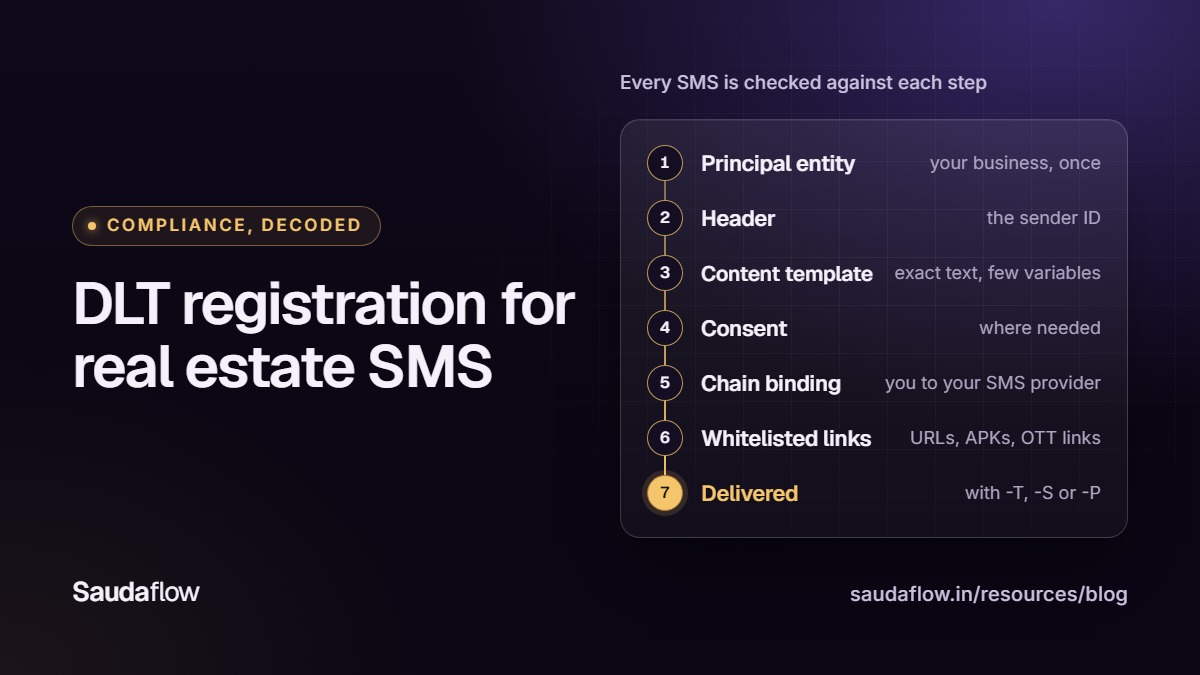
DLT registration is what a business has to complete before Indian telecom operators will deliver its commercial SMS. You register once as a principal entity on any operator's DLT portal, then add your sender IDs (headers), your message templates and, if you need explicit consent, consent templates, and bind the telemarketer chain your SMS provider uses. Every SMS is checked against all of this before delivery. If it fails even one check it gets dropped, and that is how an OTP or a site-visit reminder leaves your system and never reaches the buyer.
This guide is for the builder's marketing or IT person, or the CP firm owner, whose SMS are not arriving. It ends with a fix for each failure.
What DLT registration is, and why it exists
The rules are TRAI's Telecom Commercial Communications Customer Preference Regulations, 2018, notified on 19/07/2018 to curb unsolicited commercial communication. They put every sender, header, template, consent and customer preference on distributed ledgers that the operators run and share. The Saudaflow glossary has a one-paragraph definition for colleagues.
Real estate is clearly covered. A project promotion sent by SMS is commercial communication, and real estate is one of the eight categories customers can block by name.
TRAI has amended the rules more than once, and this guide follows two of those amendments. The earlier one is the Second Amendment Regulations, 2025, notified on 12/02/2025. The Third Amendment Regulations, 2026 followed, published in the Gazette dated 18/09/2026, and most of it applies 30 days after publication, so it's already in force by the time you read this. Two parts start later. The six-hour suspension of misused headers and templates and the new rules for automated calls start after 60 days, in the second half of November 2026. The one-month suspension for wrongly categorised templates and the new complaint appeals start after 90 days, in December 2026.
Who registers what
In the operators' FAQs, principal entities are the businesses that send commercial messages, and registered telemarketers carry those messages to the operators.
| Party | What it registers or does | In real estate |
|---|---|---|
| Principal entity (PE) | Its registration, headers, content and consent templates, whitelisted links; chooses telemarketers | The builder company, each project company that sends in its own name, a CP firm |
| Telemarketer (aggregator or delivery function) | Registers itself; with your letter of authorisation, can manage headers and templates for you; the delivery function hands messages to the operator | The SMS provider you buy credits from |
| Operator (access provider) | Runs the registers, scrubs each message against them and then delivers it | Jio, Airtel, Vodafone Idea, BSNL |
You can't deliver messages yourself, even as a principal entity, because the Vodafone Idea and BSNL DLT FAQs say you must use a telemarketer with the delivery function. And since 2025 there's a limit on how many intermediaries can sit between you and that telemarketer, the idea being that every message can be traced (PIB, 12/02/2025). Registration is per legal entity, which means a builder with a separate company for each project registers every company that sends SMS in its own name.
DLT registration steps for a builder or CP firm
- Pick one operator's portal. The Vilpower FAQ (Vodafone Idea) and the BSNL DLT FAQ say a principal entity registers only once, and its entity ID works with every operator. Jio's portal is TrueConnect, and Airtel's is its commercial communication platform.
- Sign up as a principal entity. Pick your type (proprietor, partnership, company, LLP) and put real estate down as the line of business, which sounds obvious, but it matters, because the same FAQs say your messages must match it.
- Upload documents. That's the business PAN, the authorised person's mobile and email, the business proofs the portal lists, and a letter of authorisation if your SMS provider registers for you. Since 2025 there's more, as registration now also has to include physical verification, biometric authentication and a unique mobile number.
- Pay the fee. Each operator sets its own. The Vilpower and BSNL FAQs list ₹5,000 for a principal entity, non-refundable, valid for one year with a 30-day grace period, so check the amount, tax and renewal terms on the payment page before your accounts team releases the money.
- Answer the registrar. By the same FAQs it has 72 working hours to verify your entity once your documents are uploaded and the fee is paid. If it comes back with queries, reply fast, because an account whose queries sit unanswered for 15 working days is deleted.
- Build on the entity ID. Register headers, content and consent templates, add your telemarketer and confirm the chain, and whitelist every link and number you will send.
- Keep it alive. Renew the entity registration each year, and keep every header in use, because the FAQs say a header inactive for more than 90 days goes back to the header pool for others to take. Operators can also ask you to re-verify headers and templates; TRAI's direction of 16/02/2023 had them re-verify every registered header (Khaitan & Co's summary). Watch your portal's notices.
SMS header registration: format and types
The header, or sender ID, is the name the buyer sees. On the Vilpower and BSNL portals it has six characters, with no spaces or special characters. Their FAQs show six digits for promotional messages, such as 565690, and six letters for transactional and service messages, such as KLMNOP. Sender ID registration starts once your entity is approved.
- Make it recognisably yours. The FAQs say a header should relate to your business, and restrict celebrity and political names, trademarks, other companies' brands and government or SEBI-related headers. TRAI has also told operators to clear out look-alike headers (letter of 22/03/2024, per Khaitan & Co).
- Headers stay with you. You can't hand a header over to anyone else, though you can surrender it.
- Plan one header per job. Since TRAI's direction of 20/08/2024, a content template may be linked to only one header, so a common set-up is a letter header for OTPs and service messages and a number header for promotions.
Phones also show a two-letter prefix before the header for the sending operator and its service area, so AD means Airtel Delhi (MediaNama, 20/05/2025). After the header you'll also see a type suffix, which came in with the 2025 amendment, so a promotion shows -P, a service message -S, a transactional one -T and a government message -G.
DLT template rules: categories, variables, one header each
A content template is your message written out in full before you ever send it, a fixed part plus variable parts for things like a date or a reference number. Every time you send, the operator holds the message up against that registered template, and if it doesn't match, it doesn't go.
| Category and suffix | What goes in it | Real-estate example (our reading) | Do DND and consent apply? |
|---|---|---|---|
| Transactional (-T) | Goes to your customer within 30 minutes of a transaction they started, such as OTPs, alerts and confirmations | The confirmation a buyer gets right after paying the booking amount | No |
| Service implicit (-S) | Information for your customer about something they bought, with no promotion in it | A demand reminder, receipt or possession update to a booked buyer | No |
| Service explicit (-S) | Helps complete an ongoing purchase, after explicit consent lasting seven days at a time | Site-visit reminder to a prospect who gave consent | Needs explicit consent; under the Third Amendment, DND no longer blocks it |
| Promotional (-P) | Anything that advertises, and promotion mixed into any message makes it promotional | A launch, a price offer, a festive scheme | Yes |
Those examples are our own reading of TRAI's definitions rather than TRAI's words, and the operator's registrar checks the category you pick when it approves each template. Login OTPs are where the rules just changed. The 2025 transactional definition named "apps login" OTPs, but the Third Amendment deletes those words and lists "OTPs for authentication, such as app login, password reset, two-factor authentication" under service messages. Neither category is checked against DND. If your buyer-portal OTP is registered as transactional, ask your telemarketer whether the operator wants it moved now that the amendment is in force.
- Three variables, normally. More need special circumstances, written justification, each variable pre-tagged for its purpose and at least 30% of the template fixed (TRAI's direction of 12/05/2023, as NovoJuris Legal summarises it).
- Thirty characters per variable. Longer values need justified contiguous variables, so keep a project address in the fixed text.
- Tag every variable. Under TRAI's direction of November 2025, each variable carries a tag such as #number#, #url# or #cbn# (call-back number), and the operator checks the value against it. Once the 60-day grace period ended, a value that fails its tag, such as "2,500.00" in a #number# field, is blocked (MediaNama, 19/11/2025).
- Fixed text is fixed. After approval only the variables change. New wording needs a new template.
- Carry your brand. The Vilpower FAQ says templates should contain the business or brand name and could be rejected without it; OTP templates without one were treated as invalid after 31/10/2020. Both FAQs allow Hindi and other Unicode templates.
- Get the category right. Since TRAI's direction of 20/08/2024, a template registered in the wrong category is blacklisted, and five blacklisted templates suspend the sender's services for a month or until its templates are re-verified (Khaitan & Co's summary). From 90 days after the Third Amendment's publication, the regulations count five within 90 days and apply whichever period is later.
Consent, DND and promotional hours
Customers set preferences through 1909, by call, SMS or USSD: block all promotions ("BLOCK PROMO") or block a category. Under the Third Amendment the old "fully block" choice moves into BLOCK PROMO, and no preference blocks transactional or service messages. Real estate is category 2, so "BLOCK 2" sent to 1909, or *1909*2#, stops real estate promotions to that number.
- Who gets promotions. Only numbers that have not blocked the category, or whose explicit consent sits on the operator's consent register. The Vilpower FAQ says consent given to you overrides a blocked category.
- When. The default band for promotions is 10:00 to 21:00, so they go out in those hours unless the customer switches more bands on. The Third Amendment says transactional and service messages are not blocked in any time band.
- Opt-out. Every promotional message must carry an opt-out option.
- Explicit consent. You register a consent template with its purpose and how to revoke it, and the customer confirms digitally. The operator sends the consent request from a 127xxx short code, or another code or header TRAI specifies. If a customer opts out, you wait 90 days before asking them again, however keen the sales team is.
- Enquiries. Under the Third Amendment, a written or digital enquiry supports messages for seven days and must be "maintained in a verifiable form by the Sender"; an application supports three months. TRAI's explanatory note says senders often cite an "oral inquiry" when customers complain. Keep the portal lead or form submission, with its date and source, in your lead record; our real estate lead management guide covers that intake.
- Old consent lists. Under the Third Amendment, earlier consents count only if obtained by verifiable means and registered on the consent register.
TRAI's consent is only permission for commercial calls and SMS. The DPDP Act's consent rules are a separate law, and the Third Amendment says nothing in TRAI's rules exempts a sender from that Act; see our DPDP Act compliance checklist for real estate.
A project promotion is also an advertisement under the RERA Act, 2016, which covers publicity "in any form", so section 11(2)'s authority website address and project registration number belong in the fixed text.
What changed in 2024 for whitelisting and chain binding
A lot changed in 2024, so if your SMS was set up back in 2020 or 2021, go through this table.
| Date | What TRAI did | What to check |
|---|---|---|
| 20/08/2024 | Direction: messages with URLs, APKs, OTT links or call-back numbers "not whitelisted by the Senders" to be blocked; "any message with an undefined or mismatched telemarketer chain will be rejected"; one template per header | Your whitelist, your chain, any template shared by two headers |
| 01/10/2024 | Whitelisting enforced for URLs, APKs and OTT links, after a one-month extension | Short-link domains and WhatsApp links count as links |
| 11/12/2024 | TRAI issued warnings and gave two extensions, to 30/11/2024 and then 10/12/2024, and after that "SMS traffic sent through unregistered paths is being rejected" | If you change SMS provider, bind the new one before any traffic moves to it |
This table's facts come from TRAI press releases 53/2024, 60/2024, 67/2024, 80/2024 and 92/2024, plus Khaitan & Co's summary of the 20/08/2024 direction. The last release, as Storyboard18 reported it, counts about 1.13 lakh active principal entities, naming real estate among their sectors. TRAI's releases 11/2025 and 119/2026 summarise the 2025 and 2026 changes.
Why OTPs and reminders don't arrive
Start with one failed message. Ask your SMS provider for its delivery status and failure reason, then find the row.
| What went wrong | What happens | Fix |
|---|---|---|
| Text differs from the template: edited wording, a variable over 30 characters, extra words in a variable, or a value that fails its tag | Fails template scrubbing; not forwarded | Send the registered fixed text exactly; register a new template for new wording |
| Template not linked to the header you sent from | Rejected: one template, one header | Register the template under that header |
| OTP or reminder registered as promotional, or an offer added to a service template | Treated as promotional: blocked for DND numbers and outside 10:00 to 21:00; a complaint can blacklist the template | OTPs and reminders in transactional or service templates, offers in promotional ones |
| PE–telemarketer chain not declared, or a new SMS provider | Rejected since 11/12/2024 | Declare the chain on your portal; add the new provider before switching |
| A link, APK, WhatsApp link or call-back number that isn't whitelisted | Links are blocked, and have been since 01/10/2024 | Whitelist each URL's fixed part and your short-link domain, with dynamic parts only after the "?" |
| A promotion sent at 9:30 or 21:15, or to a number that has blocked real estate | It is not delivered | Schedule promotions between 10:00 and 21:00, and get explicit consent through a consent template |
| A header left unused for more than 90 days, or an entity registration that wasn't renewed | The header goes back to the pool, and an expired entity has to renew | Use the header or re-register it, and renew the entity within the 30-day grace period |
| Someone misused your header or template | Under TRAI's 2024 direction, suspension at once; from 60 days after the Third Amendment, within six hours of the operator noticing | Reset passwords and API keys, file a complaint with law enforcement and review every header and template, within three, three and ten business days respectively under the Third Amendment |
Before you promise buyers an OTP
- An entity ID for the company whose name the message carries.
- A letter header for OTPs and service messages, a number header for promotions.
- An OTP template with your brand and one tagged variable, in the category your portal accepts for authentication codes.
- Reminders without offers, a declared chain and whitelisted links.
- A second route, such as email, for when SMS fails.
We follow this ourselves. Saudaflow sends no sign-in codes by SMS while the sender and template registration our two-factor help page mentions is still pending; staff sign in with an email and a password. That's also why Buyer Connect points buyers to a one-time code by email for now, while SMS delivery stays blocked.
This guide was checked against TRAI's Telecom Commercial Communications Customer Preference Regulations, 2018 (consolidated text of 21/05/2026), its 2025 and 2026 amendments with their explanatory memoranda, TRAI press releases of 2024 to 2026, the Vilpower and BSNL DLT FAQs, and sections 2(b) and 11(2) of the RERA Act, 2016, on 16/10/2026. We went through it again on 22/10/2026 with the Third Amendment's Gazette text (the copy hosted by TeamLease RegTech), PIB's release of 12/02/2025, the Vilpower and BSNL FAQs and the summaries by Khaitan & Co, NovoJuris Legal, MediaNama and Storyboard18. It's general information and it's not legal advice, so for your own case, talk to your advocate.
Frequently asked questions
How long does DLT registration take?
Going by the Vilpower and BSNL FAQs, the registrar has 72 working hours to verify a principal entity once you have uploaded the documents and paid, and 60 minutes for each header and each content template. Reply to its queries quickly too, since an account whose queries go unanswered for 15 working days gets deleted.
How much does DLT registration cost?
That depends on the operator, as each one sets its own fee. The Vilpower (Vodafone Idea) and BSNL DLT FAQs list ₹5,000, non-refundable, for registering a principal entity, valid for one year with a 30-day grace period, but do check the amount and any tax on your portal's payment page before you pay.
What documents does DLT registration need?
The Vilpower and BSNL FAQs list your business PAN, the authorised person's mobile number and email, and whichever business proofs the portal asks for, plus a letter of authorisation if your SMS provider registers for you. The 2025 amendment added physical verification, biometric authentication and a unique mobile number to registration as well.
Does WhatsApp need DLT registration?
No. DLT registration is for commercial SMS and voice calls on telecom networks, while WhatsApp Business messages follow Meta's own policy, under which the customer must have opted in and you start a conversation with an approved message template. A WhatsApp link sent inside an SMS is a different matter, since it's still a link and needs whitelisting on your DLT portal.
Why is my OTP SMS not delivered?
Check the template and its set-up first. The text you sent has to match the registered one exactly, and each variable has to fit its tag. The template also has to be linked to the header you sent from and sit in the right category, your telemarketer chain has to be declared, and every link in the message has to be whitelisted. Your SMS provider can give you the failure reason on one failed message, which helps narrow it down.
Can I send promotional SMS to DND numbers?
Only with the customer's explicit consent recorded on the operator's consent register. Otherwise numbers that blocked real estate (category 2) or all promotions do not get your promotional SMS, and promotions go out only between 10:00 and 21:00 unless the customer has switched on other time bands.
Sources
- Telecom Commercial Communications Customer Preference Regulations, 2018 (6 of 2018), consolidated text of 21/05/2026: definitions, Schedule-I (header, consent and content template functions) and Schedule-II (preference categories and time bands)
- Telecom Commercial Communications Customer Preference (Second Amendment) Regulations, 2025 (1 of 2025), notification of 12/02/2025, with explanatory memorandum
- Telecom Commercial Communications Customer Preference (Third Amendment) Regulations, 2026 (05 of 2026), notification of 18/09/2026, with explanatory memorandum
- Press Release No. 53/2024 (20/08/2024): directions to curb misuse of headers and content templates (whitelisting, traceability, template category, one template per header)
- Press Release No. 60/2024 (30/08/2024): whitelisting of URLs, APKs and OTT links moved to 01/10/2024; call-back numbers to be fixed separately
- Press Release No. 67/2024 (26/09/2024): whitelisted URLs, APKs or OTT links mandated for SMS traffic
- Press Release No. 80/2024: URL, APK and OTT link whitelisting from 01/10/2024 and PE-TM chain declaration under the direction of 28/10/2024
- Press Release No. 92/2024 (19/12/2024): SMS traceability implemented; traffic on unregistered paths rejected from 11/12/2024
- Press Release No. 11/2025 (12/02/2025): amendments to TCCCPR, 2018
- Press Release No. 119/2026 (18/09/2026): Third Amendment to TCCCPR, 2018
- VILPOWER DLT platform: frequently asked questions (principal entity registration and fee, headers, message types, templates, time bands)
- BSNL DLT: frequently asked questions (principal entity registration and fee, headers, templates, CTA whitelisting)
- TrueConnect, Jio's DLT platform for commercial communication
- Airtel commercial communication (DLT) platform
- The Real Estate (Regulation and Development) Act, 2016 (No. 16 of 2016), sections 2(b) and 11(2)
- Telecom Commercial Communications Customer Preference (Third Amendment) Regulations, 2026 (05 of 2026): Gazette of India, Extraordinary, Part III, Section 4, No. 561, dated 18/09/2026, with explanatory memorandum (copy of the Gazette text hosted by TeamLease RegTech)
- TRAI strengthens consumer protection with amendments to TCCCPR, 2018 (Release ID 2102413, 12/02/2025): 140 and 1600 series, 10-digit numbers, 15-day and one-year bans, header suffixes, opt-out, 90-day consent rule, registration checks
- TRAI issues directions to access service providers for taking measures to curb misuse of messaging services (05/09/2024): directions of 20/08/2024, 16/02/2023 and 12/05/2023, and the letter of 22/03/2024 on look-alike headers
- TRAI issue direction to access providers to stop the misuse of message template (direction of 12/05/2023: variables, pre-tagging, 30% fixed content, 30-character variables)
- TRAI mandates six standardized tags for commercial SMS to combat fraud (19/11/2025)
- Will telcos adding suffixes to commercial SMS headers help curb spam? (20/05/2025): the XY header prefix for operator and service area
- TRAI implements traceability framework for commercial SMS (20/12/2024): extensions to 30/11/2024 and 10/12/2024, about 1.13 lakh active principal entities, unregistered paths rejected
- WhatsApp Business Messaging Policy: opt-in permission and approved message templates
Checked against the sources listed above (each shows the date we last read it), most recently on . This is general information, not tax/legal advice; ask your CA/advocate for your case.
Comments
No sign-up and no email address. Comments appear as soon as you post them; obvious spam is held back.